Seasonal & Holidays
Freedoms Gained, Freedoms Lost: 'New Haven's Unfinished Revolutions' Exhibit at New Haven Museum Opens
The exhibit begins with Native sovereignty and self-governance before the U.S. and the ongoing fight for tribal sovereignty and land rights.


NEW HAVEN, CT — “New Haven’s Unfinished Revolutions,” a major exhibition exploring New Haven’s role in national movements that have redefined the meaning of freedom, opens on Wednesday at the New Haven Museum.
The opening kicks off with a 5 p.m. reception with city historian Michael Morand and a lecture by state historian Andy Horowitz.
The exhibition offers a fresh perspective on the founding principles of our democracy as the nation commemorates the 250th anniversary of the Declaration of Independence.
Find out what's happening in New Havenfor free with the latest updates from Patch.
With bold and immersive design, “New Haven’s Unfinished Revolutions” emphasizes significant moments when freedoms were expanded or restricted in the Elm City. A dynamic interactive, “Voices of the Unfinished Revolutions,” delivers powerful, first-hand accounts (recorded by actors from Collective Consciousness Theatre) from soldiers and residents during the 1779 British raid of New Haven, a petition by enslaved individuals citing their natural rights and military service during the war, town records about the treatment of the loyalists, and more.
"Ultimately, New Haven’s Unfinished Revolutions asks visitors to reflect on their own role in the ongoing question of what the right to life, liberty, and the pursuit of happiness means today," museum executive director Margaret Anne Tockarshewsky said. "By situating New Haven as a microcosm of the nation’s democratic journey, the project encourages audiences to consider how the humanities—history, ethics, and civic dialogue—can help us understand not only the past but our responsibilities in the present."
Find out what's happening in New Havenfor free with the latest updates from Patch.
The public is invited to the exhibition’s opening reception on Wednesday at 5:30 p.m., which will be followed by a lecture by State Historian Andy Horowitz entitled "Why Connecticut 250 Matters."
Register here.
Multimedia opportunities are dispersed throughout the gallery, highlighting labor history, including oral histories of women union members who were active in the 1930s and educators involved in the 1975 Teachers Strike.
The exhibition begins with a focus on Native American sovereignty and self-governance that predates the formation of the United States and the centuries-long struggle for recognition of tribal sovereignty and land rights. This section includes excerpts from the “Indigenous Writers of Connecticut” program (2021) with readings by Natasha Gambrell (Eastern Pequot), Clan Mother Shoran Waupatukuay Piper (Golden Hill Paugussett), and Ruth Garby Torres (Schaghticoke).
One-of-a-kind original objects from the New Haven Museum’s collection bring local stories to life—including a painting by George Henry Durrie of the renowned “Judges Cave,” where the regicides hid in New Haven; a cannon and powder horn from the Revolutionary War; a fragment of a uniform worn by an American soldier imprisoned after the 1779 British raid of New Haven; and the portable dressing case of British officer Adjutant William Campbell, one the few British soldiers killed during the invasion. Artifacts from the fledgling nation are a highlight, including the “Fugio Cent,” the first official circulation coin of the United States, minted in New Haven by counterfeiter turned mint master, Abel Buell.
Exhibition Project Director Joanna Steinberg, who serves as the Museum’s director of learning and engagement, notes that the Declaration of Independence, signed by Roger Sherman, (later New Haven’s first mayor), marked a turning point in which the rights to “life, liberty, and the pursuit of happiness” were articulated to challenge tyranny and lay the seeds for a democratic government. She adds that many social movements have since maintained that those rights have not been fully realized, and that the process of creating and maintaining a democracy is “unfinished and requires public discourse, vigilance, and the full participation of all.”
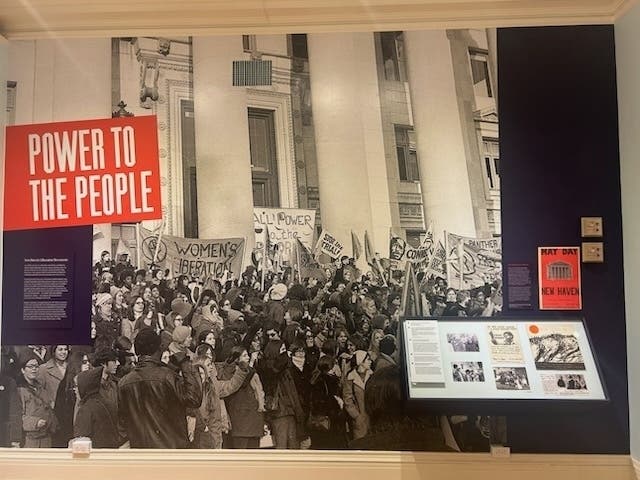
The exhibition design is immersive, with floor-to-ceiling photographs of a suffragist speaking to a crowd of men outside the Winchester Repeating Arms Company (1916) and the “Free Our Sisters and Ourselves” demonstration organized by the Black Panther Party of Connecticut and N.E. Women’s Liberation in November 1969 before the Black Panther trial.
The Model City & Hill Parents Association section of the exhibition includes striking juxtapositions of enlarged photographs of New Haven Redevelopment Agency’s aerial views before and after the development of the controversial Oak Street Connector, positioned with archival sources capturing community responses by groups including Hill Parents Association and the American Independent Movement. Photographs and ephemera from New Haven’s liberation movements of the 1960s and 1970s are followed by a culminating section on education and youth advocacy, which addresses the city’s sustained and evolving commitment to educational justice—from the 1975 teachers strike to recent educator- and student-led efforts.
The exhibition was designed by David Jon Walker and John Kudos of KASA Collective, with support for “New Haven’s Unfinished Revolutions” provided by CT Humanities as part of its America 250 | CT program. Steinberg worked closely with a team of advisors from across the community throughout the process. The following advisors’ extensive community work, scholarship, and knowledge of New Haven’s social history were invaluable to the project: Daisha Brabham, Jenny (JHD) Heikkila Diaz, Sophie E. Edelstein, Eve Galanis, Aaron Goode, Steve Kass, Michael Morand, Brett Palfreyman, Clan Mother Shoran Waupatukuay Piper, Reva Siegel, Charles E. Warner, Jr., and Brittney Yancy.
About the New Haven Museum
The New Haven Museum has been collecting, preserving and interpreting the history and heritage of Greater New Haven since its inception as the New Haven Colony Historical Society in 1862. Located in downtown New Haven at 114 Whitney Avenue, the Museum brings more than 375 years of New Haven history to life through its collections, exhibitions, programs and outreach. As a Blue Star Museum, the New Haven Museum offers the nation’s active-duty military personnel and their families, including National Guard and Reserve, free admission all year. For more information visit http://newhavenmuseum.org or @NewHavenMuseum or call 203-562-4183.
Get more local news delivered straight to your inbox. Sign up for free Patch newsletters and alerts.