Politics & Government
Officials Come Out Against Bifurcation
Top elected Newtown leaders appear to support leaving the budget as one but have mixed feelings when it comes to advisory questions.

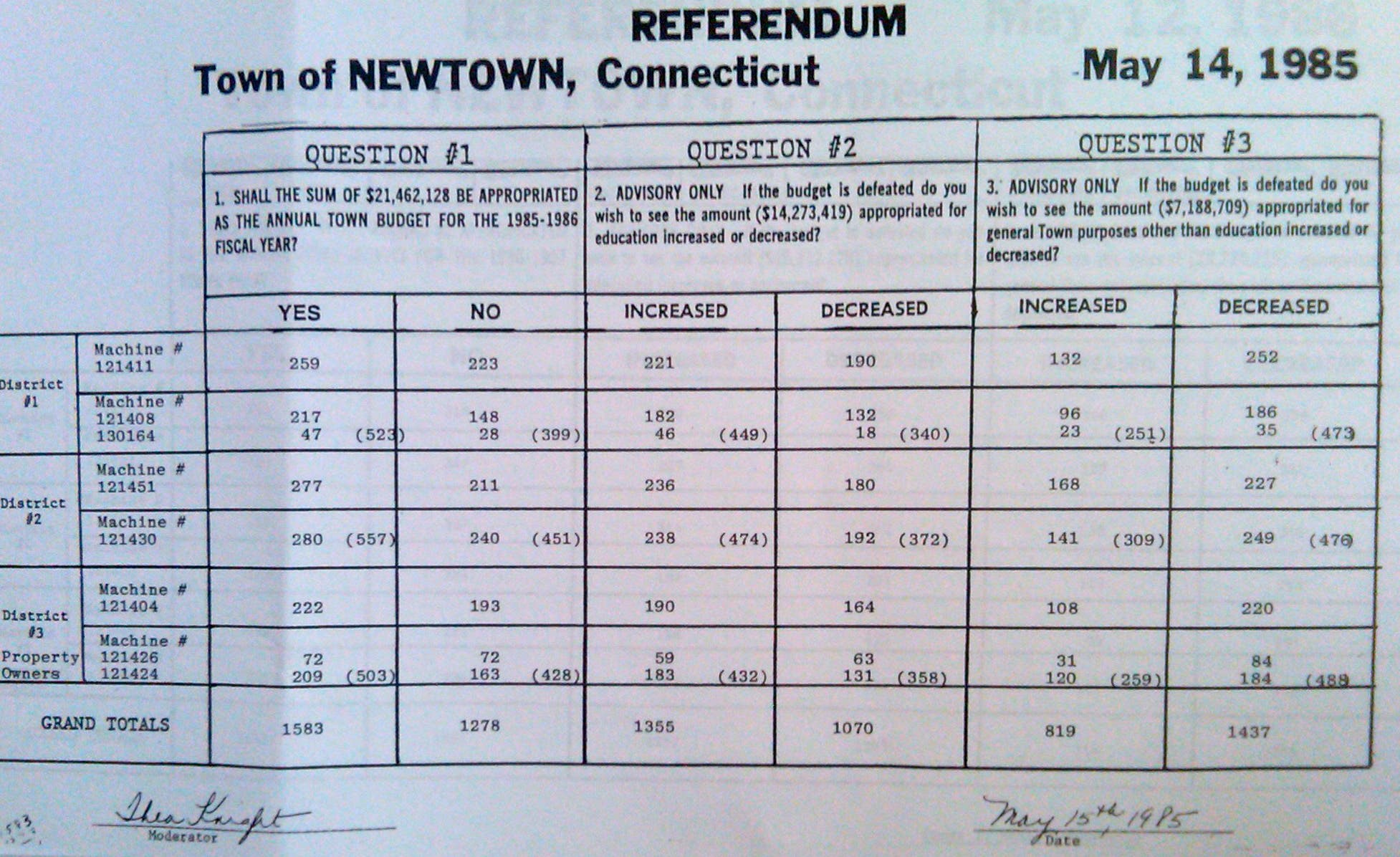
The heads of the Legislative Council and boards of Selectmen, Finance and Education unanimously oppose separating the budget referendum into one for town services and another for education, but were of mixed opinions when it came to including questions on the ballots.
First Selectman Pat Llodra, Board of Education Chairman Bill Hart and Legislative Council Chairman Jeff Capeci told the Charter Revision Commission, which met Monday at the Municipal Center, that the budget is for one town, and should be voted on as one.
"I fear that if we separate out too much the major elements, vis-a-vis bifurcation, that we create competition for scarce resources and end up with winners and losers," Llodra said in a memo to the Charter Review Commission.
Find out what's happening in Newtownfor free with the latest updates from Patch.
The commission was recently convened to look into whether the town should change its referendum process to allow for separate votes and the addition of questions that would ask voters whether the proposed budget was too high or low.
Commission members assembled a list of towns that bifurcate their budgets and researched how those towns do it. In some cases, if one of the budgets fails but the other passes, elected officials are still allowed to tinker with the passed budget before putting both out to another vote.
Find out what's happening in Newtownfor free with the latest updates from Patch.
Llodra said she would not favor that scenario.
"I would not be in favor of any vote that wouldn't be binding," she said. "The results of that action should be taken very seriously and not 'monkeyed' with."
Hart said having two budgets would pit one side against the other and he would rather "de-escalate" the competition for dollars. He also said he would support adding questions to the ballot only if it did not confusing voters and clearly relayed voter intent.
"The wording is going to be important," he said. "We want to make sure we find wording that is clear."
Board of Finance Chairman John Kortze, who also appeared at the commission, said he did not want to offer a personal opinion on the issue but he did say that he and fellow finance board member Joseph Kearney researched the financial rating of the 18 towns with bifurcated budgets and found that 13 of them have a lower rating than Newtown.
In addition, he said it is difficult to split costs into one solely for town services and the other for education. For instance, debt service payments are included in the town budget but the debt can sometimes be to pay for school construction. In turn, school space is often used for town purposes.
Kortze also said he worried about whether advisory questions would further complicate matters.
"We can't usurp the representative democracy that we have that is the foundation of how we all operate," he said. "We have to have that responsibility."
Capeci said he would be in favor of adding a question to the ballot that asks voters to approve the budget, deny it because it is too high or deny it because it is too low, though he said officials should still have the right to revise the budget request however they see fit before putting it out to another vote.
"I wouldn't be in favor if I knew that would be a binding kind of question," he said.
Legislative Council member and former town Finance Director Ben Spragg said he would favor adding the question because during the past budget season, it was difficult to tell whether the referendum failed because voters wanted a lower budget or because school supporters wanted more added. He favored a system that would give officials insight into voter intent.
"At that point if the budget fails, we would be trying to convert the no's to yes," Spragg said.
Finally Bob Tait, the current finance director, told the commission the town sometimes runs up on a deadline for sending out the tax bills. Bifurcating the budget increases the number of times a budget is put to a vote, which in turn may increase the chances of a failed referendum, he said.
"It's hard enough getting a referendum and hoping it passes the first time," Tait said.
The only person in the room who spoke publicly in support of bifurcating the budgets was Newtown resident Ruby Johnson, who has frequently complained that the town won't produce detailed figures showing the hours public works employees have put in, assisting with infrastructure work at at Fairfield Hills. Officials have said the employees were working on many projects across town at the time, and it is nearly impossible to go back and separate out those hours.
Johnson said bifurcation would require the town to provide more details on costs in the future.
"Both of them would need to answer more questions than they are answering now," she said.
Clarification: Board of Finance Chairman John Kortze presented testimony on some of the issues surround bifurcation but said he did not want to offer his personal opinion on the matter. In addition, he also said it is difficult to split costs into one solely for town services and the other for education. An earlier version of this article was not complete in its description of his statements.
Get more local news delivered straight to your inbox. Sign up for free Patch newsletters and alerts.