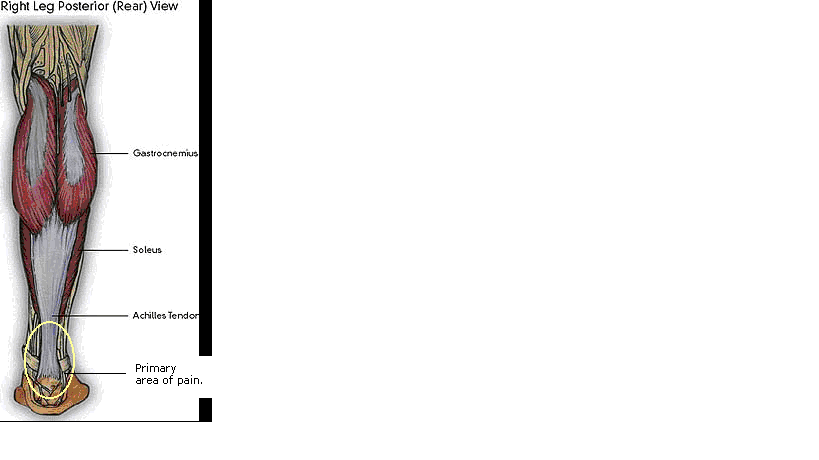
About the Achilles Tendon
The Achilles tendon is the strongest and largest tendon in the body. It is extremely vulnerable to injury due to its limited blood supply and the numerous forces to which it is subjected.
The Achilles tendon is known as a co-joined tendon. This tendon directly joins into Gastrocnemius and the Soleus muscle (calf muscles). The Achilles tendon transmits the force of the calf muscles (Gastrocnemius and Soleus) to produce the push-off during walking, running, and jumping.
The area of the tendon (approximately 2 to 6 cm above its insertion into the Calcaneus) has the poorest blood supply, and therefore heals the most slowly. This makes it extremely susceptible to injury.
Find out what's happening in Newtownfor free with the latest updates from Patch.
Causes of Achilles Tendon Injuries
In triatheletes, the most common cause of injuries to the Achilles tendon is overpronation, inflexibility, or lack of strength.
The repetitive stresses caused by running and cycling can cause friction and inflammation. The body responds to inflammation by laying down scar tissue (adhesive tissue) in an attempt to stabilize the area. Once this happens, an ongoing cycle begins that worsens the condition.
Find out what's happening in Newtownfor free with the latest updates from Patch.
Inflexibility is often caused by the build-up of these adhesions, either within the soft tissue or within structures above or below the tendon’s kinetic chain.
In cyclists, the initial stress is often caused by having a low saddle height. This low saddle height can result in excessive dorsiflexion of the foot, which stresses the Achilles Tendon.
In runners, too rapid an increase in mileage, hill training without proper strengthening, and recent or inadequate changes to running gear can cause injuries to the Achilles Tendon.
A tight muscle is a weak muscle. Runners with weak, or unstable calf muscles place increased stress on their Achilles Tendon. Weakness in the Gastrocs and Soleus can cause abnormal pronation during the stance phase of the normal gait cycle.
Always Consider the Kinetic Chain
Any restrictions in the kinetic chain of the Achilles tendon, either above or below the tendon, can affect the functioning of the Achilles tendon. Such structures would include:
1. Hamstring muscles - The upper portion of the gastrocnemius (superficial calf muscles) are in contact with biceps femoris, semitendinosus, and semimembranosis (three sections of the hamstrings).
2. Plantaris muscle - This muscle inserts into the middle one third of the posterior calcaneal surface (heel bone), just on the inside of the Achilles Tendon.
3. Popliteus muscle - This muscle is involved in medial knee rotation. When it is restricted, it may cause increased stress on the lower extremities.
4. Flexor Hallicus Longus, Flexor Hallicus Brevis, and the Tibialis Anterior, muscles. These muscles are involved in cases of increased pronation and hyperpronation.
Treating Injuries to the Achilles Tendon with ART
Active Release Technique (ART®) is very successful at treating this type of injury since it removes restrictive adhesions between both the superficial and deep tissue structures along the entire kinetic chain.
Post Treatment Exercises
Strengthening the Calf muscle and the entire related kinetic chain is extremely important in order to ensure that injuries to the Achilles Tendon do not return.
Strengthening exercises are only effective if they are executed after the adhesions within the soft tissue have been released. Attempts to strengthen muscles bound by adhesions often cause the structure to become more restricted, which in turn causes additional tension within the soft tissue.
Research has shown that using eccentric contractions (lengthening of the muscle during contraction) is one of the most effective types of strengthening exercises for the calf muscles. This concept can be applied to the entire kinetic chain.
In addition to the strengthening component, stretching, and balance exercises continue to be key components in correcting the problem to ensure that the problem does not reoccur.