Health & Fitness
Core Skills in Rapid Rehousing Training Dec. 16 in New Haven
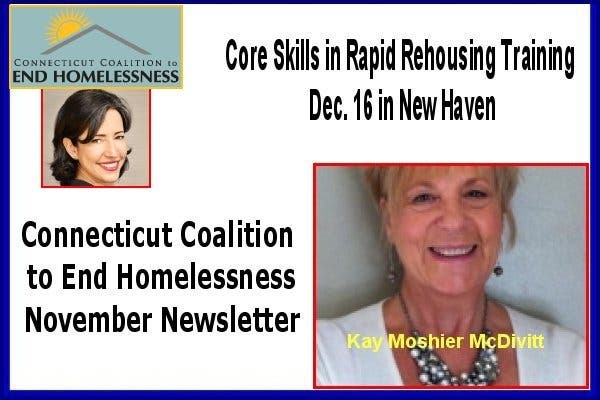
Kay Moshier McDivitt of the National Alliance to End Homelessness back to Connecticut for Rapid Rehousing training.


News from CCEH A letter from Lisa Tepper Bates
Hello all —
We share the goal of ending homelessness in Connecticut. Two of our immediate targets in advancing this goal are to end homelessness among veterans by the end of 2015, and among the chronically homeless by 2016. If we can end the homelessness of these two populations, we not only provide the right help for many people, but we will have proven that we can end homelessness — if we coordinate our efforts, and work one person at a time.
The Connecticut Coalition to End Homelessness and the Partnership for Strong Communities are excited to announce that Connecticut has been selected, along with 68 other U.S. jurisdictions, to participate in Zero: 2016, a national technical assistance effort to end Veteran and chronic homelessness in the next two years.
Find out what's happening in North Havenfor free with the latest updates from Patch.
Nationally, Zero: 2016 is being spearheaded by Community Solutions, a nonprofit based in New York City. Statewide, the CCEH and PSC will jointly lead and coordinate this effort, working in close partnership with the state and direct service providers to accomplish the goals of ending veteran and chronic homelessness in 2016.
Connecticut will work with Community Solutions to accelerate our housing efforts through four focus areas: closing the research-to-practice gap, real-time data and performance management, local systems redesign, and local team and leadership development. Community Solutions will provide hands-on coaching and data tools, and will establish a national peer-to-peer learning network to accelerate innovation across communities.
Find out what's happening in North Havenfor free with the latest updates from Patch.
Opening Doors – CT will publicly announce Connecticut’s acceptance into Zero: 2016 and share more information about the state’s efforts to end veteran and chronic homelessness in conjunction with the statewide Veterans Summit on Dec. 9. We hope to see you there and look forward to continued collaboration to become one of the first states in the nation to end veteran and chronic homelessness by the end of 2016.
Core Skills in Rapid Rehousing Training Dec. 16 in New Haven
Did you miss our spring Rapid Rehousing Training Series? CCEH is pleased to welcome back Kay Moshier McDivitt of the National Alliance to End Homelessness back to Connecticut for Rapid Rehousing training.
On Tuesday, Dec. 16, Kay will present a repeat of her spring training entitled Core Skills in Rapid Rehousing for those who were not able to participate. Training will be held at the United Way of Greater New Haven, 370 James Street, New Haven.
This training will focus on the essential elements of rapidly rehousing homeless families and individuals: housing first approaches, rapid rehousing models and best practices and case management skills.
Topics to be covered include:
an overview of the Housing First and rapid re-housing models, current best practices, and community examples; developing strategic partnerships as part of rapid re-housing or other Housing First programs; service strategies, including housing location, landlord engagement, and home-based case management; and critical factors for good program design and implementation, including data collection and outcomes.
This training is geared toward shelter providers, rapid rehousing case managers and other frontline staff in homeless services, as well as program managers and directors. It is particularly well suited for programs looking to implement a housing first or rapid rehousing approach or for those looking to increase the skills of front line staff in these areas.
The session is from 9 a.m.- 4:30 p.m.; registration begins at 8:30. Cost is $20 per person for CCEH members and $35 per person for nonmembers. Lunch is included. Questions about this training can be directed to Kristen Granatek, Manager of Technical Assistance and Program Services at kgranatek@cceh.org
About Kay Moshier McDivitt
Kay is a Technical Assistance Specialist at the National Alliance to End Homelessness. In this role, she works with the Center for Capacity Building to help communities create, implement, and evaluate plans to end homelessness based on their specific needs. She is the Center’s point person on issues related to retooling transitional housing and the Performance Improvement Clinics, and assists in projects ranging from 10 year plan development to rapid re-housing planning.
Prior to joining the Alliance in 2011, Kay served as the Community Homeless Advisor for the Lancaster County (PA) Coalition to End Homelessness, providing leadership for the County’s 10 Year Plan to End Homelessness and Continuum of Care, and as Vice President for Programs for Tabor Community Services, Inc., where she oversaw a number of model program initiatives focused on ending homelessness including prevention and rapid rehousing approaches.
She has provided community leadership in the homeless service arena since 1994 both at the local level and national level on best practice models for ending homelessness. She received her degrees in Social Work and Sociology from Eastern Mennonite University.
CCEH Membership Meeting Nov. 12
More than 70 CCEH members are coming to the statewide membership meeting this coming Wednesday — are you?
This meeting, planned by members and for members, will be an exciting and important opportunity to build a stronger network of relationships and resources statewide. And it’s the first big step in members taking a more active role in the Coalition and its work. If you or your organization is a member of CCEH, we’d love to see you there RSVP...ASAP!
Questions? Contact membership consultant Ben Fink, at ben.fink@gmail.com. Hope to see you there.
Fairfield County Collaborating Across Communities
Opening Doors of Fairfield County (ODFC) received good news from HUD in October. The long-awaited letter from Anna Marie Oliva, Acting Director of Special Needs Assistance Programs, formally allows the County’s CoCs to work collaboratively as one region in advance of a formalized expected 2015 merger, which will consolidate the three existing Fairfield County CoC’s (Stamford-Greenwich, Bridgeport, and Norwalk).
Fairfield County partners will share local planning grants for use of regional activities and use Shelter Plus Care funds on a regional (rather than a CoC-specific) basis, in addition to other steps that will allow for better regional planning and sharing of resources. HUD also authorized ODFC to develop and monitor benchmarks for the region as a whole using HDX and HMIS data to facilitate collective planning and resourceful use of funding. Now, the region can begin to establish evaluative targets and standards for the entire three-CoC area, in advance of the formal CoC merger.
HUD’s reply supporting ODFC’s collaborative approach is an important acknowledgement of the power of the collective impact strategy that Fairfield County partners have embraced as a strategy to end homelessness. HUD has also recognized, as providers know, that our homeless population moves across communities. To end homelessness, we have to think on a scale larger than one city or town -- alone. We have to think and plan on a regional basis, if we are to serve our clients more effectively and end homelessness in Connecticut.
Congratulations, Fairfield County, for your regional thinking and for the positive news from HUD!
Jackie Janosko joins CCEH’s HMIS team
CCEH continues to enhance the capacity of our data and analysis department with the addition of Jackie Janosko as a Research Analyst. Jackie comes to CCEH with a combined 19 years of data analysis experience, with eight in housing and homelessness services. She worked most recently with Operation Hope of Fairfield, Inc. as their contract and database administrator, and additionally served as the co-chair of the Standards and Evaluations committee in Greater Bridgeport Opening Doors.
Jackie brings a unique skillset to the organization and is positioned to have an immediate impact on the work of CCEH. She has the ability to take complex data and convey it in a way that everyone can easily digest the information through creative visualization and presentation. When asked on her thoughts of joining the team at CCEH, she replied: “I’m excited to have this opportunity to use my abilities on a statewide level to help use data and research to further the mission of the Coalition” – and we are excited to have her here, too!
PIT 2014: Homelessness Down 11%
The HUD Point-in-Time Count (PIT) is the only national survey that counts everyone who is staying in a shelter or other homeless programs, as well as people who are unsheltered (every other year).
The PIT methodology has been fairly consistent over time, allowing for a national-level assessment of whether the number of homeless people is growing or shrinking each year. Though the PIT does not allow us to count every single homeless person, nor does it capture the number of people who are at risk of homelessness or unstably housed, it is the only national tool we have that allows us to determine approximately how many people are homeless, understand the the characteristics of our homeless population, and how homeless Americans are using shelters.
The 2014 PIT Count data shows that numbers of homeless people is moving in the right direction. The 2014 PIT Count data shows that numbers of homeless people is moving in the right direction:
- Overall homelessness has declined by 11 % since HUD started collecting this data in 2007
- Chronic homelessness has seen a 21 % decrease in 2007
- Veteran homelessness has decreased by 30% since 2007.
Regional Planning Forum Nov. 20
We now have a unique opportunity to influence the development of affordable housing, convenient and reliable transportation, enhanced community development efforts, environmental quality and sound fiscal policy in our region for the next generation. The trick is whether we grab it!
On Nov. 20, Regional Plan Association is working with the Partnership for Strong Communities to host a second Connecticut forum at the Pequot Library in Southport that will consider those issues and help RPA shape its 4th Regional Plan, a document that will influence regional cooperation, the use of federal aid and coordinated state policies in the 21st Century. The first forum Oct. 29 in Hartford was huge success! A full house heard experts outline the key issues facing the state that must be addressed in the plan. You can hear and see the discussion here.
Please register now by emailing stephen@pschousing.org for the Nov. 20 forum. This effort is being supported by a wide range of major organizations and community leaders across the state, as you can see on the flyer. Admission is free, as is lunch, and there is free parking and easy access via MetroNorth. This is our opportunity to shape our future. Let’s grab it s