Home & Garden
Diamondback Terrapin Finds Home at Hoyt Island in Norwalk
The species was added to a special concern list by CT DEEP.


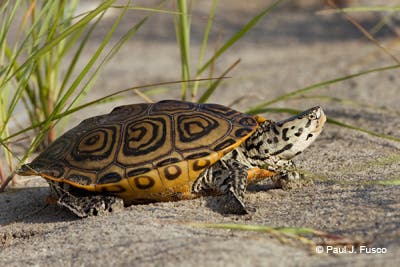
The Norwalk Land Trust’s three-acre sanctuary has become a sustainable habitat for the northern diamondback terrapin.
The animal was added to a list of species of special concern by the state Department of Energy and Environmental Protection.
More info:
Find out what's happening in Norwalkfor free with the latest updates from Patch.
While the size of the colony on Hoyt is indeterminate, the number of sightings is characterized as numerous.
The island was deeded to the nonprofit land trust in 1979 by the late Countess Eleanor Czapski (1901-1982), an environmentalist, longtime Wilson Point resident and a member of the Guggenheim family.A band of volunteers recruited by the Norwalk Land Trust more recently removed many of the invasive plants on the island, much of it a shrub called winged euonymus that reaches 12-feet in height and chokes out native vegetation.
Find out what's happening in Norwalkfor free with the latest updates from Patch.
The intention was to enhance the habitat for wildlife like the terrapin and birds such as osprey, herons and egrets, as suggested in a conservation and management report by Anthony Zemba, senior ecologist with the Hartford-based environmental planning firm of Fitzgerald & Halliday.His conclusion was that a stronger presence of native plants would create a lusher habitat for nesting, foraging, migration and protection against predation. Eleven turtles and their cousin the diamondback terrapin are native to Connecticut.
Where turtles area essentially fresh water or sea water inhabitants, terrapins live on land and water, typically brackish environments like the salt marshes and tidal estuary of Hoyt Island, one of the 27 Norwalk Islands, 500 yards offshore from the Village Creek neighborhood.
In the spring, the sandy beach at Village Creek also becomes an incubator for clutches of terrapin eggs. At birth the hatchlings are barely an inch long. Female grow to a foot in length, males half that size. They survive for between 25 and 40 years. The upper shell or carapace is distinguished by concentric grooves, the under shell or plastron, orange or brown in color.At one time terrapins were considered a gourmet food.
Then they virtually disappeared from the table. Even as populations rebounded, it has been illegal in Connecticut to collect them from the wild or keep them as pets.Now, Kathy Herz, wildlife biologist with Connecticut DEEP, reports new regulations to be enacted this year classify the northern diamond terrapin as a species of concern, as opposed to endangered or threatened, two levels for wildlife facing more critical pressures.Her colleague Brian Hess, also a wildlife biologist, said preserving a remote wildlife habitation like Hoyt Island “really does matter.”
“A densely populated urban state like Connecticut is a tough place for turtles to live,” he said. “They are threatened by development, climate change, vehicle traffic and the potential for viruses and disease. Keeping the island as a sanctuary is important to the survival of a number species that are imperiled. ”
Get more local news delivered straight to your inbox. Sign up for free Patch newsletters and alerts.