Politics & Government
In Norwalk's High Schools, Health Centers Expand on the School Nurse's Role
For more than two-thirds of the city's high school students, an array of health programs are offered.


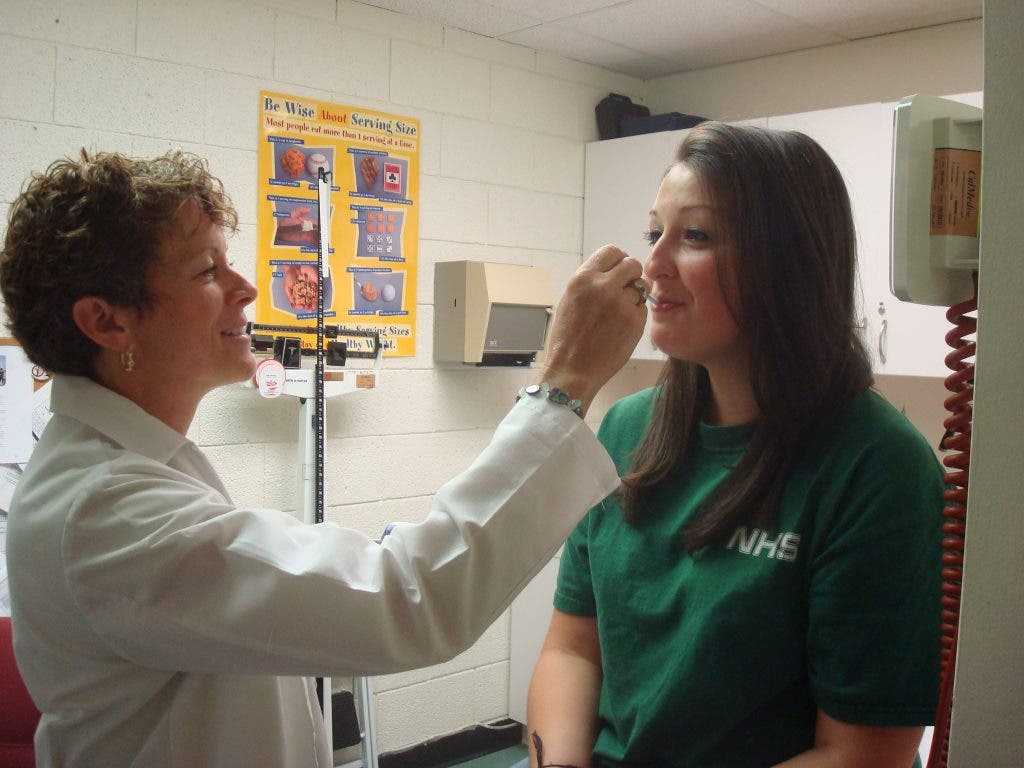

Three of the most important medical offices in Norwalk are in the city's three high schools, where about 2,500 students are enrolled in a program that goes beyond the traditional role of the school nurse.
More than two thirds of Norwalk's high school students are enrolled in the Robert E. Appleby School Based Health Center program, which has offices in Norwalk, Brien McMahon and Briggs high schools, as well as a social worker at Nathan Hale Middle School.
"We are a full-service clinic," said Lorna Young, a medical assistant and office manager of the school health center at Brien McMahon High School. "We can do sports (physical examinations) and school physicals. We also diagnose and treat strep throats, ear infections ... anything like that. We can vaccinate the uninsured; we treat the uninsured."
Find out what's happening in Norwalkfor free with the latest updates from Patch.
But the program also teaches teenagers about health prevention and runs discussion groups. On Wednesdays at Brien McMahon, a six-week workshop during the lunch shift focuses on nutrition education. A "teen talk group" for girls is also run from the health center.
"The girls come in and talk about whatever's on their minds—health problems or whatever, and the social worker runs that one," Young said.
Find out what's happening in Norwalkfor free with the latest updates from Patch.
The office is open from 9 a.m. to 2 p.m. Students either come in on their own initiative or teachers or the school guidance department sends them over, she said.
"We can be a sort of safe haven where kids can talk to us about stress, school problems, boyfriend problems—anything," Young said. "It's all confidential."
All 120 students at Briggs High School are in the program, as is most of the student body at Brien McMahon and Norwalk high schools. At McMahon, 1,200 students are enrolled. In additon to Young, the center at Brien McMahon has a nurse practitioner, a physician's assistant and a licensed social worker.
"The bottom line is, we want to keep these kids in school and keep them healthy: That's our mission," said Rhonda Capuano, director of the program, which is run by the Human Services Council of Norwalk, a nonprofit social services agency.
The state, city, private foundations and the public all help fund the program, Capuano said. Each year in late spring or early summer, the Human Services Council conducts a SoNo Strolls fundraising event in which a cocktail party in SoNo is followed by dinner at various restaurants.
For 27 years the state’s school based health centers have delivered health care to students in schools. There are more than 75 such centers in the state.
The centers provide both physical, mental, and oral health services to more than 44,000 students annually, according to The Connecticut Association of School-Based Health Centers (CASBHC).
These children lack access to basic medical care. Either they are uninsured, underinsured, or lack transportation, lack knowledge about available services and the importance of preventive health.
“We fill a gap,” said Dennis Torres, Director of Healthcare Services at Family Centers.
Torres, who oversees the School Based Health Centers, said they're essential even for students whose parents carry health insurance. When one factors in a $40 or a $50 co-pay, time off from work, and the idea of pulling a student out of school it becomes challenging to see a doctor, he said.
“We can provide time and energy and include health education with each visit,” he said.
The passage of federal health care means that by 2014 an estimated 98 percent of the state’s children will be insured, Torres said. Even so, having on-site access makes a tremendous difference in student’s health, he said.
Connecticut adolescents in 2001 experienced a 3 percent rise in deaths due to accidents, suicide and homicides while the United States numbers decreased by 17 percent, according to CASBHC. In Connecticut, teens are the most underserved segment of the population.
And of everything that comprises comprehensive health care, mental health can be overlooked.
“Mental health is a big component too,” Torres said. “More accessibility means more successful outcomes.”
In Stamford, last year, about 4,500 students were enrolled. Of those students, about less than half used the center, Torres said. Participating students average about four-and-a-half visits annually.
The health center at Stamford’s Westhill High School, one of several such school-based health centers in the state, treats more than 1,500 students. For them, the center is their only means to primary medical care. And because it’s on site, its always available.
Last month at Norwalk High School, Mayor Richard A. Moccia presented a proclamation celebrating the health centers to Marjorie Appleby on behalf of her late husband. The city's Robert E. Appleby School Based Health Center program is named after him.
Torres was on hand at a similar celebration last week when Family Centers, a private, non-profit organization, marked National School-Based Health Center Awareness Month at Westhill High School. Congressman Jim Himes, a Democrat representing the Fourth District, also attended.
“It really is the pointy end of the spear,” Himes told Patch. “It’s the only way to reach a vulnerable population. I nearly fell out of my shoes when I learned that a high school in Stamford has 60 percent of its students who don’t have health insurance or adequate health care.”
In Norwalk's four participating schools, according to Capuano, "Typically you get about 65 to 85 percent of the student body enrolled in the program."
This article has been corrected to state that the event celebrating the health centers in Norwalk was held at Norwalk High School, not Brien McMahon.
Get more local news delivered straight to your inbox. Sign up for free Patch newsletters and alerts.