
The Oxford Historical Society will sponsor a tour of the town’s historic landmarks on Saturday, May 5, from 10 a.m. to 4 p.m. Tickets may be purchased in advance at the Town Clerk’s Office in the S. B. Church Memorial Town Hall for $15. Reservations may be made by calling 203 910-4574 or by accessing http://www.oxford-historical-society.org. On the day of the tour tickets will be available for $20 at the Twitchell-Rowland Homestead at 60 Towner Lane.
The tour will showcase buildings dating from 1714 – 1835. It includes three churches and a former tavern and stop on the Underground Railway. A large farmhouse now preserved as a museum, two private homes and other sites may also be visited that day. Volunteers from the Oxford Historical Society will serve as docents. All proceeds will go to the Homestead Preservation Fund.
The following site will be featured on the tour:
Find out what's happening in Oxfordfor free with the latest updates from Patch.
The Twitchell-Rowland Homestead
Included on the Connecticut Register of Historic Places, the Twitchell-Rowland Homestead is a traditional saltbox built circa 1755 by Joseph and Elizabeth Twitchell on Christian Street. The property was purchased in 1900 by Philip and Elizabeth Bronson Rowland. Their farm became one of the first to supply milk to the Creamery in Southbury. In 2004, the house was slated for demolition. The Oxford Historical Society raised funds to move the old home to 60 Towner Lane and then restored it to serve as the town’s museum.
Find out what's happening in Oxfordfor free with the latest updates from Patch.
The Oxford United Church of Christ Congregational
The Oxford United Church of Christ Congregational began as the Ecclesiastical Society of Oxford in 1741. The first building was completed in 1743. In 1793 the church membership hired Timothy Candee to build the present Meeting House which was completed in 1798. A bell was purchased in 1797, but it cracked in 1800 and was replaced. The tower steeple needed constant repairs and was torn down in 1836. The parish house was added in 1959 and a new steeple constructed in 1992. The interior of the sanctuary at 3 Academy Road was completely rebuilt and dedicated in May 2008.
St. Peter’s Episcopal Church
St. Peter’s Church was formed in 1764 under the leadership of the Rev. Richard Mansfield, said to be the longest serving Episcopal pastor in United States history. The first building was on Governor’s Hill Road. By 1834 it was replaced by the present structure now found at 421 Oxford Road. In 1888, eight extraordinary stained-glass memorial windows were installed in the sanctuary and narthex. The parish hall was added in 1964.,
Oxford's part in the Connecticut Freedom Trail
The Washband or Washburn Tavern was originally a small, one-story and attic dwelling built by John Twitchell in 1714. Around 1741, the Washburn family purchased the property, enlarged the house, and began to operate a tavern. A larger addition was added around 1794 when the Oxford Turnpike opened and brought many travelers and trade to and from the Port of New Haven.
The house was a station on the Underground Railroad and runaway slaves were hidden there during their escape north to Canada. A massive elm tree north of the house served as a boundary between the Native Americans of Chusetown (now Seymour) and those of Woodbury before white settlers arrived and into colonial times.
Today the Washburn Tavern at 90 Oxford Road is owned by Nancy Daoud and is home to Opus: Advice First, a private wealth advisory practice. Docents will be on the lawn to tell visitors the history of this unique Oxford landmark.
George P. Sanford Homestead
The George P. Sanford Homestead at 330 Quaker Farms Road is presently owned by David Heim and Katherine Foran. The one and one-half story, Dutch-style structure features a central brick chimney with four fireplaces. The one in the keeping room boasts a beehive bake oven in the right-hand wall. The windows are in keeping with the age of the house, with 12-over-12 or 12-over-8 lights. The house is on a gentle rise from the road, with a wooded background to complement its colonial beauty.
Christ Church, Episcopal
In 1812, St. Peter’s Episcopal Church approved a chapel in Quaker Farms. Under David Tomlinson’s direction, the church was designed and built by George Boult in 1812. A unique feature of the structure at 470 Quaker Farms Road is the enclosure for sheep that still can be seen under the sanctuary floor. The central chandelier is over 200 years old. The steeple is in three stages, with an octagonal lantern enclosed at the peak. In 1968 it was rebuilt and the old weathervane representing a fish which had fallen years earlier was once again set in place.
Boxwood Glen
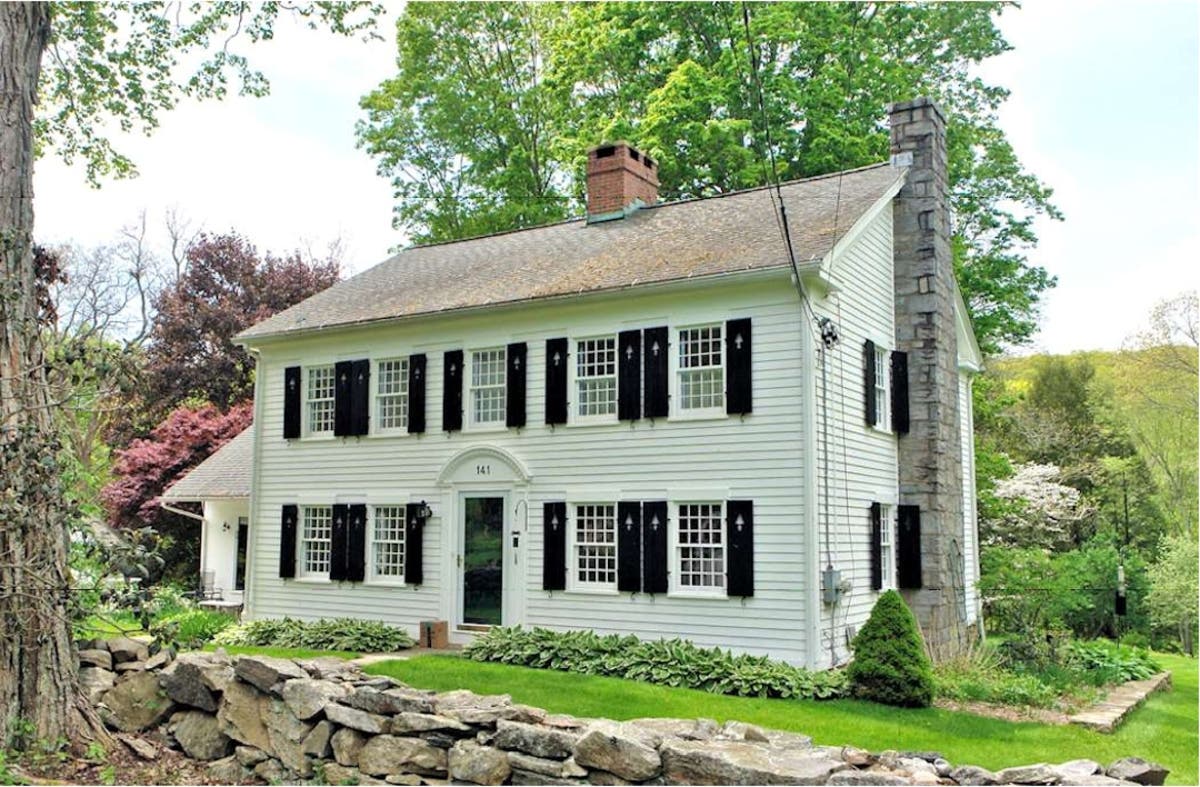
This former dairy farm sited at 141 Maple Tree Hill Road originally had apple orchards and a cider mill. In 1937, Dr. Raphael Kurzrok purchased it and renovated the home, preserving much of its design by keeping the 12 over 12 windows. The circa 1740 house has a center chimney with five fireplaces spanning two floors, along with another fireplace in the basement. Dr. and Mrs. Kurzrok were avid gardeners, planting signature trees and the “boxwood secret garden.”
Since purchasing it in 2006, Ron and Judy Benson have continued to restore and to research the house.
Further information about Oxford’s early structures may be found in the recently published book Historic Buildings of Oxford Past and Present, on sale at the Twitchell-Rowland Homestead during the tour.