

You
never know who lives down the road from you until you come see Antonio Munoz,
Pamela Stoddart, Debra Schaffer, Lewis Schaffer, Karen Beck, and Allison Meyler
step out onto Main Street at Rockwell Gallery/ Ridgefield.
Calendar Listing :
RIDGEFIELD, CT – May17th, 2012 - Rockwell
Art Galleries in Ridgefield gets local in “Purlieu 2012” featuring digital
graphic artist Antonio Munoz, abstract painter Pamela Stoddart,
three-dimensional photo collage artist Debra Schaffer, eclectic parts sculptor
Lewis Schaffer, contemporary Karen Beck, and abstract painter Allison Meyler on
May 17th- July 28th. The public is invited to an opening
reception on Thursday May 17th from 5:30-7:30PM. The event is free and open
to the public. Rockwell Art and
Framing of Ridgefield is located at 470 Main Street, Ridgefield, CT 06877.
Phone 203-894-8000.
Antonio Munoz merges his passion for pattern and color with
the boldness of iconographic silhouettes through his Textile and Graphic Design
work. His dream is to contribute to a world of graphic allure and intensity.
He graduated from Sacred Heart
University in Fairfield, CT in 1994 with a degree in Graphic Design. That same
year, Antonio became the recipient of the Award of Excellence from the
Connecticut Art Directors Club 19th Annual Award Show. Throughout his career as
a graphic designer, Antonio has created successful solutions for global
corporations as well as local startups. A resident of Ridgefield, CT, he is a
member of the Ridgefield Guild of Artists Board of Directors.
Pamela Stoddart attended the University of Colorado for computer science and English literature.
After a brief stop in Laguna Beach CA for a marketing career, she
made her way out East and relocated to NYC, working in the fashion industry, at
Liz Claiborne, in marketing.
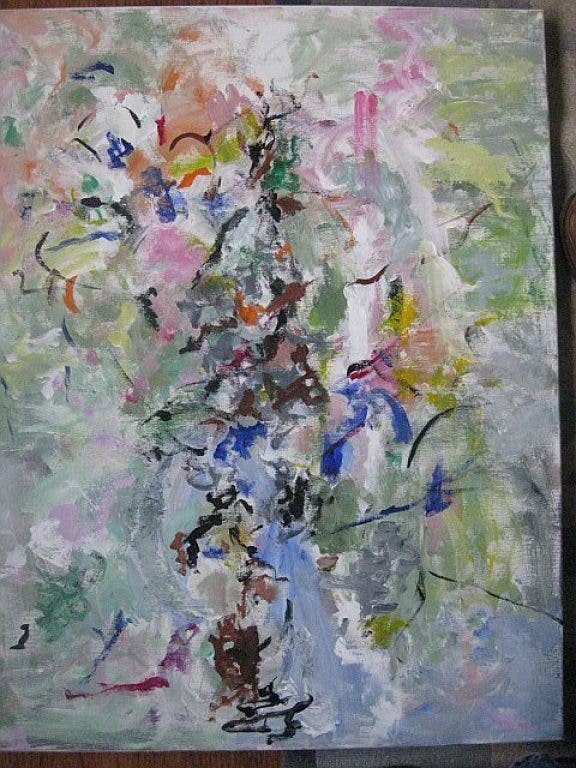
Now in Ridgefield for 18 years, she has been drawn to the artistic
community in and around town. She joined the Guild of Artists as a board member
and rekindled her love for painting focusing on abstracts. She is inspired
daily by the world around her, seeing things literally and wanting to
paint them abstractly.
Debra Schaffer makes art out of everyday
experiences and portrays the mundane that is often overlooked, undervalued or
taken for granted. Her subjects range from architectural objects, to
streetscapes, and the hustle and bustle they emanate. Her completed works consist
of a themed photo collage that has been carefully composed and layered into a
three dimensional story told with a sculptor’s flair and a woman of great
character.
Lewis Schaffer makes things. From his experiences of
building furniture, bicycles, decks, and bottle openers, he has evolved to
sculpture. His most recent collection features creative inventions from castoff
parts of “trash” bikes in a variety of elegant whimsical forms. His avid
cycling hobby with his family steered him in this direction.
Karen Beck
has always embraced the art world throughout her career. She enhanced the corporate sector by
curating, commissioning, exhibiting and installing major artwork while
continuing to paint and define her own art.
“My brush moves to the movement and creation of the painting
using the materials as my choreography to the composition. The study determines the tempo of brush
movement and intensity of the colors.
It is as if the movement comes through the artwork.”
Allison Meyler inspired by
landscapes, both seen and imagined, and stirred by the lines of modern architecture,
bridges and barns, begins her artistic process with drawing tools on paper and
continues her work in acrylic paints and inks. While initial sketches provide a
starting “structure” for the work, the introduction of acrylics allows for the
exploration of contrasting shapes and patterns. Alternating between these two
mediums results in an abstract painting that has both purpose and movement and
is expressed with fresh colors and gestural marks.
“Most of my paintings are produced as part of a
series. I generally start with multiple
pieces of paper, taped together in a grid or line formation, and I paint as
though it is one continuous surface. When disassembled, I enjoy the “surprise”
of un-taping the large surface and viewing each piece individually, as well as
a whole, or sometimes rearranged into a different order. Often, after un-taping the separate pieces, I
continue to work on them, individually, or in a different order. For me, this is an important part of the
“abstraction” process in my work.”