Neighbor News
Wooster School DLI Chemistry Students New Exploration
Advanced Chemical Applications has pushed students to personalized and lasting understandings of the varied uses of chemistry.



In its inaugural year, Wooster School’s Deep Learning Initiative (DLI) class Advanced Chemical Applications has pushed students to personalized and lasting understandings of the varied uses of chemistry.
From September through December, students took the role of environmental chemistry researchers. Student groups conducted background research on environmental pollutants that could be impacting our campus on the hill and then designed experimental protocols to evaluate the presence of these contaminants. Groups evaluated the levels of nitrate and nitrite in Miry Brook, synthesized gold nanoparticles to detect the presence of lead in soil, explored the levels of ozone around campus and built a flame photometer to evaluate the level of sodium in water sources. Students compiled their research into individually written professional articles that pushed them to further their ability to write about science at a professional level.
While none of the projects flagged potentially dangerous levels of pollutants, students did develop significant lab skills and an understanding of the complexity that true research demands. As one student said, “I didn't realize just how much effort a complete research project required. I also didn't expect to end up with inconclusive results, which is slightly disheartening, but surprisingly common in science.”
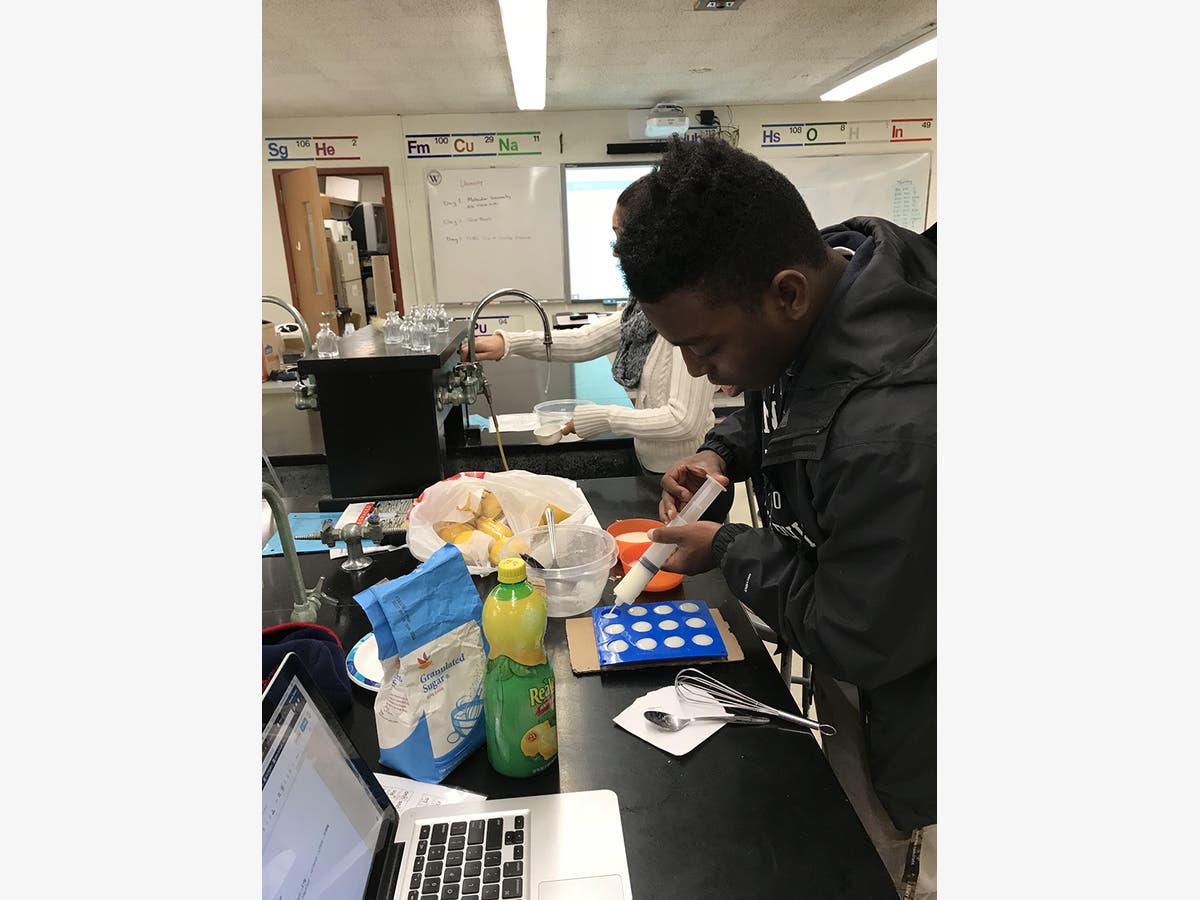
Starting in January, students began a new exploration of chemistry that focuses on the intersection of biology and culinary arts. Students are studying advanced topics in biochemistry and organic chemistry which have been paired with various molecular gastronomy techniques. For instance, students studying DNA and nucleic acids for homework come into class and develop recipes for reverse spherification, a technique which forms caviar beads from fruit juice. Others have studied enzymes while using transglutaminase, a natural enzyme, to “meat glue” pieces of protein together having removed bone or cartilage. Other standout recipes have been lemon spheres, nutella whipped cream, crème brûlée prepared sous vide, mango spaghetti, and vegan apple-cinnamon gel cubes.
Photo 1 and 2: Wooster student preparing Lemon Spheres using sodium alginate, calcium lactate glutamate and xanthan gum.
Photo 3 and 4: Preparation of ginger ale caviar (tinted with blue food coloring) using agar agar and cold vegetable oil.
Photo 5: Pieces of steak reassembled into a single piece using transglutaminase.
About Wooster School
Wooster School is an independent, co-educational college preparatory day school, serving students from Fairfield and Westchester Counties. Located in Danbury, Connecticut, the School serves students from Kindergarten through grade 12. A leader in classroom innovation and teaching, Wooster School is a place where thinking and learning are personal, meaningful, and visible; and where faculty work closely with students in small classes and cohorts to think and communicate critically and creatively. At Wooster, every student participates, every student contributes, and every student learns and develops the necessary skills to be a life-long learner and leader in college and beyond.
To learn more, visit http://www.woosterschool.org/ or contact Wooster School Admissions at (203) 830-3916.