Neighbor News
Simsbury Site for Summer STEM Exploration
Enrichment academies included week of challenging problem solving opportunities with math and computer coding
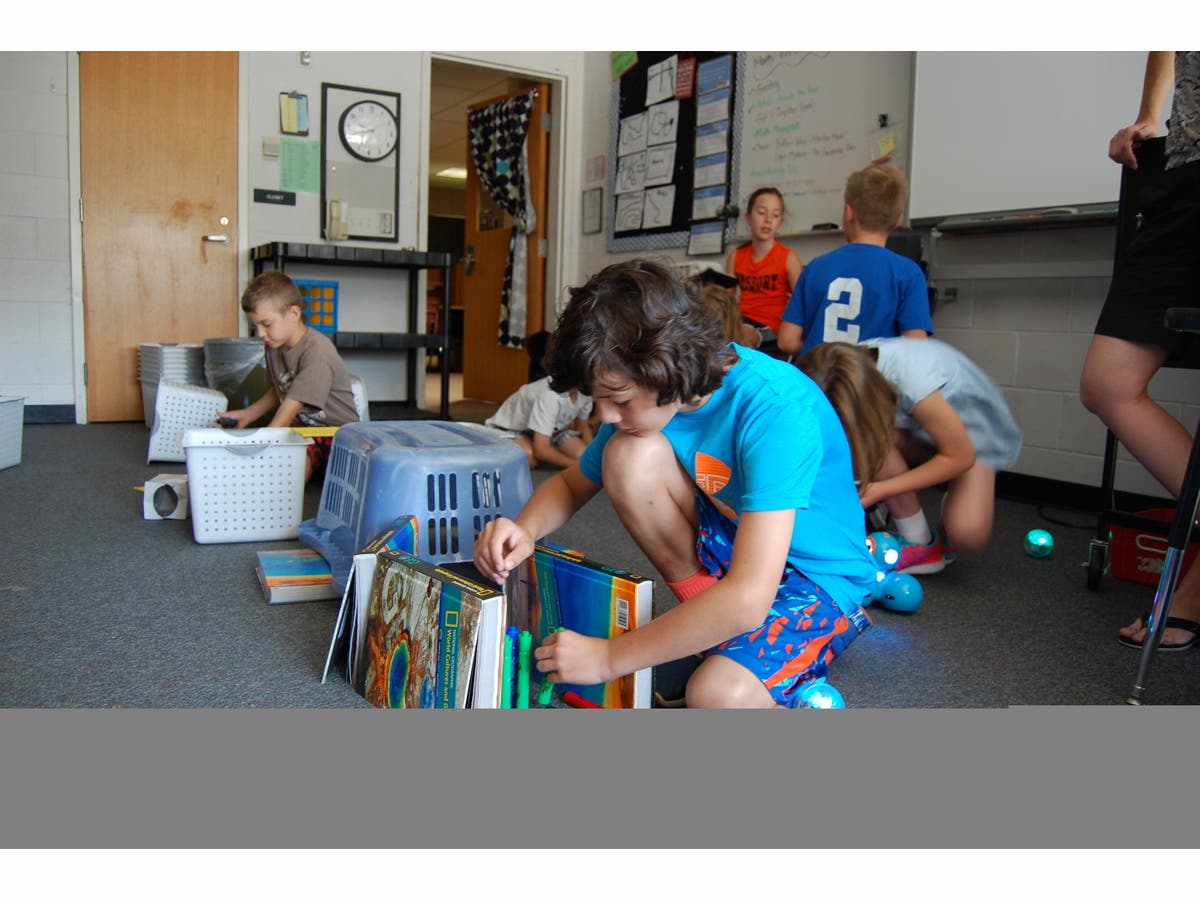

By the last week in June, school was out in Simsbury, but students in grades 4-6 weren’t quite ready to put their brains in summer mode. Simsbury’s Department of Continuing Education (DCE) partnered with the Simsbury Public Schools to offer summer math and writing enrichment academies at Tootin’ Hills School, including a week of challenging problem solving opportunities that encouraged computational thinking but more importantly, made math problems and computer coding really fun!
Using creative approaches to problems, the students worked with a number of miniature “robots” with intriguing names, such as Ozobot, Sphero, and DASH. Students learned how to control the robots’ movements with iPads. In Lesley Turner’s classroom, fourth graders set up an obstacle course for their robot to navigate. They planned out how they would code the robot using paper and markers to sketch out their ideas. One of Turner’s students was not at all daunted by the prospect of using an iPad to program her robot to record a voice, change colors, or move along a path. She shrugged and said, “You just kind of figure it out on your own.”
During the school year, the robots that the students worked with this summer are available in “Makerspaces” at the library media centers in Simsbury’s middle school and each of its five elementary schools. These centers for hands-on exploration of science, technology, engineering, and math (STEM) concepts were provided by a grant awarded by the Kathleen Magowan Educational Enhancement Fund. The fund was created by the Board of Education to honor the legacy of Kathleen Magowan, who taught in the Simsbury Public Schools for 35 years and who provided a generous donation to encourage the promotion of a high standard of education into the future.
Find out what's happening in Simsburyfor free with the latest updates from Patch.
Projects sometimes started with the most basic tools of pencil and paper, where students might approach a problem by making a table or a list. Then they might look for a pattern—or even act it out. One morning, library media specialist Kristen Brighenti had a group of fifth and sixth graders figuring out a classic math problem, how the custodial staff could close up 1,000 numbered lockers on the last day of school. The students had to figure out a rule using a very small subset of the lockers and by analyzing a pattern of open and closed doors. The first student opened each locker, the second opened or closed every other locker, and the third opened or closed every third locker, etc. The students had to figure out a pattern to determine how many lockers would be left open once they finished. When they discovered that one of the lockers was stuck, which would have completely compromised the exercise, true to the spirit of the workshop, they used a creative approach to solving the problem, that of using red and green paper taped to the locker to indicate whether it should be open or closed.
It didn’t take the group too long to solve the puzzle, and then it was time to form a circle and share what each had learned, some of which didn’t always come so easily.
Find out what's happening in Simsburyfor free with the latest updates from Patch.
Said Brighenti, “These kids are already good at math. We give them problems where they have to struggle, where they experience disequilibrium. They might say, ‘I can’t do this,’ but as they develop perseverance and tenacity, they find they can.”