Schools
Westminster Poetry Series Hosts Terrance Hayes
Terrance Hayes, recent winner of National Book Award for Poetry shares his poetry and ideas with students
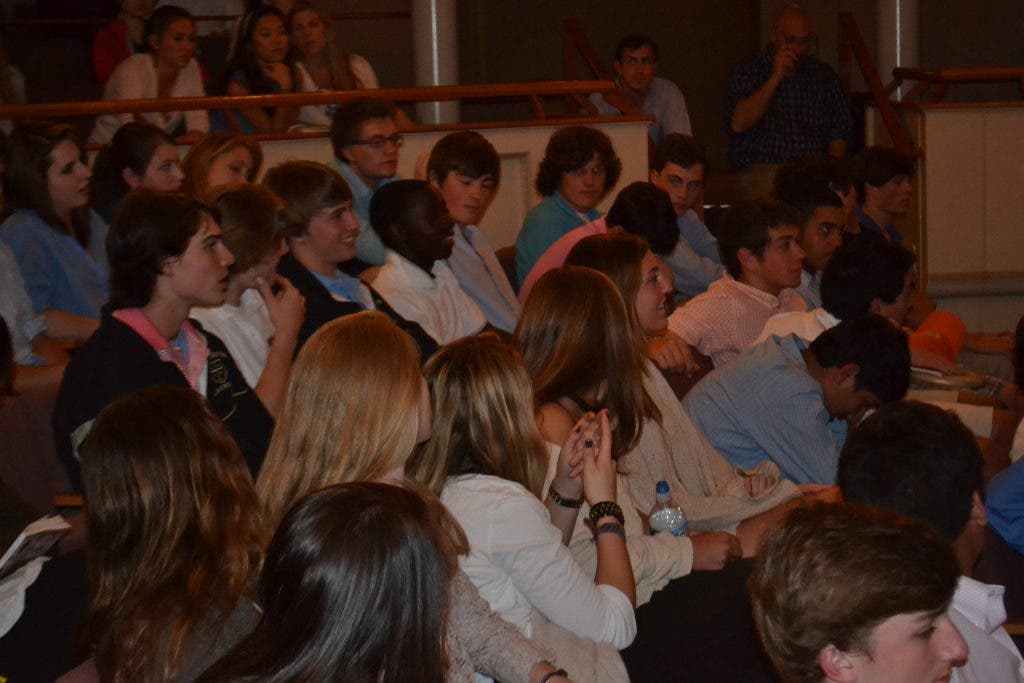


It is intimidating to write about the poet Terrance Hayes who just won the National Book Award for Poetry in 2010, but essential. Hayes came to on Monday, April 11 and read in his easy going, unpretentious manner to a largely student audience who were spellbound.
It is intimidating because Hayes himself is not, but his skill in translating the human experience into tightly layered modern capsules of words and images about the natural tensions of life is captivating and just plain interesting. Hayes brings a perspective that is current, fresh, and honest and a talent that is impressive. Sitting and listening to his poetry in the Werner Centennial Theater on Westminster’s campus, felt like being an insider on the cutting edge of the poetry world.
“Terrance Hayes is a powerful, graceful, surprising and challenging poet,” said Scott Reeves, a Westminster English teacher, as he introduced the poet. Hayes who turned 40 this year seemed slightly uncomfortable with the attention.
Find out what's happening in Simsburyfor free with the latest updates from Patch.
“I never know what I am going to do now,” Hayes said while smiling at the audience. “I like Q and A’s better than reading poems.”
Nonetheless, Hayes read from his newest collection called Lighthead (Penguin 2010), as well as his previous works. Lighthead, by his own admission, has evolved from Muscular Music (1999), Hip Logic (2002) and Wind in a Box (2006).
Find out what's happening in Simsburyfor free with the latest updates from Patch.
“I see echoes of lines I wrote earlier now…’gold plated windows’ and ‘gold plated incantations.’” Hayes said referring to a line from his earlier poem ‘Emcee’ as he recognized his own ideas that have been more developed in his latest prize winning work.
Hayes’ openness during the evening provided insight into his writing process and some of his themes which are often about African American identity and what he is learning in his own life experiences as a husband, father, and artist. Not surprising he is also a creative writing professor at Carnegie Mellon University in Pittsburgh, PA where he lives with his wife and two children.
“When I sat down, I was hearing Hendrix. Music is a gateway into bigger subjects,” Hayes explained while relating that his brother had just left to go to Afghanistan when he wrote the poem ‘Jump School.’ He added that his brother was not in the Army, but was involved in a more secret way.
“I’m trying to understand danger,” Hayes said of his poem where he is imagining his little brother’s paratrooper training. Hayes was giving this example to show the audience how he uses his writing to help him live his life.
Many of the poems Hayes read at Westminster used his favorite musicians and cultural icons which prompted his telling the young audience to go look up these names on iTunes or the Internet.
“I just like my playlist to be out there in the world,” Hayes laughed as he recognized that his music may not be familiar to all in attendance. “Now y’all go look up Cool Keith,” he said with an appealing Southern drawl before reading ‘Papa was a Rascal.’
You can find implicit or explicit references to Jimi Hendrix, Paul Robeson, Dr. Seuss, Nina Simone, Luther Vandross, and Grace Jones among many others in Hayes’ works. He uses them as “gateways” into his narrative poems or as images to question with, like in ‘Shakur’ about rapper Tupac Shakur, which questions the “faux lacquer of bliss” that comes with drug use.
Terrance Hayes is the 11th poet to come to read for the Westminster Poetry Series. English department head, Michael Cervas has been very prescient in his selections for visiting poets, like Billy Collins who signed on to be the second Westminster poet one week prior to being named the U.S. Poet Laureate and Ted Kooser, the 6th poet, who also was about to be named U.S. Poet Laureate; Hayes only recently won the prestigious 2010 National Book Award for Lighthead. Cervas noted that this reading was by far the best attended, and he has seen the students really respond to Hayes’ writing.
“He doesn’t want to be just an African American poet,” said Cervas of his impression of Hayes. “Hayes is down to earth and just has a tremendous facility with language.”