Health & Fitness
Architext #1310: Whose Fault Is It?
Errors and mistakes occur in construction projects. Without clearly defined roles and responsibilities, assigning blame is often difficult. Here's an example.

Last week I got a call from a client that I had done some planning for two years ago. Kelly and Nick live outside of Boston with their two boys. They engaged me to do some schematic design work for a kitchen renovation project that they planned to do at their vacation home on Cape Cod.
My work was very preliminary. I reorganized the kitchen layout and appliance locations to create a more functional space. My effort ended when I sent them a plan sketch of the new layout—no construction drawings or specifications, just the sketch. They said they didn’t need more than that (architects get that a lot). They intended to engage a contractor, buy the new appliances and lighting and do the project. No biggy.
Kelly’s call was like many I’ve received over the years. After the appetizers, she said they were finishing up the kitchen project and we’re really happy with my new layout. Then the main meal comes: “ .. we’re almost done…we got it down to just one remaining, unresolved issue …and we thought you might be able to give us some help.” Boy, I wish I had a nickel for every time I’ve heard that line over the years—I’d be the one retired on the Cape!
Find out what's happening in Southburyfor free with the latest updates from Patch.
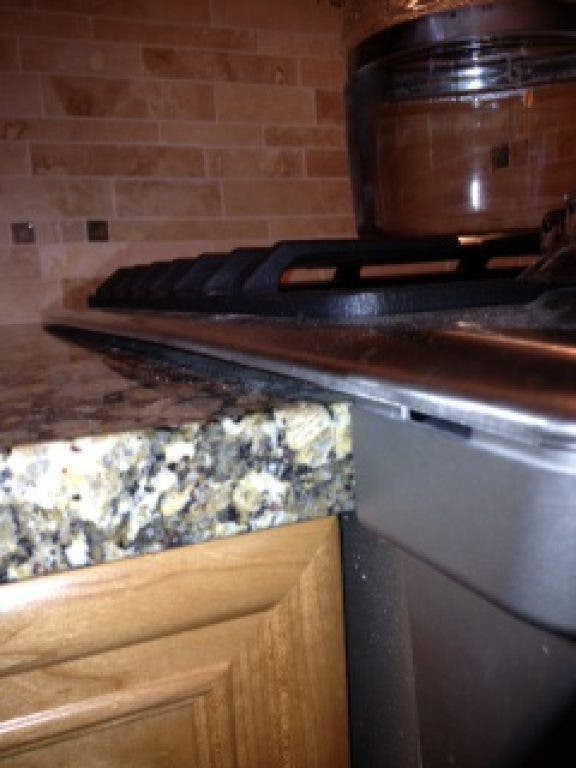
Turns out the Electrolux (vacuum cleaner? – No!) high-end slide-in-range they bought doesn’t fit right with the granite countertop. This type of range has a “lip” on either side that actually “sits” down on the top of the countertop to create a clean, built-in look. That snug, desired fit is achieved by an up or down adjustment of the feet on bottom of the range. In Kelly’s case, there is a 3/8” gap between the range lip and the adjacent countertop. If the range is adjusted down to create the right fit, there is a conflict with the adjacent cabinet doors whereby they can’t open correctly without hitting part of the range. Nasty! The result: A cleaning nightmare. A bad look.
Kelly had talked with the countertop vendor, the cabinet supplier, the appliance store and the contractor. “Dom, whose fault is it? Shouldn’t the contractor have coordinated that? How about the cabinet supplier- they never asked me what type of range we were getting…..and round and round we go. How’s this going to be solved? Who is going to pay for the fix?..and round and round we go.
Find out what's happening in Southburyfor free with the latest updates from Patch.
Now we jump into the deep, black, abyss known as Responsibility, which eventually leads to Assigning Blame that finally morphs into You Are Paying To Fix This! Books have been written on this issue as it applies to construction projects, so this only a light treatment of the topic. Every project requires that standard roles be filled and proven procedures be followed. This is not a casual process: individuals have to be assigned a role that comes with a scope of responsibility. I suppose, by chance, some jobs are successful without much attention being paid to this responsibility thing. Surely they represent a very small percentage. But, I’m in the planning and management business so part of my work is to pro-actively assign roles and responsibilities in order to give a project the best chance of success. These roles, and their related responsibilities, are clearly defined in the construction documents (drawings and specs) and in the construction contract. Those documents become the reference point to assess responsibility (i.e. who is on the hook) when errors and disputes occur. In the end, there really is no deep, black abyss; responsibility can be easily and clearly defined for most common projects.
Let’s apply this to Kelly’s project. One of the responsibilities inside of ALL projects is the COORDINATION of the various parts and components of the work. Someone needed to coordinate the range with the countertops and the cabinets to see if there were any conflicts in how those components would interface. Obviously this didn’t happen on Kelly’s job. This same attention would be applied to numerous other areas of the work. Here’s a couple other examples of coordination in a kitchen renovation project: the plumber needs to know that the new refrig has an ice maker so she can provide a water supply; the electrician needs to know where to provide the power feed to the back of the electric range, he also needs to know that there is a special tile backsplash that is 8” high so outlet placement needs to be carefully planned……
To be sure, typically, coordination is a responsibility of the general contractor- it’s part of the reason they are paid a mark-up on all the materials and labor they bring to the job. When an owner pulls a part of the work (materials or labor) away from the contractor, thereby eliminating his ability to apply a mark-up to those items, the waters get muddy. He naturally wants to shed the coordination and therefore the responsibility that comes with managing those items. In Kelly’s case, she told the contractor that she would get the appliances and she would be picking out and buying the cabinets. When she began discussing the range problem with the contractor, he immediately told her that the coordination of the appliances was hers. At the start, when she told him that she would get the appliances, he told her that his electrician was only going to provide the power for the range, hook it up and slide it in. What she didn’t know (and how would she?) was that he was really saying---I got nothing to do with all the coordination surrounding the range—that’s all you Baby!
Kelly: And the cabinet vendor, is it their fault? No, they don’t care about what range you’re buying---all they want to do is sell cabinets. And the appliance guy- ditto. And the countertop people- ditto.
At this point in the conversation, Kelly pretty much knew she was cooked. She owned the gap problem. I didn’t need to ask about the contract she signed which was probably the skimpy proposal that the contractor had provided her---and that obviously wasn’t going clearly define his responsibilities in any thorough, much less, owner-friendly way.
We ended the conversation with my providing some recommendations on possible fixes and her realizing that she ultimately would have to pay for them. Then, as usual, I got the perfunctory invitation to stop by and see the job…yeah, like the next time I happen to be driving by the Cape!
Here’s the takeaways-
- If you know and understand the typical roles and responsibilities of principals (owner, contractor, designer) in a construction project, be sure they are clearly assigned and included in all contracts.
- If you don’t know the stuff in #1, get somebody who does and can help.
- If you're into going commando and want to leave the stuff in #1 up to chance, Godspeed! But don't be surprised if some things fall through the cracks---or in Kelly’s case- the gaps on sides of the range.
Hope this helps. Good Luck. DN
Dom Narducci is a practicing architect in Southbury, CT. He provides complete architectural design and project management services (Freestone-inc.com) and offers a line of stock house plans (FreestonePlans.com). Additionally, Narducci teaches and writes on design and construction issues. Comments are welcome. If you have a question for Ask the Architect!, email Dom at: dnarducci@freestone-inc.com.