Neighbor News
DAWN at Ceres
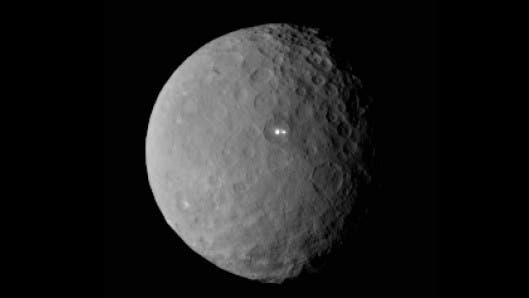
NASA's DAWN spacecraft enters orbit about Ceres - the largest asteroid of the solar system shows us some exciting surprises.
After a long hiatus, I am back - hoping to both keep you informed of astronomical happenings, and build excitement in the community for the next sessions of my astronomy course. For full details about the course, please visit www.turnerclasses.com.
NASA’s DAWN spacecraft entered orbit around the “dwarf planet” Ceres Friday March 6th. This mission is of great interest for several reasons – the technology of this spacecraft is unusual, Dawn is the first spacecraft to enter orbit around two different targets, has already revealed surprising features on the surface of Ceres, and Ceres itself may hold even more fascinating possibilities than we had previously considered.
The Dawn mission was launched eight years ago, and the spacecraft visited the smaller asteroid Vesta from 2011 to 2012. The technical complexity of this mission is driven by the attempt to enter semi-stable orbits around these two small astronomical bodies. These large asteroids have masses about one millionth that of Earth, and the gravitational field holding Dawn in orbit is about 1/20th that of Earth’s. Making matters more complicated, slight variations in the distribution of mass inside the asteroids, as well as not having perfectly round shapes, make the gravitational field varying by location.
Find out what's happening in Southburyfor free with the latest updates from Patch.
To handle the delicate process of entering and staying in orbit around these small objects, Dawn is powered by an advanced ion engine, rather than a more conventional rocket thruster. The ion engine is both a very fuel efficient, and very weak thruster. At maximum thrust, the force applied to the spacecraft is about the same as the force applied to your hand by the gravitational pull of a single piece of paper. But while a chemical rocket thruster is typically fired for no more than a minute at a time, an ion engine can be fired for days or weeks at a time and will achieve the same spacecraft speed, but with much finer control.
Ceres is the largest of the asteroids, with a diameter of 590 miles (Earth’s diameter is 7926 miles in comparison) and contains about a third of the mass of material found in all of the asteroids combined. Discovered on the first day of the 19th century (January 1, 1801), it was originally considered a planet, then downgraded to an asteroid, and now – after the chaos of redefinitions the demoted Pluto from planethood – is the second largest “dwarf planet”.
Find out what's happening in Southburyfor free with the latest updates from Patch.
A few years ago, researchers conjectured the possibility that Ceres may have a subsurface layer of water ice, which in the more distant and warmer past was likely a subsurface ocean – similar to the subsurface oceans now believed to exist on some of the moons of Jupiter and Saturn. And where there has been liquid water, there has been an opportunity for the formation of life.
On the approach to Ceres, images from Dawn have shown a striking feature –intense white spots within one of the larger craters on the surface, seen in the image for this post. Although we will learn much more about these spots in the coming weeks as Dawn images the surface in much finer detail, the initial thinking is that these are deposits of water ice on the surface, possibly caused the craters puncturing the crust and reaching the internal ocean beneath. If this is the case, Ceres may offer the fantastic opportunity to search for the remains of ancient life at the surface of the asteroid, avoiding the difficulty of drilling deep into a moon or asteroid from billions of miles away to reach the subsurface ocean.