Neighbor News
How Much Food Do You Really Need for 50, 75, or 100 Guests?
A practical guide to planning portions for your next backyard party, graduation, birthday, or family gathering

If you've ever planned a party for a crowd, you've probably asked yourself the same question: How much food do I actually need?
Buy too little and you're worried about running out. Buy too much and you're left with a refrigerator full of leftovers—and a grocery bill that got considerably larger than expected.
After catering thousands of guests throughout Connecticut, we've learned that feeding a crowd isn't simply a matter of multiplying a recipe by the number of people attending. The right quantity depends on what you're serving, how many choices guests have, the length of the event, and even the time of day.
Find out what's happening in Southburyfor free with the latest updates from Patch.
So, if you're planning a backyard gathering in Southbury or the surrounding area, here's a practical starting point.
Start With the Protein
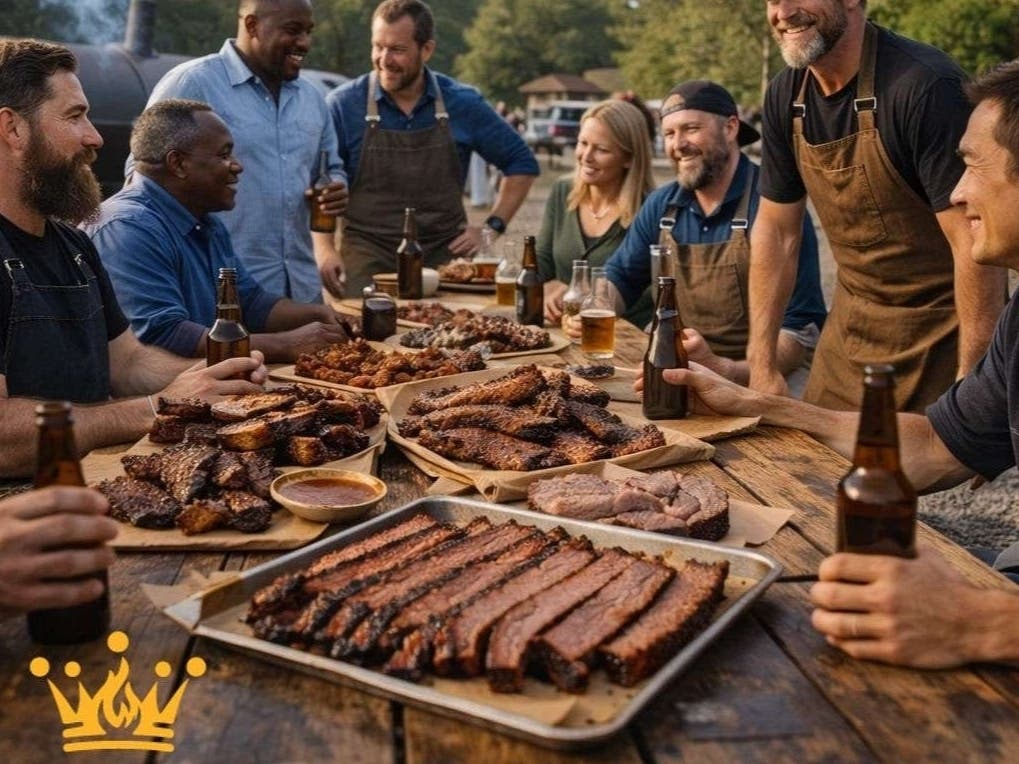
For a BBQ-style meal where meat is the centerpiece, a good planning guideline is approximately ½ pound of cooked protein per adult guest when there are multiple menu choices.
Find out what's happening in Southburyfor free with the latest updates from Patch.
That doesn't mean every person will eat half a pound of meat. Some will eat more, some considerably less, and children will generally eat less than adults. The number is a planning average that helps account for the natural variation among guests.
For example:
50 guests: approximately 25 pounds of cooked protein
75 guests: approximately 37–38 pounds
100 guests: approximately 50 pounds
But there's an important catch: cooked weight isn't the same as the amount of raw meat you need to purchase.
Different proteins lose different amounts of weight during cooking. Brisket, pulled pork, ribs, and chicken can all have significantly different yields. That's why simply buying ½ pound of raw meat per person can leave you seriously underestimating what you need.
More Choices Can Actually Mean Less of Each
Planning two or three proteins?
You don't necessarily need ½ pound of every protein per guest.
If you're serving pulled pork, BBQ chicken, and brisket, for example, guests will divide their portions among the available choices.
That's one of the advantages of offering a variety of proteins: guests can build their own plate instead of taking a large portion of one item.
The same principle applies to sides.
How Many Side Dishes?
For a typical BBQ buffet, a reasonable starting point is approximately ¾ to 1 pound of total side dishes per adult guest, depending on the menu.
That total might be divided among three or four sides.
For 50 guests, you might plan for roughly:
12–17 pounds of each of three sides
For 75 guests:
19–25 pounds of each of three sides
For 100 guests:
25–33 pounds of each of three sides
These are planning ranges—not hard rules.
A side dish that's especially popular with your crowd may need more. A heavier side such as mac & cheese will generally be consumed differently than a lighter vegetable or salad.
And if you're serving appetizers, desserts, or other substantial foods, your side requirements can change as well.
Don't Forget the “Invisible” Food
One of the easiest mistakes when planning a party is concentrating entirely on the main meal.
Don't forget the items that quietly add up:
- Rolls or buns
- Pickles
- Sauces
- Condiments
- Cheese
- Garnishes
- Chips and appetizers
- Desserts
- Beverages
- Ice
Individually, these may not seem significant. For 100 guests, however, small quantities become big quantities very quickly.
Should You Plan for Leftovers?
Yes—but don't plan to feed another entire party.
A modest buffer is a smart idea, particularly when you're feeding a crowd.
We generally recommend allowing approximately 10–20% additional food, depending on the type of event and how important leftovers are to you.
A family reunion where everyone expects to take food home is different from a two-hour afternoon gathering where dessert follows the meal.
There's also a psychological benefit to having a little extra.
Nobody wants the last guest walking through the buffet line to discover that the brisket pan is empty.
The 50-, 75-, and 100-Person Cheat Sheet
If you're looking for a simple starting point for a BBQ buffet, here's the basic math:
50 Guests
Plan for approximately 25 pounds of cooked protein and roughly 38–50 pounds of total sides, depending on the menu.
75 Guests
Plan for approximately 37–38 pounds of cooked protein and roughly 56–75 pounds of total sides.
100 Guests
Plan for approximately 50 pounds of cooked protein and roughly 75–100 pounds of total sides.
Again, these numbers are starting points. Your actual requirements can change considerably depending on the menu, guest demographics, event length, time of day, appetizers, desserts, and whether you're serving buffet-style or plated meals.
One More Thing: Don't Forget the Logistics
Food quantity is only half the equation.
You also need enough:
- Serving utensils
- Plates
- Napkins
- Cups
- Chafing dishes
- Fuel
- Tables or serving surfaces
- Refrigerator or cooler space
- Trash and recycling capacity
And if you're cooking everything yourself, there's another question worth asking:
Do you actually have the equipment and refrigerator space to prepare and safely hold enough food for 100 people?
That's where a party can quickly go from “I've got this” to “What have I gotten myself into?”
The Bottom Line
Feeding 50 people isn't simply feeding the same person 50 times.
Crowd catering is about understanding portion behavior, cooking yields, menu variety, food preferences, timing, and logistics.
The good news is that once you understand the basic math, planning becomes much easier.
And if you're still not sure how much food you'll need, don't be afraid to ask someone who does this professionally. A little planning before the event can prevent a lot of stress during it.
After all, the goal of hosting a great party isn't to spend the entire afternoon wondering whether there's enough food.
It's to enjoy the party with everyone else.
Aaron Bethlenfalvy is the owner of King of Que BBQ, a Southbury, Connecticut-based catering company serving events across the region.
This is part of an ongoing series exploring how local hosts are rethinking events across Southbury and surrounding communities.