Community Corner
100 Years Old: An Incredible Life Story Of A World War II Medic
A student editor of the South Windsor High School newspaper tells of her experience meeting a World War II veteran from Connecticut.


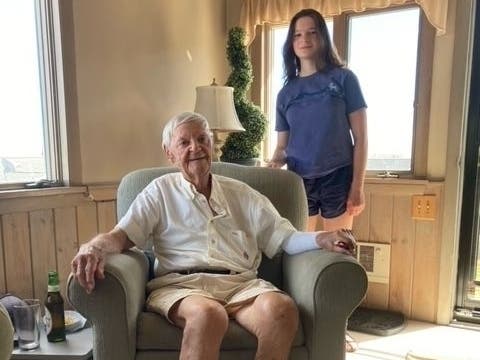
Editor's note: this story was written recently by Katelyn Drenga, editor of the South Windsor High School newspaper, The Bobcat Prowl, and is published here with permission.
Leogrande is a reminder to remember history. To never forget about the people who risked their lives, so that we could live in peace. 100 years of age, World War II veteran Charles (Carl) Leogrande walked in strong, strolling over to a green chair where he then sat and told me his story.
A good friend of my grandpa, I’d seen Leogrande many times before that day. However, it wasn´t until this summer that I learned about his experience in WWII.
Find out what's happening in South Windsorfor free with the latest updates from Patch.
Living in Mystic, only five minutes away from my grandfather, many times he’ll drive to the house (yes he still drives at 100) to sit and relax by the breeze of an open window, enjoying the ocean view on his green rocking chair while talking and having a sandwich from the local market.
Yet, while relaxing now, Leogrande once was a medic risking his life to bring aid and support to injured soldiers on the front line.
Eighty years ago, a 19-year-old Carl was drafted as a soldier. He explained that without hesitation, he agreed to serve his country.
Find out what's happening in South Windsorfor free with the latest updates from Patch.
After training, Leogrande became a tank driver for the 12th armored division. However, he’d later become a medic.
According to Hellcats: The 12th Armored Division in World War II, the 12th armored division was one of the 38 war divisions and nine armored divisions activated in 1942. First formed at Camp Campbell in Kentucky, the division (generally referred to as “The Hellcats”) was later transferred to Abilene, Texas, which is where the 12th Armored Division memorial museum stands today.
After a tank in front of him flipped over, Leogrande said he immediately rushed over to help. Able to utilize skills from Boy Scouts; he fixed the guy up quickly.
An officer from the other side of the scene saw Leogrande helping this soldier out, and asked him to be a medic, so he did.
In his days as a medic, Leogrande traveled with members of his division to England, France and Germany. He also would later travel with his division to the Battle of the Bulge.
On the front lines with the fighting forces, Leogrande explained he was trained to use splints, how to stop bleeding and how to use morphine. To go a step further, he actually replaced his original bag by converting an extra weatherproofed ammunition case into a medic bag, painting a red cross on the case so it wouldn’t be mistaken for ammunition. He did this so that in the chaos, his supplies would be shielded from getting ruined.
On the battlefield, Leogrande said whenever he heard ¨Leo!¨ being called out from a distance, it meant someone became injured and they needed his help. Leo was a nickname for his last name.
He said, ¨It taught me to appreciate every day, and also that I never want to be a medic again.¨
When later asked about the most important value he learned throughout the war, Leogrande said, ¨To always take care of one another.¨
That value has certainly not faded, as it’s seen consistently in his personality. A guy with a thoughtful, gentle character, Leogrande allows others to feel comfortable and welcomed. He’s always thankful, kind and amiable, greeting everyone when he stops by.
One man he became good friends with during the war was Donald from Minnesota. “I used to see him a lot,” Leogrande said.
And while most of these values and experiences were derived through fellow soldiers, Leogrande also added American soldiers were not the only ones he learned from.
¨Americans learned from the Germans; developed strategies from them,¨ he said, retelling the time a civilian from another country invited him over for dinner.
After returning home safely at 22, Leogrande started an oil business and met his wife Annabelle on a blind date. He would stay with her for 50 years until she sadly passed away in 2003.
After the war ended, the media erupted with films, highlighting WWII. A viewer of a few of these, I always wondered how they actually compared to soldiers’ true experiences in the war.
Asking Leogrande his thoughts on war in movies, he described that all the guys “acted like macho men. We were just regular guys.”
A brave and humble veteran, Leogrande was recognized last year in a Congressional address. The record explained:
“Leogrande continues to attend every reunion of the 12th Armored Division. Though 782 members were lost during the war, 14 of them still remain, and Mr. Leogrande looks forward to joining his fellow soldiers for their 2022 reunion, which will take place in Texas."
"We meet every year, and are the only division with our own museum,” Leogrande said.
A few months after being recognized in the address, Leogrande flew to Abilene, Texas for the annual reunion. Roughly 1,800 miles from Connecticut, it’s a long way, but a trip important to him, to the other soldiers, to his country. These people mean so much to him.
Shortly after his trip to Texas, the 12th Armored Division Memorial Museum posted on Facebook about the experience, stating:
"One of the best moments this year was being able to take two of our WWII veterans, Chuck Brown and Carl Leogrande, on a halftrack ride during the reunion."
Out of the 11,000 soldiers in the 12th Armored Division, with up to 1,000 in a battalion, Leogrande is one of the 14 left, and is the only one who can still walk unassisted.
So in all the world’s chaos, in all the uncertainty and violence, stand for Leogrande. Stand for the 11,000 soldiers in the 12th Armored, and the 782 of them who couldn’t make it out. Stand for 16 million U.S. soldiers: 407,316 killed. Leogrande stands as a reminder to us all, to honor the ones who fought for us all. To not kneel, but stand for the good in the world, the brave in the world, the United in U.S.A.
Get more local news delivered straight to your inbox. Sign up for free Patch newsletters and alerts.