Kids & Family
Hands On History
Colonial history comes alive for Stamford students at the Hoyt-Barnum House.


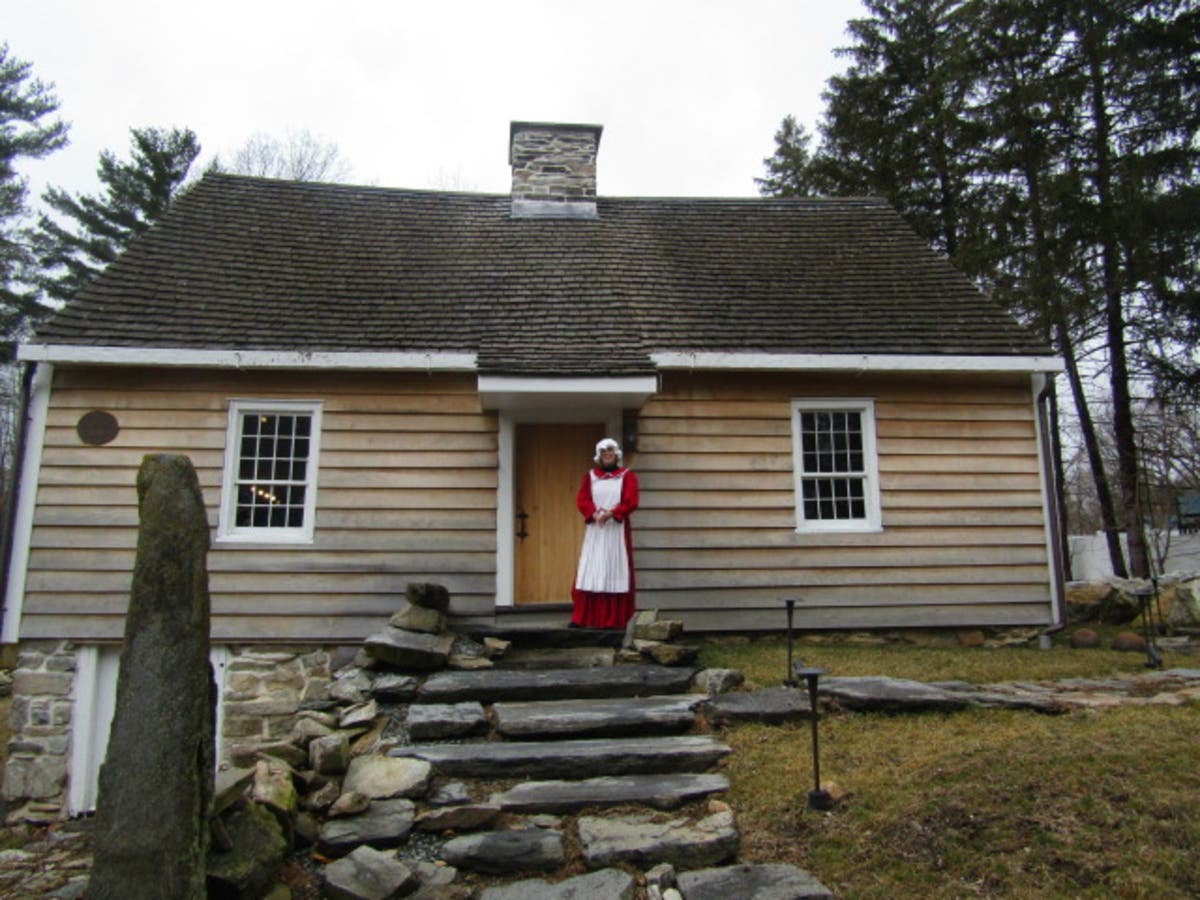


American colonial history can be difficult to comprehend for young students. How could people survive without electricity, cars or stores? Luckily, second graders from Northeast Elementary School recently got some hands-on learning experience at Stamford History Center’s Hoyt-Barnum House.
The Hoyt-Barnum House was built in 1699 by Samuel Hoyt on Bedford Street in Stamford and was relocated in 2016 to 1508 High Ridge Road. The oldest existing residence in Stamford, it was home to Samuel’s thirteen children and is on the National Register of Historic Places.
Claudia Wolen, the History Center’s Education Coordinator, dressed up in a colonial costume of a red shift dress, white apron and mob cap to guide the children on a tour of the house. The first stop was the fireplace/hearth area where students saw an antique toaster, mortar-and-pestle, coffee grinder and a straw basket for bee keeping. “What does the beehive oven remind you of?” asked Wolen. The children agreed that it looked like a pizza oven and indeed it was used for baking. After viewing a butter churn and a candle-stick mold, Wolen challenged the children to lift two empty water buckets suspended on a wooden yoke. “I can lift this! It’s not too heavy,” boasted one boy. Wolen laughed and told him that the Hoyt children would have used it to transport full buckets of water from a nearby stream.
Find out what's happening in Stamfordfor free with the latest updates from Patch.
Colonial life was not all work, however. The students gathered in the Keeping Room where guests such as the local minister would sit and visit with Mr. and Mrs. Hoyt. Wolen showed them a Horn Book—a paddle-shaped primer—from which young colonials learned the alphabet and basic grammar. Each student was able to play with a tumbling Jacob’s Ladder and to try to catch a ball on a string in a cup, colonial toys featured in the PLEASE TOUCH exhibit.
The house’s only bedroom holds a rope bed. “Who’s heard of the nursery rhyme, ‘Good night. Sleep tight’?” asked Wolen.”’Sleep tight’ refers to the ropes under the bedding which needed to be tightened every night,” explained Wolen as she cranked the winch to make the ropes taut. She also showed the students a metal bed-warmer to be filled with coals and slipped under the bed covers. “Where is the bathroom in this house?” Wolen asked. The students looked around and shrugged their shoulders. “There was no toilet,” answered Wolen as she pulled a porcelain chamber pot out from under the bed. “They used this instead!” The students shrieked with surprise and laughter.
Find out what's happening in Stamfordfor free with the latest updates from Patch.
“Where did all of the kids sleep?” asked one little girl. Wolen led the way up to the attic where the students took turns laying on “pallets”, straw-filled sacks used as mattresses by the Hoyt children. Wolen showed them the other use for the space which was where they spun wool yarn on a spinning wheel and wove it into cloth on a loom. “Most people only had a few pieces of clothing,” explained Wolen.
The tour wrapped up in the basement. Samuel Hoyt was a farmer and also a blacksmith. Many of the tools of his trade are on display downstairs, including horseshoes and an anvil.
The second graders were already familiar with the Hoyt family when they visited the house. Their teacher, Mrs. Boccuzzi, explained that Mrs. Wolen had visited the school earlier with the History Center’s outreach program, “Time Travelers”. After learning how Stamford grew from a rural community into an urban one, they heard the story of the Hoyts’ “Little House” and how it was relocated to save it from being torn down to accommodate Stamford’s new police station. “They were all so excited to see the ‘Little House’ which they had placed on the Stamford map as a wooden block,” Boccuzzi said.
The Stamford History Center invites you to visit the Hoyt-Barnum house. School tours can be booked through Claudia Wolen at wolenclaudia@gmail.com. Small groups can tour the house on Thursdays and Fridays at 12:30, 1:30 and 2:30; and Saturdays at 11, noon, 1:30 and 2:30. Tickets are $5/person (cash or check) and include an audio guide. Children under 12 are free with a paying adult. (Children must be supervised at all times.)