Politics & Government
Stamford Gets 'Short End of Stick' for State Education Funding: Mayor
Martin said some Stamford schools resemble wealthy districts while others look more like Hartford or New Haven.


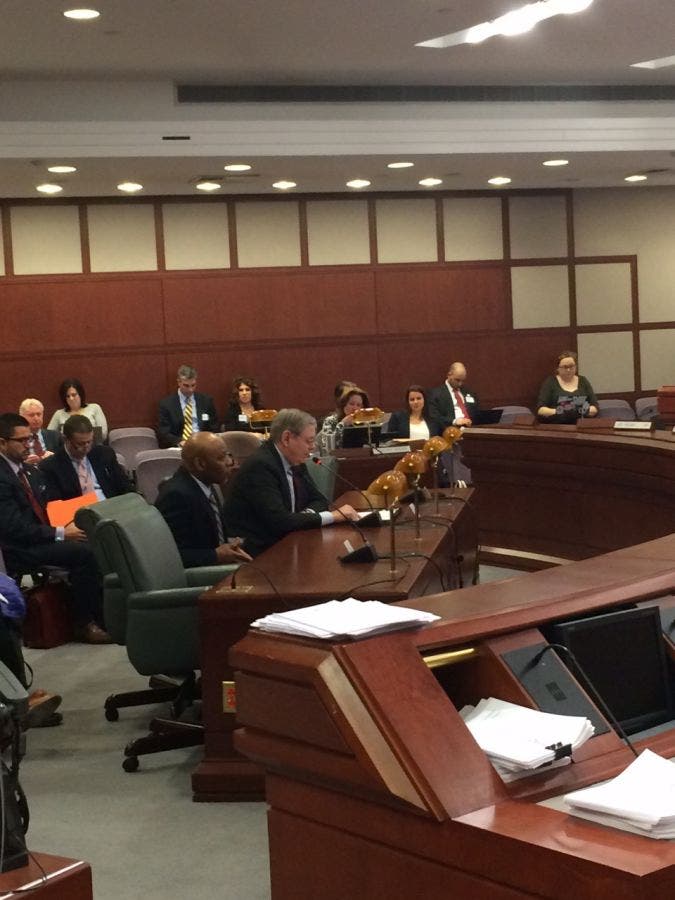
STAMFORD, CT — Mayor David Martin spoke of how Stamford gets the "short end of the stick," when it comes to education funding from the state.
Below are some of Martin's comments made at an Education Committee hearing:
“…As we all recently saw in the CCJEF case, in which the City of Stamford was a plaintiff, the current formula for funding public schools in Connecticut is inequitable and unfair. At current levels, Stamford only receives ~$685 per student in ECS funding; this is woefully inadequate given the challenges we face in Stamford. Stamford, and Norwalk, which is in a similar situation, continually gets the short end of the stick when it comes to state support of our schools.
Find out what's happening in Stamfordfor free with the latest updates from Patch.
We are a unique situation. Part of our school system greatly resembles the challenges faced in Hartford, Bridgeport, and New Haven. And another part of our school system resembles those of our more wealthy neighbors.
This diversity puts more of a strain on our school system than other more homogenous school districts. Students in Stamford come from many different ethnic backgrounds, with more than 60 languages spoken in our schools. In the same kindergarten classroom we often students capable of reading at a second grade level, while others in the same class do not know their letters and numbers, making it much more difficult for a teacher to teach, and more costly for the school system as a whole. Stamford is the most diverse school system in the state, with one exception . . . the data shows that West Hartford is a tiny bit more diverse than Stamford.
Find out what's happening in Stamfordfor free with the latest updates from Patch.
I’m not saying that Stamford has the same degree of financial need as the other large cities in Connecticut, but I share with you that like those cities, Stamford is well above the state average in students with free and reduced lunch, well above the state average for percentage of ELL students, and well above the state average in affordable housing. The median family income in Stamford and Norwalk is very close to the state average, yet despite our greater educational challenges, neither community receives anything close to the state average funding per student.
We try to be careful with the resources we have. Both Stamford and Norwalk spend less per capita than the state average, less per capita than all the other cities in our economic region, and less per capita than Bridgeport, Hartford, and New Haven. We have had to become more efficient because of our limited resources and limited state funding.
But we cannot keep up. Our elementary schools are among the largest in the state, and they are still overcrowded. We are building a new school now, with state assistance, but even after it is completed we will still have almost 400 kids in “temporary” modulars that are almost 20 years old. We already have a higher cost of housing burden on our residents that the state average, and despite the fact that we have greater educational challenges and greater diversity in our schools, we are forced to spend less per student than our surrounding communities. That is simply unfair to our children.
It is a common misconception that Stamford’s grand list ensures that we have ample resources to satisfy our needs, without consideration of our specific challenges, and very importantly, our moderate income. But despite the shiny buildings that you see when you pass Stamford on I-95, like almost all other municipalities in the state, the majority of our taxes come from our residents, not from corporate office buildings. In fact, the vast majority of the income derived from the businesses in Stamford does not go to Stamford, it goes to the state.
Some have called Stamford the “economic engine” of the state. Stamford and Norwalk are the two largest cities, and at the center of one of the state’s most important economic regions.
Together, Stamford and Norwalk directly account for almost $1 billion in income and sales tax that goes to the state. And that doesn’t count the hundreds of millions that the state gets indirectly, because Stamford and Norwalk is where people work and earn a living, but income tax is reported from the community where they live.
Unfortunately we only get back pennies on the dollar. We need some more of that money back to keep our cities healthy, to keep the economic engine working, and to make certain our kids get a good education.
Many municipalities across Connecticut are faced with difficult economic realities with less promised state funding on the horizon. And some large cities have indicated that they may have to consider bankruptcy in the not-too-distant future. We can all acknowledge that Stamford is in a stronger financial position, but like the other major cities, we cannot run an urban area on property tax alone.
This is not a zero-sum game. More ECS support for Stamford and Norwalk is an investment in our collective future. It will not only give our kids a better education, it will also give us the ability to keep the economic engine working. Which is good for everyone in the state.
To be more specific, I support a comprehensive study of the ECS formula, but it is already apparent that the ECS formula needs to recognize the increased cost of ELL students, needs to incorporate direct support of individual schools that are highly diverse, and needs to place greater emphasis on resident’s income in considering a community’s ability to pay rather than being almost exclusively driven only by grand list. And obviously communities that are growing in student population cannot be shortchanged funding, while other communities receive more than 100% of their allocation.
This broken formula needs to change. We need to change it to ensure the economic vitality of our cities, and we need to change it to ensure that every student is receiving equal access to education.”
Image via Stamford Mayor's Office
Get more local news delivered straight to your inbox. Sign up for free Patch newsletters and alerts.