Health & Fitness
Stamford Health Rolls Out New Virtual Reality Training
The technology allows medical professionals to hone their skills through different scenarios with virtual patients.


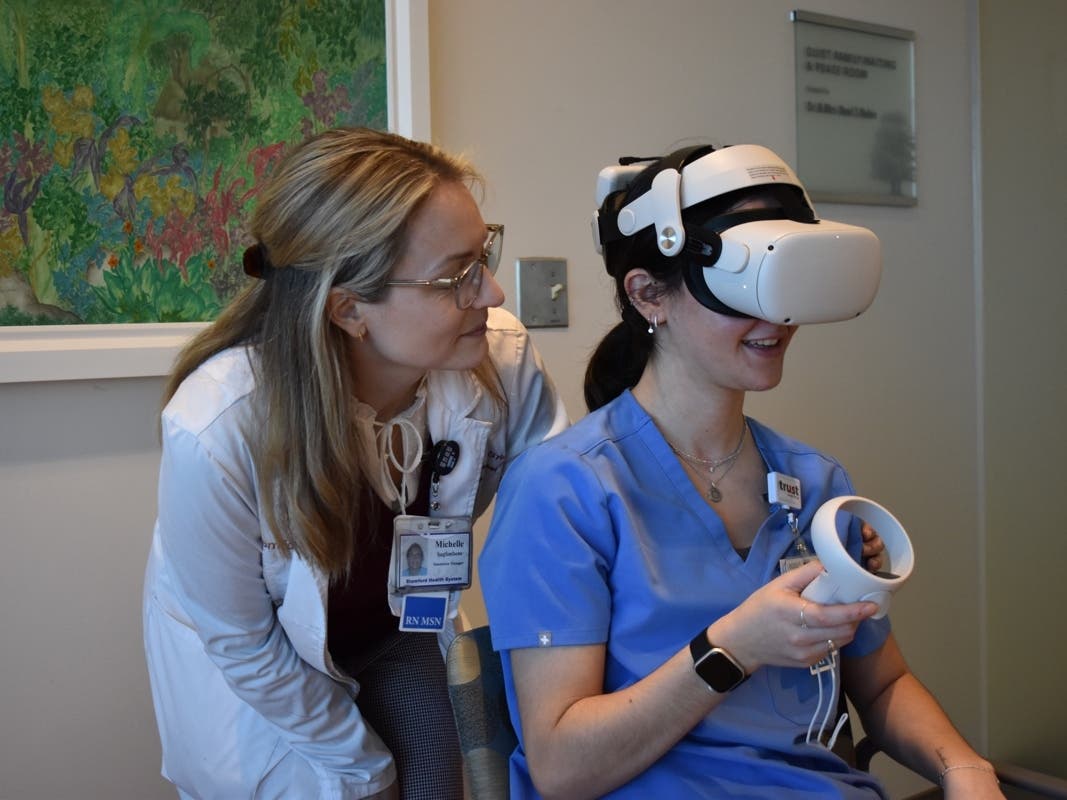

STAMFORD, CT — The next generation of medical training has arrived at Stamford Health.
The health system became the first in Connecticut to implement virtual reality (VR) training for its frontline staff last month. The technology, which is delivered through VR headsets akin to those in the video game industry, allows doctors, nurses and medical residents to hone their skills through different scenarios and virtual patient interactions.
The platform comes from Oxford Medical Simulation, a company that specializes in this kind of technology.
Find out what's happening in Stamfordfor free with the latest updates from Patch.
"Our vision was really to be innovative and bring cutting edge education materials and technology to Stamford Health," Michelle Saglimbene told Patch. Saglimbene is the manager for Stamford Health's Center for Simulation and Learning.
The training allows medical professionals to interact with virtual patients and conduct head-to-toe assessments; identify changes in a patients’ hemodynamics or lab values; and practice important and critical patient care skills, without touching a real patient
Find out what's happening in Stamfordfor free with the latest updates from Patch.
"Nurses can actually go in and they put on a headset, and they enter this isolated hospital meta area, where they can interact with a patient who looks real, who has vital signs and lab values that are going to change or alter depending on the treatment or the lack of treatment they provide," Saglimbene explained.
Stamford Health plans on rolling out more scenarios in the future that deal with de-escalation and breaking bad news to patients.
"Not only is it immersing the nurse and residents in the actual clinical skills, it's honing those communication skills and how to communicate interprofessionally with other practitioners, nurses, doctors within that virtual hospital setting to coordinate care and to make sure our patients are safe," Saglimbene said.
Suzanne Rose, the executive director of research at Stamford Health, said the training will have a big impact on decision making and critical reasoning. Participants will have to decide what kind of medication a patient needs based on lab numbers and how the patient is presenting.
The training will also help with teamwork among medical staff.
"Multiple players can be inside a scenario and it allows people to communicate inside that scenario. It's difficult to replicate that in a real environment. It's difficult to get all those people together," Rose said.
Rose described it as "on-demand" training. Eventually, Stamford Health hopes medical professionals and students can take advantage of the training during downtime, Saglimbene added.
For example, if a participant wants to hone their skills in a particular area, such as a scenario involving diabetes and blood sugar levels, they can put on a headset at work in a conference room or even remotely at home for a 15-20 minute training session.
"It just has expanded the amount of learning we can provide and also the places we can provide learning," Rose said.
The technology gathers metrics and highlights strengths and weaknesses for each participant, so educational plans can be tailored for individual learners.
"Our goal is going to be evaluating the learner, and what is their readiness to practice," Rose said.
Stamford Health plans to make the training available to Stamford Health's GEMS cohorts. The GEMS program provides comprehensive orientation to new graduate nurses to transition them to clinical nursing.
The health system hopes up to 90 graduate nurses and about 90 medical residents can take part in the VR training during the first year of the launch, with more experienced staff also participating as well.
Get more local news delivered straight to your inbox. Sign up for free Patch newsletters and alerts.