Health & Fitness
Behind Stonington's Doors
The Stonington Historical Society will host a self-guided walking tour of Borough homes this Saturday, October 6 from 10-4. Tickets are $35 at the gate.


Stonington's first millionaire lived in an elegant home by anyone's standards, but in 1837 it was one of the grandest homes on Main Street. 39 Main Street actually began as a much more modest home on Water Street and was moved to its present location in 1839. Local legend has it that several "hills" were leveled to make the move more manageable, resulting in the raised appearance of several of the homes at the lower end of Water and Main Streets. On Saturday, October 6, The Stonington Historical Society is hosting "Behind Stonington's Doors: A Village Tour of Historic Homes" that will feature the home of C.P. Williams, Captain Charles Brewster, Captain Phineas Wilcox, and others. Seven properties in all will be open to visitors. The tour runs from 10-4 and tickets will be available on the green in Stonington Borough for $35.
Captain Phineas Wilcox's home on Gold Street is one of three homes similar in in their Greek Revival details and were all built circa 1836. A recent renovation revealed the original wide floorboards and an unusual, yet incomplete, stencil.
Another home on Temple Street was originally built circa 1784 by Stonington's first postmaster, Jonathan Palmer. He received his first commission as "Collector and Surveyor" of Stonington from President George Washington in 1791. The home was moved - actually a fairly common occurence in Stonington Borough - sometime around 1880 from its original location at the corner of Main and High Streets for Dr. Charles Brayton. It has remained in the same family since the 1940s.
Find out what's happening in Stonington-Mysticfor free with the latest updates from Patch.
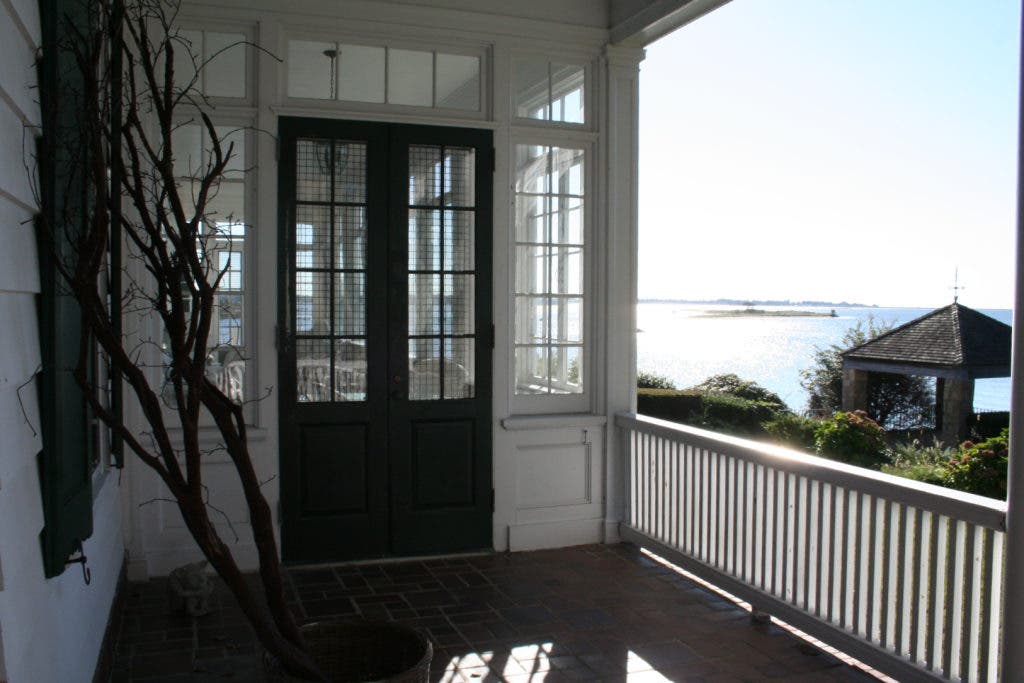
One of the most interesting homes on Saturday's tour was originally built for Eugene Atwood in 1890. This home is notable for its location, history, and spectacular views, but perhaps most known for its appearance in three films. It was used for scenes in Mystic Pizza, The Iron Lady, and most recently, Hope Springs. This home's appearance belies its original "Italian Revival" facade. In the early 20th century, the home underwent extensive transformation to a more fashionable and "modern" Colonial Revival style.
A charming gambrel-roofed home on Diving Street is reputed to have once been a house of ill-repute and one of the current owner's cherished artifacts is the undated notice of condemnation. It is one of the oldest homes on this tour and dates to the 1750s. The current condition and furnishings are quite elegant and would never hint at the storied past this home has enjoyed.
Find out what's happening in Stonington-Mysticfor free with the latest updates from Patch.
The La Grua Center has curated an exhibit of vintage merchant signs and photographs that have been gathered from local attics (including the Historical Society) that once advertised the businesses of Stonington Borough - many of which are still vivid in local memory. The Borough was a thriving business community for most of the 18th, 19th, and 20th centuries. This exhibit is open to visitors and will remain on display through November.
Included on the tour admission to the properties of the Stonington Historical Society: the Old Lighthouse Museum and the Capt. Nathaniel Palmer House. An opportunity to see "Behind Stonington's Doors" happens only once every three years. It is a rare opportunity to step into history. The Stonington Historical Society's mission is to preserve, interpret, and celebrate the history of Stonington. Please Join Us.
More history and details are included in the guide book that accompanies your ticket. My thanks to Lois Cole, who researched and wrote the descriptions, for the guide book.