Community Corner
East Haddam Stage Company Brings “Sherlock Holmes: From Page to Stage” Alive in Hartford
In one compelling hour, the EHSCO aptly carried off a glimpse into the life experience of William Gillette at the Mark Twain House Museum Auditorium.
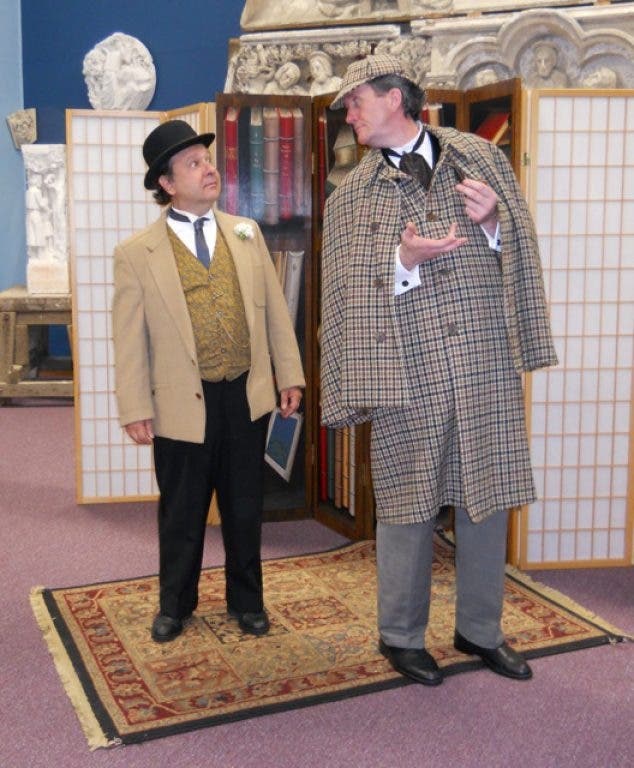


Strangers to our heavenly corner of the universe might not know much about actor/writer William Gillette, the illustrious namesake of East Haddam’s Gillette’s Castle, let alone his connection to Sir Arthur Conan Doyle’s iconic Sherlock Holmes. But, once clued in, what a story: of rebellion, frustration, intellect, industry and vindication. Not to mention, a tragic love. . .
The extremely knowledgeable Ms. Kandie Carl of the East Haddam Stage Company, “wearer of many hats,” has written and directed a dynamic one act play delineating that fascinating journey. The biographical “Line Action Documentary” dips into historical clippings, facts and Victorian era theatrical scripts by Gillette; the result being an entertaining and informative hour on the stage.
Find out what's happening in The Haddams-Killingworthfor free with the latest updates from Patch.
Four skilled actors – including a narrator, played by Jay Selavka – brought the story of William Hooker Gillette’s acting career to life. Michael Vernon Davis played Gillette and Sherlock Holmes; George Lomardo played the Reverend Twitchell, Mr. Bender, Dr. Watson and others; Rayah Martin portrayed Helen Gillette, Fifi Oritanski, and Alice Faulkner. Set design and costuming by K.K. Becker and Harold Niver. Todd Little was the Production Assistant.
Born in 1853 into Hartford society (his mother’s family, the Hookers, were founders of Hartford), Gillette’s father, a senator, believed his gifted orator son was destined for a law career and politics. But “Will” Gillette, bitten by the stage bug, had other ideas. Even though the Theater was considered a disreputable occupation for a gentleman, “predestination and insubordination drove me to the stage,” he later confessed.
Find out what's happening in The Haddams-Killingworthfor free with the latest updates from Patch.
Gillette absorbed the intellectual fervor of brilliant Hartford society (where the Stowes, the Beechers, and the Clemenses, or Mark Twain’s family, resided). His approach, therefore, to the Theater was considerably more cultured.
Will’s life on the stage began at the age of 20, in 1873. In 1874, Gillette met the Clemens family and was given a part in Mark Twain’s play, “The Gilded Age,” effectively jump-starting his career. Later on, Twain was persuaded to loan him three thousand dollars (a large sum in the late 19th century) to fund a theatrical production of Gillette’s – another tie to the great writer, another debt of gratitude given.
Gillette was talented at mimicry and impersonations (“character sketching and imitations”), but in his heart, he was a playwright. The ins and outs of technical theater were also part and parcel of his skill set, as he also worked in stage design, lighting and stage management. Above all, the young Gillette was a perpetual student, a keen observer of human nature.
Soon a prolific playwright largely of self-writ popular farces and variety shows, Gillette teamed up with a shrewd theatrical agent and manager, Mr. Bender, who valued Will’s talent and work ethic. Then, in the mid 1880’s, Gillette met the love of his life, Helen, while touring with a theatrical company. They worked together and were very close, very happy for six years.
But at age 35, Gillette lost his beloved wife, Helen, to a ruptured appendix. Devastated, he never married again. In the early 1890’s, Gillette’s own bouts with bad health, mostly tuberculosis, kept him briefly out of commission on the stage. But he kept writing, feverishly, and enjoyed more and more theatrical success. His biggest hit, “Secret Service,” flourished worldwide from 1896 – 1898.
More than halfway into Kandie Carle's play comes the turning point in Gillette’s life. At the age of 47, Bender, his agent and partner, suggested Gillette look into working on a play by Sir Arthur Conan Doyle, featuring the popular character, Sherlock Holmes. In the early 1890’s, Conan Doyle’s Sherlock Holmes stories grew enormously popular; the modern detective appealed to the imaginations of millions.
Sherlock Holmes also appealed to Gillette’s imagination. So much so that in 1906, one critic observed that William Gillette had ceased to exist; he and the famous sleuth were now and forever one. From 1899 until his death in 1932, Gillette portrayed the charismatic sleuth, Sherlock Holmes. Gillette gave Holmes his trademark look: the tweed deerstalker hat, the classic overcoat with cape, the Meerschaum pipe, the large magnifiying glass. The first play, co-written from Conan Doyle’s original script, “Sherlock Holmes and the Curious Case of Alice Faulkner” was a tremendous success.
The playwright and actor, Gillette, shared many character traits and quirks with the keenly intelligent and perceptive master sleuth, Holmes, that he helped craft on the page and brought to the stage. Both were shrewd observers of human behavior; both were dramatic and compelling to watch.
In one compelling hour, the East Haddam Stage Company aptly carried off “a glimpse into the life experience of William Gillette.” And, although actors who came after Gillette became more famous for portraying Sherlock Holmes because they had the benefit of immortalization via technology (the one short silent movie clip of Gillette as Holmes was destroyed), for the true fan and theatrical historian, William Gillette will now and forever be associated with – and indeed, embody -- Holmes.
For more information, visit , and be on the lookout for when the features free productions of his work. Sometimes you’ll even see the master in his familiar tweed hat and coat, thoughtfully mouthing his pipe and bidding one and all a Very Good Day.