Community Corner
Murder and Mayhem in Haddam
In 1921 the trial and execution of a local man caused a major sensation in town.
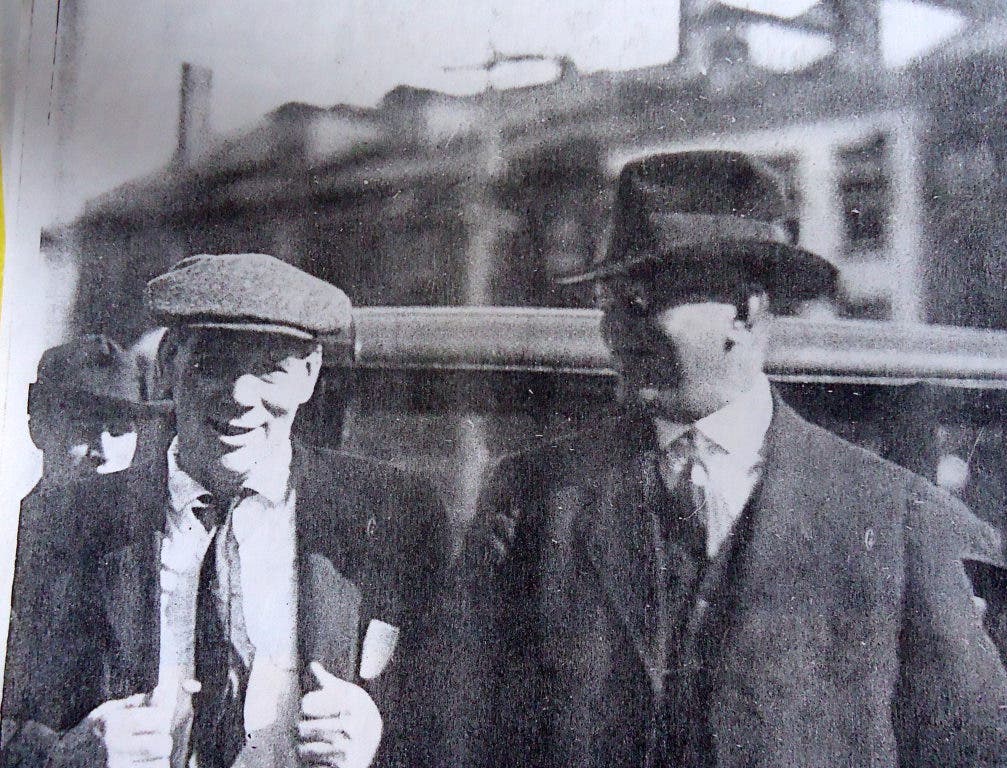

While doing research for the book on the history of Haddam (Portrait of a River Town, Greater Middletown Preservation Trust, 1984), I spent every day in Haddam for three years. I got to know the history of the town well and talked with many local residents. I thought of the place as home.
I picked up pieces of the story of Cremation Hill here and there… Schutte, murder, burning… However, the story from one person to another was never the same. Therefore, I devoted about a year researching what really happened! The funny thing is, the reality was so much more interesting than the myths.
The trial and subsequent hanging of Haddam’s own Emil Schutte for the murders of the Ball family of Haddam caused a sensation in Connecticut during the 1920s.
Find out what's happening in The Haddams-Killingworthfor free with the latest updates from Patch.
Born on December 4, 1867, Emil Schutte was 20 years old when he arrived in New York from Germany, possibly the Saxony region, on October 1, 1887. Seven years after he arrived, Marie J. (maiden name unknown) emigrated from Germany, and they were probably married soon afterward. Marie Schutte was 10 years younger than Emil, only 17 years old when she came from Germany to New York. One account described her as kind looking woman, with dark hair and eyes, and slender.
Emil and Marie Schutte had seven sons. Their eldest, Walter, was born in New York in 1898. The other six boys were all born in Connecticut: Julius in 1899, William in 1902, Rudolph in 1904, Emil R. in 1906, Gustav in 1908, Herbert in 1912, and Wilson in 1915. By 1908 the Schutte family was living on the Middlesex Turnpike, in the Shailerville section of Haddam just north of the Baptist Church, and Emil was the owner of his own farm. By 1918, Emil also operated a grocery store on the property. By 1920, a gasoline pump in front of the house provided the increasing automobile traffic on the turnpike with a place to fill up. A small shed adjacent to the house advertised that Schutte also sold grain, hay, and feed supplies.
Find out what's happening in The Haddams-Killingworthfor free with the latest updates from Patch.
Schutte did well, financially. He had some powerful friends in Middletown. However, he was not well liked. It may have been his German heritage at a time when America was at war in Europe, but most likely, it was his shady dealings. He’d had at least two lawsuits that he lost related to selling land that either he didn’t own or that he misrepresented. He threatened those who filed against him.
I had the great fortune in 1990 to interview an elderly Haddam resident who remembered the Schutte family. William Meyers was born in 1903 and grew up on Walkley Hill Road in Haddam center. His father was a butcher and did odd jobs for a wealthy neighbor. Meyer attended the small school across from the Brainerd Library with William and Rudolph Schutte. Meyer recalls that Emil Schutte was a scary man, with only a faint German accent.
Meyers saw Mrs. Schutte as a “little old lady,” although Marie was not yet forty years old.
It was clear, Meyers said, that Marie Schutte was terrified of her husband and worked like a slave in the store and on the farm. He referred to the Schutte children as “different.”
Meyer remembered clearly one visit to the Schutte store in about 1915. His father had gone to the Dickenson place on Plains Road to butcher a pig. After killing the animal, cleaning and hanging it to drain, they headed to Schutte’s to pick up some supplies. While his father was in the store, William wandered out back and saw Gustav Schutte, who was known as Gussie. With William as his audience, Gussie grabbed a live chicken, ripped off its head and began to eat the struggling fowl.
It was Julius, however, who seemed to suffer the most from his father’s temper. Even Meyer knew that Julius was beaten more often than any of the Schutte children. Julius Schutte told authorities that when he left for the Navy in 1916, his father’s parting words were, “Go, and may the first bullet that comes along strike you dead.”
Emil Schutte’s life began to unravel on Wednesday, May 18, 1921. On the evening of that day, Marie and Emil argued about some land that Emil had put in Marie’s name. Evidently, some years earlier, most of Emil Schutte’s land holdings had been transferred to his wife to protect them from any lawsuit that might risk his investments. On the advice of her sons, Marie Schutte resisted signing over the property to Emil on that Wednesday, and he threatened her with a revolver. When she ran to her son Walter’s house nearby, Walter came to her defense and fired a shotgun over his father’s head. The family, in support of their mother and in fear of their lives, had Schutte arrested. With their father in custody, the sons finally blurted out the past sins of their father.
Within three days of Schutte’s arrest for threatening his wife, he was a suspect in four murders, and authorities were looking for links between Schutte and several local disappearances and arson fires. Police investigations, however, concentrated on the disappearance of Dennis LeDuc in April of 1921, and the deaths of Joseph Ball, his wife, and their son in 1915.
For the next two or three months, the state police, the Middlesex County sheriff’s office, led by Sheriff Burt Thompson, and the state’s attorneys office worked to piece together a case against Emil Schutte. Schutte’s own sons provided most of the incriminating information.