Arts & Entertainment
Return Jonathan Meigs: Revolutionary War Hero
Middletown native with odd first name served with distinction after the war as well
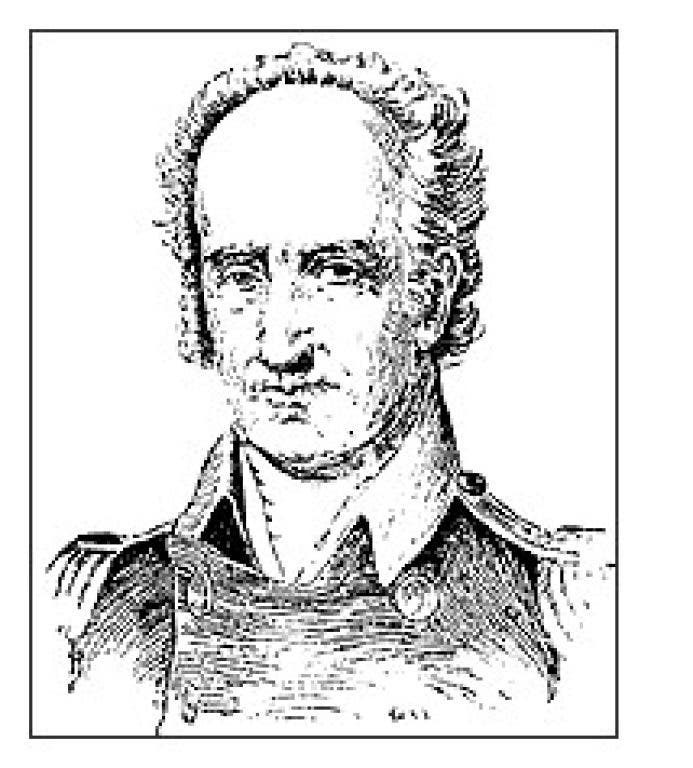


The Beer’s 1885 History of Middlesex County was published on the 250th anniversary of the founding of Connecticut and is full of interesting anecdotes of Connecticut’s past. Among the more interesting stories detailed in that history is that of Colonel Return Jonathan Meigs—pronounced so as to rhyme with “eggs”-- during the American Revolution. One of 13 children, he was born in Middletown on December 17, 1740, and died in Tennessee on January 28, 1823, 188 years ago this week.
Meigs joined the local militia at an early age and by the time he was 34, he had advanced to the rank of captain (1774). Following the fighting at Lexington and Concord on April 19, 1775, Meigs led a contingent of light infantry to Boston to join the newly formed Continental Army and was soon promoted to major of the 2nd Connecticut Regiment. Later, in 1775, Meigs became a divisional commander under Benedict Arnold and accompanied him on his march to Quebec. During the 63 day journey to Quebec, Major Meigs kept a detailed diary of the expedition, which was subsequently published and remains in print to this day. The British captured Meigs during the assault on Quebec. He was later paroled by a British commander named Carelton as a goodwill gesture for his humane treatment of one of Carleton’s adjutants. Meigs soon returned to the Middletown area to embark on his most famous exploit of the war.
In May of 1777, Colonel Meigs set out on one of the most remarkable raids of the Revolutionary War. He led a contingent of nearly 200 men in whaleboats across Long Island Sound to attack British forces at Sag Harbor, NY in a reprisal raid for a recent British attack on Danbury. The Meigs-led raid succeeded in destroying 12 British ships, burning many supplies, killing several Loyalists, and capturing 90 as prisoners. Remarkably, Meigs’s raiding party did not lose a man. Meigs’s raiders departed from Guilford—his ancestral home—and rowed across the Sound. They portaged their boats over a section of North Fork in Suffolk County in an area now known as Hashamomuck Beach. Following a route from Southold Bay to Shelter Island Sound, they arrived in Sag Harbor around 2 a.m. to burn the British ships. They then stormed a British fort on a hill near the Old Burying Grounds at Southampton (see photo). It was a “silent” attack done with fixed bayonets. The 90 prisoners were brought back to Connecticut.* The raiders covered 90 miles by sea and land in a 25 hour period and didn’t lose a man—simply remarkable. For his daring and heroic action, the Second Continental Congress cast Colonel Meigs a commemorative sword. He was subsequently appointed full colonel of the 6th Connecticut Regiment by Governor Trumbull. In 1779, Meigs served with distinction in the Battle of Stony Point—on the Hudson near West Point-- under the command of General “Mad” Anthony Wayne.
Find out what's happening in The Haddams-Killingworthfor free with the latest updates from Patch.
Following the war, Meigs remained in Middletown where his family owned a hattery shop on the south end of Main Street (see photo--lower right). He then set out for southeastern Ohio where he was instrumental in establishing the town of Marietta—named in honor of Marie Antoinette. In 1801 Meigs was appointed to be an Indian agent among the Cherokees in Tennessee. He continued to help the Cherokees until his death in 1823. So well respected was Meigs among the Cherokees, that he was given the name “The White Path.” Historian H.T. Malone commented on the good fortune of the Cherokees to have had Meigs as their agent:
Fate smiled on the Cherokees in 1801 with the appointment of Return Jonathan Meigs as Indian Agent. A seasoned frontiersman, Meigs had a thorough knowledge of the Indians and a deep sympathy for their problems. Sensible, just, firm, and above desire for personal gain, the new agent devoted himself to promoting the well-being of the Cherokees. Diplomatic in spite of his rough background, he ably served his government, successfully dealt with state authorities, and generally gained the confidence of Indians. After the confusion of frontier crises Colonel Meigs was a stabilizing force in a crucial period of Cherokee history.**
Find out what's happening in The Haddams-Killingworthfor free with the latest updates from Patch.
According to Meigs family historian, Rick Meigs, the unusual name of “Return” has occurred in the Meigs family at least 13 times. The family seemed to have a penchant for choosing odd names for their offspring: some of the other odd Meigs family names include “Silence” and Submit”—for twins; other names given were “Thankful,” “Concurrence,” “Mindwell,” “Recompense,’ “Wait-still,” and “Church.”***
Commended by none other than George Washington for his service during the American Revolution, author of the definitive history of Arnold’s ill-fated raid on Quebec; one of the few granted a commemorative sword by the Continental Congress for leading one of the most daring and successful raids of the war; instrumental in establishing the town of Marietta, Ohio, and, finally, way ahead of his time in his humane treatment of American Indians, the life and achievements of Return Jonathan Meigs should be more widely known and celebrated than they are.