Community Corner
Ali: Patch Editor Reflects On A 1989 Chance Interview And Lessons Learned From The Champ
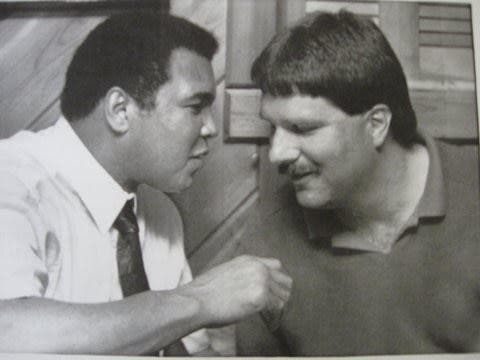
Ali was his talkative self during a visit to Connecticut in 1989.


It was late Friday night, and the finishing touches were being placed on the weekend’s statewide feature story about a boy who turned a tumultuous time in his life into something good.
And then the news broke.
Ali had died.
Find out what's happening in Vernonfor free with the latest updates from Patch.
My thoughts immediately turned to another deadline night in 1989.
I was in the middle of a high school lacrosse story in the Greenwich Time newsroom when the phone rang. The sports editor grabbed it.
Find out what's happening in Vernonfor free with the latest updates from Patch.
Muhammad Ali was in town, he was told, dining at Manero’s steakhouse. His host, a resident who was a lawyer for the Nation of Islam at the time, was inviting us to spend a few minutes with The Champ. He said he liked our sports coverage and figured we would like a nice story on The Champ.
I finished the lacrosse story, made my way down the hill from Greenwich Avenue to Steamboat Road and to Manero’s. I popped my head into the main dining room, and the aroma of the garlic bread and the famed Gorgonzola salad and the sound of the singing waiters, usually captivating, took a back seat to the site of Ali holding court in the center of a large table.
The host motioned that the group was still eating dinner, and I sat down to wait until everyone finished. About 20 minutes later, he came over, indicated dessert was being served and brought me to a chair next to Ali. I sat down.
At first, Ali did not acknowledge my presence - he was in the middle of a conversation. That seemed to be consistent with his actions on TV - he always finished with one person before he moved on to the next.
He then turned.
"OK, what do you want to know?"
"Anything you want to tell me, Champ."
"I'll tell you this," he said."If George Foreman fought Mike Tyson he would knock him out." At first, it sounded like Ali was playing the role of wily old veteran making jokes about the new era of fighters not measuring up to his generation of fighters. But one could quickly tell he was serious. He was in the mood to talk boxing, and he thus proceeded to break down a potential contest, round-by-round, that ended with a Foreman KO.
It was as comfortable an interview as I have ever experienced, and it was Ali. He then lightened the moment even further with the old “What do you do at a red light...” joke. We were laughing, nose-to-nose, and Greenwich Time photographer Steven Daniel captured the moment. The picture hangs in my dad’s living room.
I’ve never been in awe of celebrity throughout my 30-plus years as a journalist, but that night there was a presence in the room - an aura I had not felt up to then and have not felt since. Ali had already made the decision to forego his Parkinson’s medication to keep his energy and his schedule. The path from the brain to the mouth was no longer a highway, but it was Ali, the world’s ambassador who gave the child in an African village the same attention as a U.S. senator. He was still the old Ali, just a little more mellow.
Ali transcended sports to social awareness in a time when the country needed it - and the flashback to 1989 made me think on how he did it. We have become used to the celebrity selfies and the self-serving Tweets. Obviously, Ali didn’t have the technology, but he would not have needed it. He visited people, worked with people, made people aware that the world can be a better place with a little creativity and thinking.
The boy in the story on the screen didn’t know it, but it was almost like he had taken a lesson from Ali.
A few years after the Ali interview, I was having a conversation with a civil rights and social historian who had just come back from the Million Man March. He said to put everything in the context of 300 years of U.S. history when discussing how far we have come.
And Ali, from 1942 until 2016, was in that context as a living testament to how things are and ought to be and now will be forever a memory along the same lines.
Ali will be laid to rest this week. Thanks for the memories, and the life lessons, Champ. I am not sure we will ever encounter someone like you again.
Ali looked adversity in the face, stared us all down - like that moment in the center of the ring with the referee right before a fight - and told us the way things ought to be. He did make the world a better place with punches, both real and metaphorical, whose sting will stay with us forever.
Photo Credit: Steven Daniel/Greenwich Time via Chris Dehnel's personal collection
Get more local news delivered straight to your inbox. Sign up for free Patch newsletters and alerts.