Community Corner
Connecticut Civil War Monument Is A Textbook Of Major Battles, Sacrifices
It's Memorial Day every day at Mt. Hope Cemetery.




Editor's Note: Each weekend, Patch will share a story sparking conversations beyond one town.
VERNON, CT - One of the best-kept secrets in this part of Connecticut also happens to be a significant contribution to history.
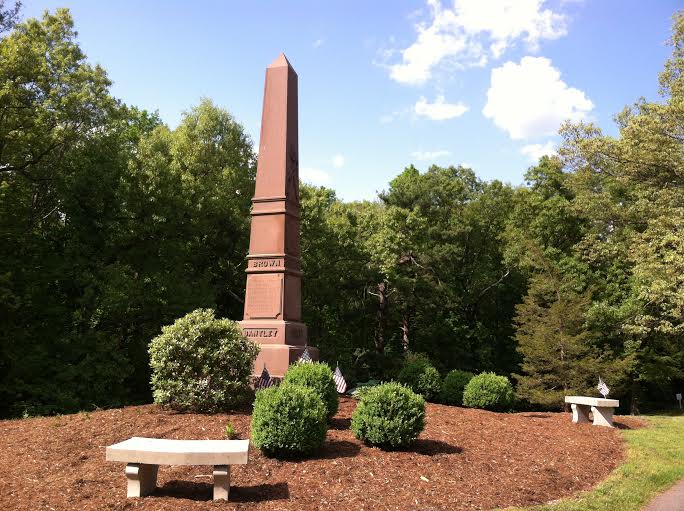
It’s a three-dimensional textbook, a Civil War monument that depicts several major aspects of a major American chapter.
Find out what's happening in Vernonfor free with the latest updates from Patch.
But just finding it is half the battle.
"It's so well hidden that even I did not know it existed until I starting helping decorate the Civil War veterans graves in the cemetery," said Matthew Reardon, the director of the New England Civil War Museum, also located in Vernon. "It's really Vernon's first Civil War Monument, predating the Memorial Hall (at town hall), where the museum is located, by over 20 years."
Find out what's happening in Vernonfor free with the latest updates from Patch.
The New England Civil War Museum is on the second floor of Vernon’s town hall in a fully preserved Grand Army of the Republic hall. The monument is about 4 miles from the museum through the Rockville section of town, then down Route 83, in Mt. Hope Cemetery. It is a sanctuary tucked in a corner of the Talcottville section of town, an area just over the Manchester line whose roots run deep in the town's heyday of manufacturing.
Civil War connections were made early-on. According to Vernon HIstorical Society member Jean Luddy, old John Brown found himself in a bit of hot water well before Harper’s Ferry. Brown was a wool buyer and had used transaction money from some mill owners for a personal real estate endeavor in anticipation of paying it right back, only to fall a little short. In one apologetic letter sent to Vernon in 1939, he signed off "unworthily yours" while promising to send back anything fronted to him.
"Talcottville is section of town - a village - that is a rich part of our history," Vernon Historic Properties Commission Chairman Robert Hurd said.
The Talcott family owned one of the mills and in 1867, right after the war, set up a cemetery tucked into a corner of the village near what is now 100 Main Street. Trouble is, the tucking was done so well it can take several swoops in a car to figure out where it is, even though a historical marker designates the spot.
"I drove by it at first," joked local historian Jon Roe. Roe said an archway had been present at one time. No one can document when it went missing, but Roe said after one turns off Route 83 and onto Main Street, look for a historical marker right near the mailbox for 100 Main St.
The driveway to Mt. Hope runs between two houses, then opens up to green pastures, rolling hills and monuments — a lot of monuments.
Second Oldest in the Nation?
And one monument stands out — the Civil War memorial, erected in 1869. At one point, it was rumored - and even considered - to be the second-oldest in the nation. But over the past couple of years, local historians have backed off subscribing to that claim.
"We have never been able to determine that for sure," Roe said. "But we know one thing - the names there were involved in a lot when it came to the Civil War."
Reardon said the contention that is was the second-oldest in the U.S. "seems to be speculation" that took on a life of its own over the years.
One thing is for certain, Reardon added, the soldiers whose names appear on the stone structure represent a Civil War textbook from the bloodiest day in American history to the most infamous prison camp in the conflict.
Here is a look at who is on the monument:
• Capt. Frank Stoughton, Company D, 14th Regiment, Connecticut Volunteers. He's the ranking soldier on it and he died on Jan. 1, 1866. As an officer, it is amazing he lived for nine months after Robert E. Lee's surrender at Appomattox.
The regiment was involved in 34 major battles and skirmishes, and there is a display noting its record of service on a wall at the New England Civil War Museum.
The battles the 14th fought include Antietam, Fredericksburg, Chancellorsville, Gettysburg, Bristoe Station, The Wilderness, Spotsylvania and Cold Harbor.
"They went practically through the entire war, from Antietam to Appomattox," Reardon said of the men of the 14th. "Their first year was especially brutal. They went from about 1,000 men in September 1862 at the Battle of Antietam to a little under 200 by July 1863 at the Battle of Gettysburg."
• Horace Hunn, Company B, 16th Regiment, Connecticut Volunteers. Hunn died in a hospital in Maryland on Oct. 12, 1862, two days shy of a month after the Battle of Antietam. According to a feature on the monument on stonesentinels.com, the regiment engaged 779 soldiers and suffered 43 killed and 161 wounded at Antietam.
• Philip Foster, Company B, 16th Regiment, Connecticut Volunteers. Foster died at the Battle of Antietam on Sept. 17, 1862, considered the bloodiest day in American military history. The Civil War Trust places the casualty total at 22,717 as 87,000 Union troops slugged it out with 45,000 Confederates.
• Henry Loomis, Company B, 16th Regiment, Connecticut Volunteers. Loomis drowned in the Potomac on April 24, 1865. It was a day when troops were dispatched up and down the river in search of Abraham Lincoln's assassin, John Wilkes Booth. Booth was located and killed by Federal troops two days later.
• Alonzo Hills, Company B, 16th Regiment, Connecticut Volunteers. Hills died in a Charleston, SC, prison camp on Oct. 6, 1864. In April 1864, the 16th was defending the garrison at Plymouth, NC, and, vastly outnumbered, was forced to surrender.
• James Bushnell, Company B, 16th Regiment, Connecticut Volunteers. Bushnell died on Nov. 15, 1862, nearly two months after Antietam. The troops had loaded their muskets for the first time the day before the battle.
• Orrin Brown, Company A, 106th Regiment, New York Volunteers. Brown died of typhoid fever on April 22, 1863, according to a history of the regiment on dam.ny.gov. Disease ravaged the troops during the war.
• Francis Brantley, Company H, 6th Regiment, Connecticut Volunteers. Brantley died at the notorious prison camp in Andersonville, GA. He was one of about 45,000 who perished there because of disease, starvation and abuse.
Other wars are represented at the cemetery, but the Civil War monument is the largest.
"The monument is probably my favorite historical place to visit here," Roe said. "I will grab a coffee, go out to the cemetery in the morning when it’s quiet and just look around. There is a lot of history on it."
He paused and laughed a bit.
“Now that I know how to find it.”
Get more local news delivered straight to your inbox. Sign up for free Patch newsletters and alerts.