Business & Tech
From Yale to Wallingford: A Food Business That Promotes Local, Sustainable Eating
Sustainable Food Systems LLC, a Wallingford business that once provided consulting chefs for ABC's "Jamie Oliver's Food Revolution," has made it his mission to promote healthy, sustainable food to schools and organizations.
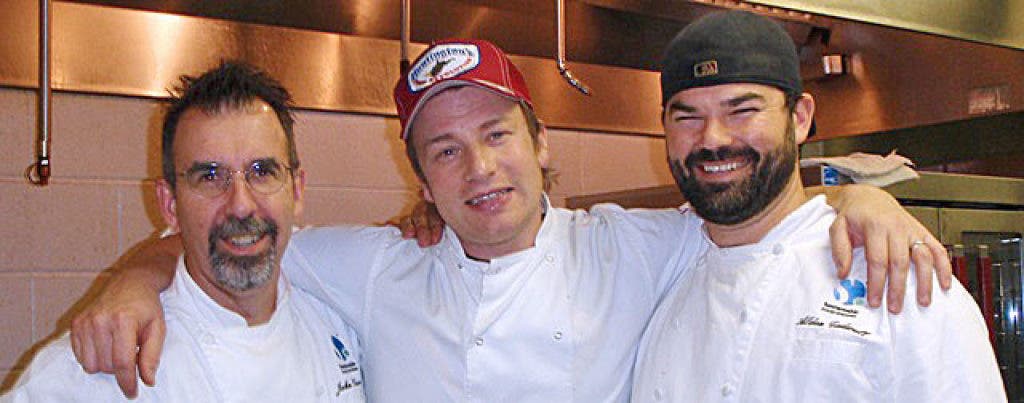


John D. Turenne, president and founder of Wallingford-based Sustainable Food Systems LLC., recalls his reaction when, as executive director of Yale University’s dining service in 2001, he learned one of Yale’s colleges was switching its menu to sustainable foods.
“As I went through the process of understanding what sustainable food is, my eyes opened,” he said of the locally grown and ecologically conscious foods.
“Social issues, farm animals, farm workers, the local economy, the health of my customers, the environment,” he said. “My life-changing reaction was, ‘Oh, wow, we have to get this right.’”
Find out what's happening in Wallingfordfor free with the latest updates from Patch.
Sustainable food began its most recent incarnation around 1971, when Alice Waters opened the restaurant Chez Panisse in Berkeley, Calif. Her dedication to fresh, ecologically solid food took a fast track to Connecticut in 2001, when her daughter Fanny enrolled at Yale University. Shortly after Fanny arrived, the university launched its Food Sustainability Project. Waters served on the steering committee and Turenne was tasked with figuring out an institutional shift to sustainable foods.
Shift to sustainable foods Turenne did. In 2005, the man who moved to Wallingford to serve as director of food services at Choate Rosemary Hall founded his consulting business, Sustainable Food Systems LLC.
Find out what's happening in Wallingfordfor free with the latest updates from Patch.
“One of the big and fun jobs that we’ve had — we were the consulting chefs on an ABC television show called “Jamie Oliver’s Food Revolution,” he said. The program, which aired in 2010 and 2011, saw the British chef take his campaign for healthy food to the school district in Huntingdon, WV.
“We had to help them understand what U.S. food was all about, what kind of recipes would fly with kids in America, what would meet USDA guidelines .
“Working on a reality television was quite eye-opening,” Turenne said.
Currently, he finds himself facing a different challenge as he introduces healthy foods into the far less socioeconomically challenged Fairfield school district.
“These younger kids are used to highly salty food. Junk food. Not braised greens and chicken season salad wraps,” he said. “How do we maximize and leverage my presence there to get the kids and parents to realize, ‘let’s buy this food?’ Let’s face it, school food is a business. If kids aren’t going to buy, the menu is going to fail.”
To market food that is cooked from scratch to students who, unlike the students in West Virginia, do not qualify for the government’s free lunch program, Turenne has begun standing in a school dining room each day with a microphone.
As he put it, he is “screaming and trying to get them to realize that good food is cool. ‘It’s cool to look good and feel right, which is what good food will do to you,’ . . . he said he tells the students.
Turenne said that 60-70 percent of his business comes from school districts. Yet his campaign for sustainable foods also extends into the hospital, higher education and corporate sectors. In the corporate sector, he concedes that some interest is driven by the cost of health care insurance.
Still, in all sectors, he finds himself walking “a fine line” between food that is healthy and food that the public will choose to buy.
With Thanksgiving imminent, the sustainable foods guru was pressed into offering some advice for the holiday. He suggested that celebrants prepare the entire menu on Thanksgiving day from locally sourced food.
He noted that the Connecticut Department of Agriculture lists all farmers’ markets, and that many are still open.
“Carrots, squash, potatoes, even turkeys,” he said. “Support your local farmers.”
“On a more spiritual note,” he continued, “as you sit down to real food, just be mindful of everything you eat and the impact that food has on everything around us. We can impact our environment and our local economies. Be mindful of the food you eat and its impact on the planet."