Kids & Family
Sep 17th, 1787: U.S. Constitution signed! 1862: Battle of Antietam! 1886: Hartford's Soldiers & Sailors Arch Dedicated!
Connecticut's Troops, All Gave Some, Some Gave All!


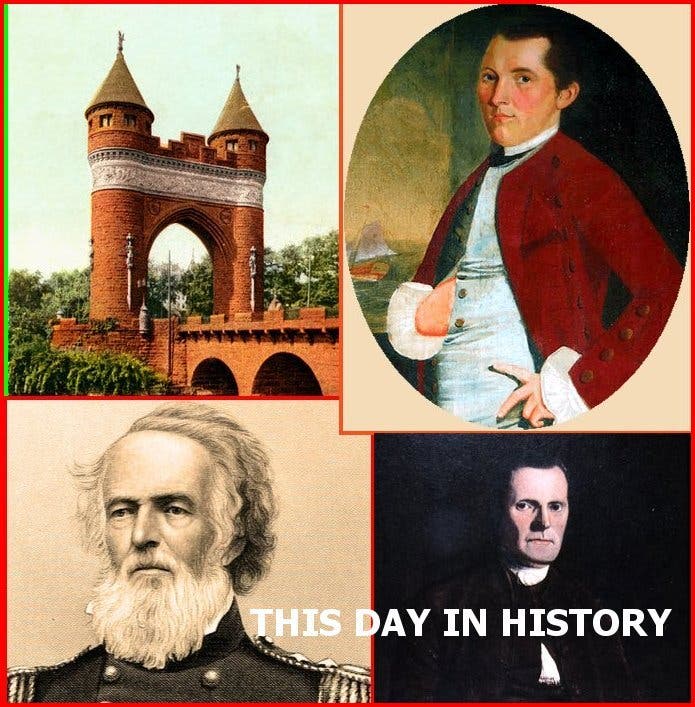
A CONNECTICUT HISTORICAL DAY:
Sep 17, 1862: Battle of Antietam:
Beginning early on the morning of this day in 1862, Confederate and Union troops in the Civil War clash near Maryland’s Antietam Creek in the bloodiest one-day battle in American history.
When fighting began in the foggy dawn hours of September 17, this strategy broke down into a series of uncoordinated advances by Union soldiers under the command of Generals Joseph Hooker, Connecticut’s Joseph Mansfield and Edwin Sumner. As savage and bloody combat continued for eight hours across the region, the Confederates were pushed back but not beaten, despite sustaining some 15,000 casualties. At the same time, Union General Ambrose Burnside opened an attack on the Confederate right, capturing the bridge that now bears his name around 1 p.m. Burnside’s break to reorganize his men allowed Confederate reinforcements to arrive, turning back the Union advance there as well.
By the time the sun went down, both armies still held their ground, despite staggering combined casualties--nearly 23,000 of the 100,000 soldiers engaged, including almost 4,000 dead including General Mansfield.
Sep 17, 1787: U.S. Constitution signed:
The Constitution of the United States of America is signed by 38 of 41 delegates present at the conclusion of the Constitutional Convention in Philadelphia. Supporters of the document waged a hard-won battle to win ratification by the necessary nine out of 13 U.S. states.
The Articles of Confederation, from 1779 to 1781, ratified several months before the British surrender at Yorktown in 1781, provided for a loose confederation of U.S. states, which were sovereign in most of their affairs. Altogether six drafts of the Articles were prepared before Congress settled on a final version in 1777. Benjamin Franklin wrote the first and presented it to Congress in July 1775. It was never formally considered. Later in the year Silas Deane, a delegate from Connecticut, offered one of his own, which was followed still later by a draft from the Connecticut delegation, probably a revision of Deane’s. President of the Continental Congress Connecticut’s Samuel Huntington signed it into law.
On paper, Congress--the central authority--had the power to govern foreign affairs, conduct war, and regulate currency, but in practice these powers were sharply limited because Congress was given no authority to enforce its requests to the states for money or troops. By 1786, it was apparent that the Union would soon break up if the Articles of Confederation were not amended or replaced. Five states met in Annapolis, Maryland, to discuss the issue, and all the states were invited to send delegates to a new constitutional convention to be held in Philadelphia.
On May 25, 1787, delegates representing every state except Rhode Island convened at Philadelphia’s Pennsylvania State House for the Constitutional Convention. The building, which is now known as Independence Hall, had earlier seen the drafting of the Declaration of Independence and the signing of the Articles of Confederation. The assembly immediately discarded the idea of amending the Articles of Confederation and set about drawing up a new scheme of government. Revolutionary War hero George Washington, a delegate from Virginia, was elected convention president.
During an intensive debate, the delegates devised a brilliant federal organization characterized by an intricate system of checks and balances. The convention was divided over the issue of state representation in Congress, as more-populated states sought proportional legislation, and smaller states wanted equal representation. The problem was resolved by the Connecticut Compromise, which Roger Sherman proposed a bicameral legislature with proportional representation in the lower house (House of Representatives) and equal representation of the states in the upper house (Senate). Roger Sherman was the only person to sign all four great state papers of the U.S.: the Continental Association, the Declaration of Independence, the Articles of Confederation and the Constitution. Thomas Jefferson said of him: “That is Mr. Sherman, of Connecticut, a man who never said a foolish thing in his life.”
Find out what's happening in West Hartfordfor free with the latest updates from Patch.
Sep 17, 1886: Hartford’s Soldiers & Sailors Arch Dedicated:
SOLDIERS AND SAILORS MEMORIAL ARCH is located on the northern edge of Bushnell Park in downtown Hartford. It is a brownstone and terra-cotta structure in the form of a Gothic arch between two medieval towers joined by a classical frieze. The arch is dedicated to all men from Hartford who served in the Civil War.
When constructed, the arch was at the southern end of a pre-existing bridge over the Park River. The Park River is now underground, but the roadway of the bridge and its parapets are still in place, barely visible, and still in use as a street.
The familiar Civil War monument symbols identifying the four services are in the spandrels of the Gothic arch, anchor for navy and crossed cannon for artillery on the north, crossed sabers for cavalry and crossed rifles for infantry on the south. Bushnell Park, Hartford, is significant historically because it is a tangible symbol of the honor and respect paid by the City of Hartford to its men who served in the Civil War. It is one of the earliest monuments in Connecticut to use the term Civil War in its lettering.