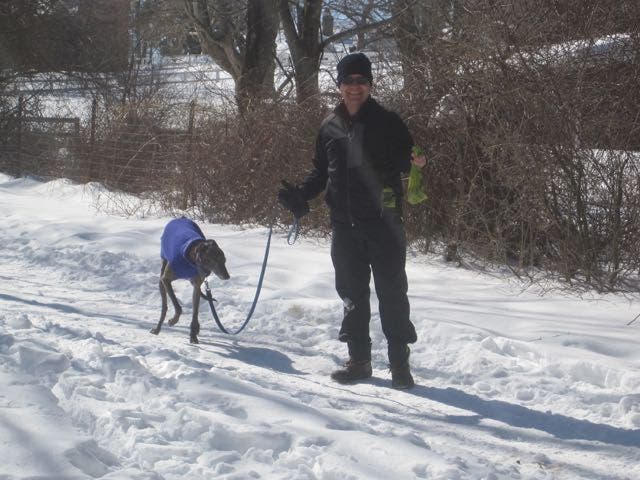

Why does it appear that dog walkers are more lax about picking up dog poop in winter? And why should they not be?
In all seasons, traversing the trails of Huntington Park is a pleasure. But beware, this winter, both on and off the trails are mounds of dog poop.
One has to question: Do dog walkers who usually pick up the poop neglect this courtesy in winter because they think it will melt along with the snow? Do they think picking up some snow in the plastic bag along with the poop, makes it heavier to carry? Do they want to keep themselves and their dogs moving to avoid frostbite?
Find out what's happening in Weston-Redding-Eastonfor free with the latest updates from Patch.
A responsible Redding dog walker makes sense of it: In the warmer months, many dogs run into the woods off trail to perform their duty and most walkers don’t follow along to pick up the poop: out of sight, out of mind. But in winter, when the snow is deep, dogs prefer to poop close to the trails. And that is why there appears to be more poop in winter, this winter especially.
But, to many of us trail-users, nothing justifies the negligence of dog walkers who leave poop on or off the trail. The Connecticut Department of Energy and Environmental Protection (DEEP) says: “Pets on a leash are permitted in most state parks and forests. Owners must remove and properly dispose of pet waste left by the pet...”. Beyond the obvious safety issues, a leashed dog stays within sight so the walker can pick up the poop when and where it happens.
Find out what's happening in Weston-Redding-Eastonfor free with the latest updates from Patch.
The statewide regulations address safety and also strive to protect human and environmental health. The DEEP writes: “Dogs are our best friends, and their “poop,” just like ours, can be a health risk and source of pollution to our rivers, lakes and coastal waters if not properly managed. Bacteria (such as E. coli) and parasites found in dog waste can threaten public health... The nutrients in pet waste, notably nitrogen and phosphorus, make their way to ponds, lakes and streams. This can encourage weed or algae growth in the waterways, which may eventually lead to lower oxygen levels. Insufficient oxygen can harm fish and other organisms that live in the water.
Surface run-off to waterways contains many pollutants but it may be surprising that dog waste has been identified as a primary bacterial pollutant. Using genetic tracking, researchers determined that almost 20% of the bacteria in a Seattle area watershed could be matched with dogs. Other studies conducted throughout the country indicate that non-human waste represents a significant source of bacterial contamination in urbanized watersheds.”
Most of Redding is a watershed and most Reddingites rely on wells as a water source.
We can all help preserve our Parks and open lands and their water bodies with the responsible use of Redding’s vast and wonderful trail system. If you see a dog walker who hasn’t picked up their dog’s poop, please say something.