Arts & Entertainment
'Will My Kid Be Homeless if He Doesn't Go to Yale?'
Weston Youth Services hosted a community forum to discuss the local implications of grassroots film "Race to Nowhere."
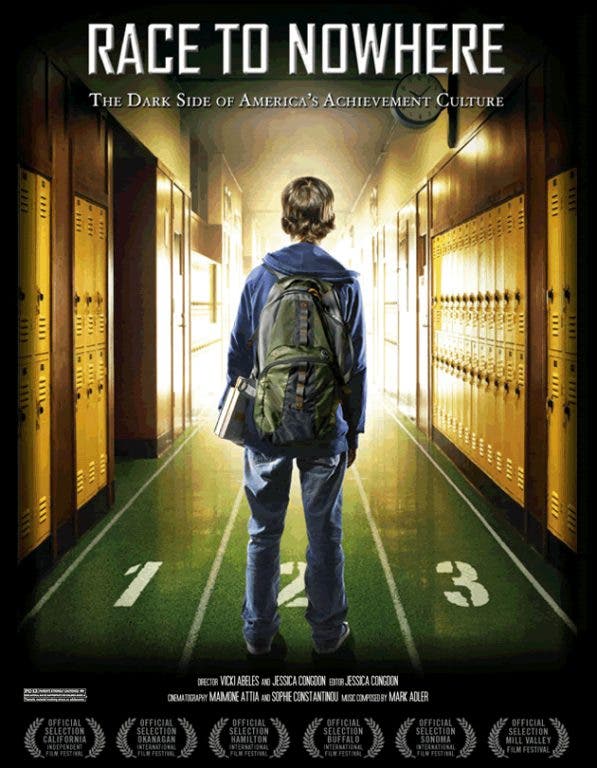
In response to the recent screening of grassroots film , Kristen Ferrara of Weston Youth Services and counselor Barbara Levy Berliner hosted a community forum on Monday evening to help local parents manage student stress from schoolwork and extracurricular activities.
The film, which has played to sold-out audiences nationwide, was one California mother's undertaking after her daughter was diagnosed with a stress-induced illness. In a sad coincidence, one student at her daughter's school committed suicide during the filming, apparently the result of a failed math exam.
Berliner, a Weston resident and therapist, was on hand to give advice and direction to parents.
Find out what's happening in Weston-Redding-Eastonfor free with the latest updates from Patch.
Many parents in attendance noted that extracurricular activities last well into the evening hours, resulting in little time for schoolwork and no free time at all.
One mother commented, "I never know when to cut back," especially difficult when a child has a wide variety of interests and appears to want to do it all.
Find out what's happening in Weston-Redding-Eastonfor free with the latest updates from Patch.
Berliner advised parents to ask themselves, "what's the child's goal, and what's your own goal," she said. "Ask yourself, does this activity continue to make sense?"
Parents whose children participate in multiple sports and activities should consider cutting those back, Berliner indicated, especially if the activity isn't a long-term interest. One mother noted that although her daughter competes in gymnastics now, she would never permit her to compete at a collegiate level.
One resident noted that "parental narcissism" was the root cause. "If there wasn't homework assigned, parents would complain and find something else for [the child] to do," she said.
Others felt that the problem appears to be a result of the combined expectations of parents, schools and college admissions processes that are designed to produce a good secondary school resume instead of a whole child.
"Our box of what is acceptable is very small," Berliner commented. "Can you allow your child to be different? Can you allow the box to be bigger," she added, noting that kids should be encouraged to find their own way.
Parents should focus on "getting involved in the love of learning" — for example, completing an assigned reading alongside your student and then talking about the book — instead of just focusing on "the product of learning," she said.
"Talk about effort and progress," Berliner said, instead of the grade at the end.
Parents have the choice "not to 'buy in' to" the competitive nature of childrearing by bragging about their child's prowess at multiple sports, activities and academics, she continued.
"This isn't about you," she said firmly.
Many parents of high-school-age children had observed the "frenzy" of activity surrounding the college admissions game. One mother said that her son had asked that his college decision be kept private until he was ready to decide.
"We tell everyone, 'we're going to respect that decision,'" she said.
The best and easiest thing that every parent can do to lessen kids' external pressure is to "let the kid breathe," Berliner said.
"Don't ask them how they did in school that day immediately," she said, noting that kids, especially teenagers, "work hard [during school hours] to be the person they want to become.
"When they come home is when they crash, when they can really be themselves," Berliner added.
"Just relax and let it be," she advised. "When kids know you have faith in them, they thrive."