Community Corner
Historian: Town's Ties to Civil War Run Deep
Three years of research showed David Press that the town's history is closely tied to the Civil War.


Westport has its Minuteman statue on Compo Road South commemorating American Revolution patriots and its Doughboy statue honoring World War I soldiers at Veteran's Green.
But to find a monument to Westport's Civil War veterans you have to go to Gettysburg, Pa., as Westporter David Press did on a 3-year quest to discover the town's ties to the Civil War.
At Gettysburg, Press discovered that Connecticut Regiment 17, Company E, was made up of 100 men and boys mostly from Westport. The soldiers took positions on Barlow's Knoll in July 1863 to face the Confederacy - and beat a retreat to Cemetery Ridge in the wake of the fearsome Pickett's Charge. Westport's Ed Lees was among the wounded.
Find out what's happening in Westportfor free with the latest updates from Patch.
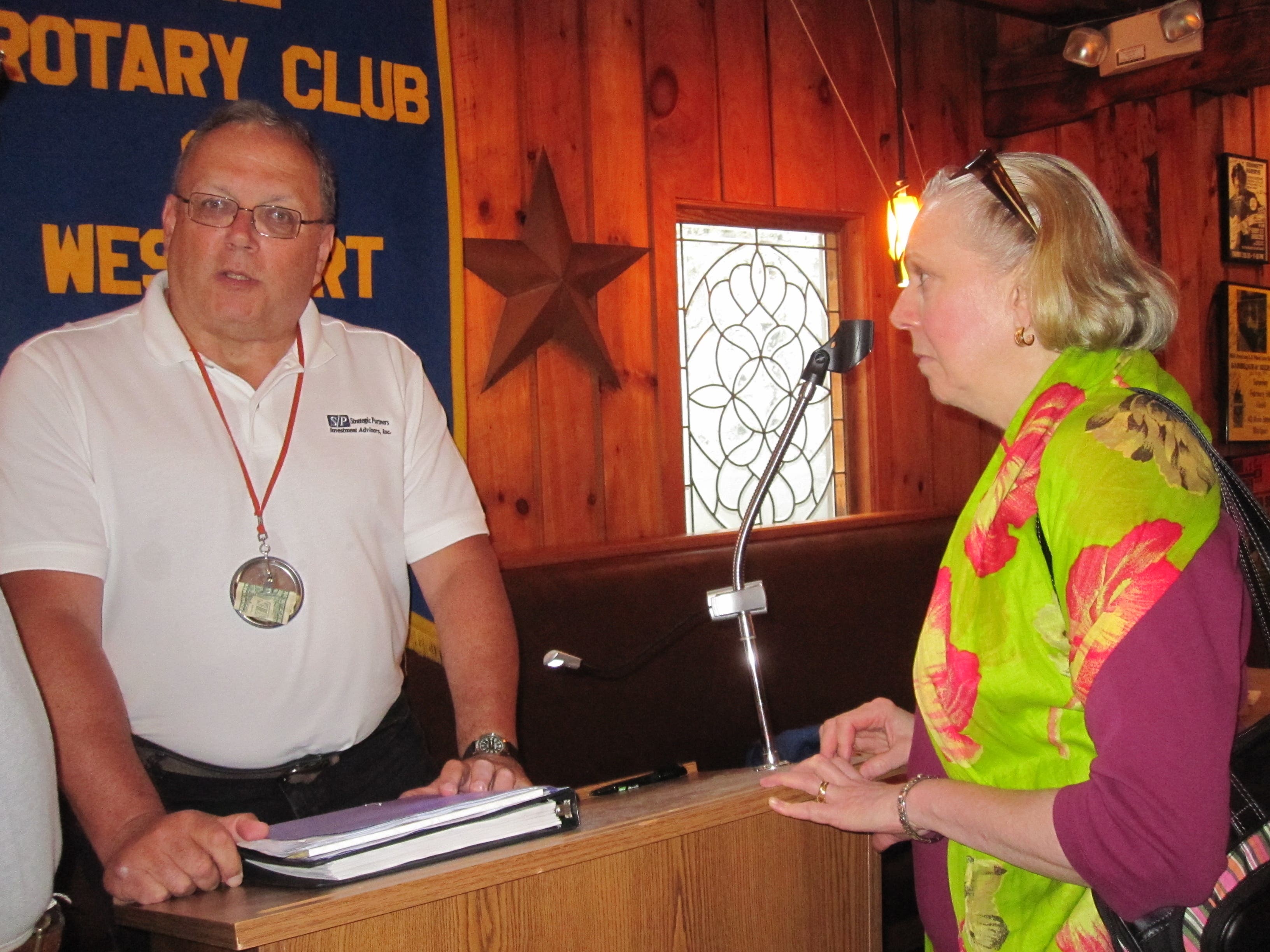
A monument commemorating the soldiers of the 17th Regiment stands at the quiet battlefield today, Press told a Sunrise Rotary Club breakfast gathering Friday at Bobby's Barbecue and Grill on Main Street.
All told, 220 Westport men and boys fought in the Civil War. Twenty-four did not return; casualties of combat or disease, according to Press. Many who returned became successful entrepreneurs during Westport's post-Civil War industrial heyday.
Find out what's happening in Westportfor free with the latest updates from Patch.
After more than three years of research, including tours of Civil War battlefields at Gettysburg and Chancellorsville, Va., and explorations of census records, the Sterling Library at Yale, National Archives, Pequot Library and many other sources, Press has prepared a draft manuscript which he would like to publish, possibly in conjunction with the Westport Historical Society.
Press shared highlights of his research during the breakfast talk and later, during an interview with Patch, explained that much of the information he collected from original sources had never been gathered before.
He emphasized that he was not the sort of Civil War buff who goes to battle re-enactments. The thrill of the quest for facts was what drove Press, a financial analyst and member of the Planning and Zoning Commission who went into a brief retirement to do his Civil War research.
The Westport of 1860 was mostly agricultural, with a population of 3,300 people and 400 farms, Press said. There were between 29 and 39 freed blacks living here, working as farm hands, servants, coachmen and barbers.
Like other northern towns built up along a river, Westport depended on the cotton crops grown in the south to feed its two cotton mills. There were also tanneries, blacksmiths and factories producing coaches and carriages.
In 1862, the call went out from the governor's office for volunteers to join the Union Army.
Westport coachmaker and gold rush adventurer Henry P. Burr petitioned the town meeting to appropriate $2,000 to pay $50 "bounties" to encourage enlistments for the Connecticut 17th Regiment.
Burr's Company E with 101 men were mustered in on August 28, 1862 and transported a month later to undergo training and defend Baltimore.
Passing through Manassas, Va., they saw the carnage of animal carcasses and soldiers' remains still left behind littering the landscape a year after the First Battle of Bull Run.
A Danbury soldier from of Company E wrote they had to eat food that pigs would have refused, but they ate it greedily.
Company E experienced the charge of Stonewall Jackson at the Battle of Chancellorsville on May 2, 1863, and saw hand-to-hand combat at Gettysburg.
Burr himself was taken prisoner and marched off to Richmond. He was later released and his Company E were sent to the barrier islands off the Carolina coast and then went home.
Meantime, Jonathan Chapman Taylor, a teacher living at 31 Turkey Hill Road, recruited a second company of principally Westport men to create Company C, part of the 28th Regiment.
They were dispatched to New Orleans to cut off supplies coming in from the west and to take Vicksburg and join the Fort Hudson siege. Taylor led a charge, was wounded and taken prisoner, but he eventually returned safely home to Westport by train.
Press related the little-noted fact that Civil War veterans commonly suffered from what we today call post-combat stress disorder from their wounds, shell shock and recollection of horrific events.
He discovered obituaries that left no doubt of suicides among returned veterans. Dead Man's Creek, which flows into the Saugatuck River near the Women's Club, is so named because the body of a Civil War veteran was deposited there, a presumed suicide, he said.
Westport's longest surviving Civil War veteran, Thomas Glynn, died on May 10, 1934. Glynn was a successful entrepreneur after the war, building a dam on Lee's Pond and founding the Aspetuck Lake Ice Company which sold ice to restaurants, hotels and food processors. He also built the breakwaters at Compo Beach and the foundations for the cannons there. Glynn resided at 499 North Compo Road.
Another colorful veteran was Rufus Wakeman, who started a successful hardware business near the present-day Mobil station in Saugatuck. He went on to build a factory at the site of the Mansion Clam House that manufactured mattresses and became the nation's leading makerof church pew cushions.
Many Westport veterans of the Civil War are buried at Willowbrook Cemetery on North Main Street and the Christ & Holy Trinity Cemetery on Kings Highway, Press said.
Although none of Westport's Civil War veterans was nationally known, one resident - Morris Ketchum - was known off the battlefield. He played a role in the decision by Treasury Secretary Salmon P. Chase to issue greenbacks during the Civil War, establishing a national currency for the first time.
It is said that Ketchum, a wealthy New York banker, entertained Chase at his 500-acre Westport estate, Hokanum, on Cross Highway.
Coincidentally, Katie Chase, the Historical Society's curator of archives, is married to William Chase, an indirect descendant Salmon Chase. She attended Press' presentation, as did Historical Society president Dorothy Curran and executive director Susan Gold.