Arts & Entertainment
JD Salinger's Westport Connection on Display
Intimate Salinger letters reveal a fondness for his Westport days.
Author J.D. Salinger forged a unique friendship with the commercial artist who created the iconic cover of his best-selling book The Catcher in the Rye when they both lived in Westport 60 years ago.
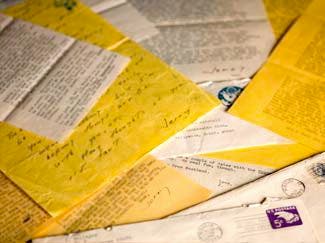
Details of the bond between the reclusive author and his artist friend, E. Michael Mitchell, have emerged with the Morgan Library & Museum's unsealing of 10 letters and cards Salinger wrote to Mitchell between 1951 and 1993. The collection went on public display this week at the Morgan, located on 225 Madison Avenue at 36th Street in New York City.
Salinger died at his New Hampshire retreat in January at age 91; Mitchell died in California the year before at age 89. Although there was no written agreement to such effect, the Morgan kept the letters under seal during Salinger's lifetime to respect his privacy. It's not known whether Salinger had any expectation they would remain private.
Find out what's happening in Westportfor free with the latest updates from Patch.
The intimate letters open a window into the heart and soul of the influential literary figure who so prized his privacy that he went to court to block publication of an unauthorized biography.
They also provide tantalizing clues about Salinger's writing habits and the possibility that he left a treasure trove of unpublished manuscripts at his death. He had not published a new work in decades.
Find out what's happening in Westportfor free with the latest updates from Patch.
The letters also hold a special meaning for Westport. They make frequent references to the brief time when Salinger and Mitchell, who was affiliated with the Famous Artists School that once was based here, were neighbors, wined and dined with each other and fed off each other's creativity.
The correspondence begins in the jaunty, irreverent voice of Holden Caulfield, the rebellious teenage narrator of The Catcher in the Rye, Salinger's breakthrough novel. It ends 42 years later with a strange, even melancholy single-paragraph note in which Salinger declines Mitchell's request to autograph a copy of Catcher for him.
That refusal may have ended the friendship from Mitchell's side, for soon he sold off the 10 letters, some typed and others hand-written, to a rare letters dealer in California. They were gifted to the Morgan in 1998.
In the earliest letter in the exhibit, Salinger wrote Mitchell giddily from London in 1951 as the overnight publishing sensation who was invited to dine with Laurence Olivier and Vivien Leigh after attending their performance in "Antony and Cleopatra."
Of the production, he wrote:
"[It was] very good, very pure. The audiences here are just as stupid as the ones in New York, but the productions are much, much better."
As for the theatrical super couple, he wrote in the easygoing, colloquial Caulfield style:
"Olivier is a very nice guy, very bright. He's knocked out about his wife, which was nice to see. She's a charmer. ..."Miss you both (Mitchell and his wife Esther, referred to as "Bet" and "Bett" in the letters) like hell. I've had a couple of dates with a Vogue model I met on the ship. No real fun, though."
Five years later, Mitchell and "Bet" were riding in the back seat of Salinger's en route to Bradford, VT, in a February sleet storm to serve as witnesses at Salinger's marriage to a 22-year-old Radcliffe drop-out.
Salinger, then 36, was eloping with his bride, Claire, because of her family's disapproval of the relationship.
Claire was the "Franny" of a short story by that name Salinger published in The New Yorker in 1955, according to Salinger's daughter Margaret A. Salinger, in her own family memoir Dream Catcher published in 2000. Later, she wrote, he expanded it to the short novel, Franny and Zooey.
Before Salinger wrote his next letter, Mitchell had broken up with his wife, although they remained close. To that end, Salinger wrote tenderly:
"I want so much to hear how you live in N.Y. - Westport too. Whether I heard it or imagined it, I don't know, but I have a notion you're not living all by yourself. If you do have somebody to be with, I passionately hope the arrangement is after your own heart. Oh, how I hope that."
On October 6, 1966, Salinger, living in Cornish, N.H., with his wife, son and daughter Margaret, wrote:
"Peggy, incidentally, brings up your name very often. She wants to get in on some of our old doings in Westport. For instance, the ravioli party that you and Bet and I gave at Himan Brown's studio. I think I've told her all our old times in Westport and Stamford."
"Thank God we had what we had Mike," Salinger writes in Holden Caulfield mode. "It's a big shitty world and it gets shittier by the minute."
1966 was also the year Salinger wrote he had "10, 12 years' work piled around, but I don't know how soon it will be before I feel up to unloading any large part of it."
"I have stuff going that I love, but oh God so slowly, so hesitantly. The world and marriage aside, it isn't easy, at best, to be in the forties and still writing or painting. So many middle-aged disbeliefs and burdensome doubts at work in the mind. The trick is to use the disbeliefs in the work, not to shy away from them, and that seems to me to be what we both must do. . . . I think I mostly mean that it's more important, more necessary than ever for us, in our forties, to write and paint only what we want to, in whichever way it comes, and as slowly as it comes."
Many of Salinger's letters express urgent yearnings to get together with Mitchell again in person. Yet, it does not appear from the letters that they ever got together after Salinger left Westport to live in New York City and later on a remote hillside in Cornish, NH.
"I think of you so very often and wonder how your life is going," Salinger wrote wistfully in 1966.
"I think maybe I'll be coming to NY before Xmas, but I'm not sure. It's good for me, though, to have some idea that I'll be seeing you fairly soon, at long last."
By 1966, Mitchell had written that he had established himself with a barn studio in Westport and a place on the Lower East Side of New York.
"Oh, I'm glad you have a real place in town, away from all the crap [of uptown New York City]," Salinger wrote. "I'd love to see both your places."
Writing on Dec. 3, 1983, Salinger related his unhappiness that a writer had been commissioned by Random House to gather information about him for a biography.
"I'll weep if they bother you and Bet. Murder in my heart, daily, hourly, incessantly, and you ask or hope if I feel as nasty as ever about planetary affairs. If anything, I feel nastier."
In Christmas greetings sent in 1984, Salinger wrote proudly of his son's budding theatrical career and his daughter's scholarship and ventured further:
"I feel closed off from all general or personal conversation, these years, and consort with almost no one but 1 or 2 local or distant madwomen."
"Thanks for your card, old orange. . . . I wish us - you, Bet, me – intactness and sanity for 1985. . . Jerry"
The following year, Salinger composed a rambling letter in October with the following passage reflecting upon the shared Westport times:
"What I'm mainly trying to say, though, is that I've felt unable to afford the marvelous distraction of first class friendship, especially of the kind you and Bet embodied in the old Westport/Stamford era. . . . I am trying to account briefly for my admitted awful shortcomings as a friend . . . Luckily, if that's the word (and it isn't) the luxury of finishing up a day's stint at the typewriter and riving off eagerly to talk, eat, drink, etc., with the like of Bet and Mike Mitchell doesn't seem to repeat itself in a single lifetime. I've always counted, maybe unreasonably, on your being absolutely and unwaveringly sure, to the grave itself, that I have never had two dearer friends, and that our friendship, at least in my mind, never alters an iota, never narrows, never drifts away, for all the relatively inactive years between."
The letter goes on to relate his continuing commitment to his writing.
"Old goat that I am, I still occasionally propose marriage to anybody who passes by my window, but always under the same old selfish terms: that I don't have to leave my desk, my scripts [manuscripts] and my books unless absolutely necessary or convenient. I see almost no one, if I don't have to."
As the Christmas holiday season drew near in 1990, Salinger sent a card with the hand-written message:
"So many thoughts of old years, this cockeyed Westporting time of year. Love to all three of us [an apparent reference to Mitchell, his ex-wife Bet and Salinger], wherever we are. Jerry.
The final letter in the collection foretells a chilling in the relationship:
Dear Michael
Mislaid your letter . . . Of course it isn't a pain in the ass to sign a book and mail it off to you. Not that, never that, what's wrong is that I don't think I can sign a book anymore. I haven't done it in years. I never did much of it and the little I did had a peculiarly depressing effect on me, as though the act had nothing whatever to do with real reading and real writing, and no good, possibly some "bad" could in time come of it. Most stuff that is genuine, anyway, is better left unsaid. I don't remember what I wrote in one of the early copies I gave with a whole heart to you & Bet, but am sure the blank flyleaf would have said more & truer what those dear old days of bonafide, for-real, tri-cornered comradeship meant to me. In just that vein of awkward thought, I'd just as soon, if it's O.K. with you, not miss out on leaving the flyleaf of the other book blank.
Am well, and hope you are, too. Jerry
It's not known whether Salinger saved the letters from his friend Mitchell - whom he addressed over the years as "Mike, Michel and "old fart" in equally fond communications, nor if the Morgan collection contains all the letters Salinger wrote to Mitchell.
Mitchell was highly respected in the Westport artists' community and later, when he taught animation for Disney Studios in California.
Westport artist and illustrator Howard Munce, 93, one of the original twelve "famous artists," was also a good friend of Mitchell. He has a vivid memory of Mitchell's skills as a draftsman as well as his conversational sparkle and breadth of knowledge.
"He was the real deal," Munce recalled in an interview.
The image Mitchell created for Catcher's first edition is of a fiery, muscular red stallion recoiled in frenzied motion, seemingly impaled by a rod. In the background is a sketch of a park within a city.
The image references the Central Park carousel where Catcher's narrator, the insouciant Holden Caulfield, takes his younger sister Phoebe in the closing pages of the novel.
In the book, though, the horse she chose to ride was "this big, brown, beat-up-looking old horse" — not at all in the nature of Mitchell's stallion.