Community Corner
"Main Street Memories"
Westport Historical Society invites reminiscences and nostalgia.


Back in the 1960s, Peggy Rabut, 93, did all her shopping for her family of six on Main Street in Westport, with its fish market, butcher, bakery, two hardware stores, bookseller and two 5¢ and 10¢ shops.
Welch's Hardware, Charles Meat Market, Greenberg's Department Store, Dorain's Drug Store, Ben Franklin, Oscar's Food Shop, the "barber shop around the corner" and so many more — these former mainstays of the Main Street experience are just fond memories to Rabut.
The one exception was shopping for the children's clothing: that necessitated a stop on the Post Road at Goodwill, a seller of good used clothing at prices she and her husband, an artist, could afford.
Find out what's happening in Westportfor free with the latest updates from Patch.
"Everybody knew everybody in those days," Rabut recalled on Saturday at the Westport Historical Society during an afternoon celebration of "Main Street Memories."
The event launched publication of Susan Malloy's map and directory of Main Street merchants doing business in the 1960s. It was illustrated by Westport graphic artist Miggs Burroughs.
Find out what's happening in Westportfor free with the latest updates from Patch.
"Main Street Westport, Connecticut 1960, had quite a different look than it has today," states the brochure with map and illustration on sale at the society for $1.75. "Many of us remember bygone shops and restaurants with affection and nostalgia."
The Historical Society invited attendees to inscribe their most special memories in a hefty book that would join the society's archives.
Sheldon White had no trouble recalling a piquant episode from his childhood.
"Those days - the 1940s - I always rode my bike into town," White said. "My best friend and I would collect Coke bottles for $.02 refunds."
Then they would head to the soda fountain at Achorn's drug store (spelled "Acorn's Pharmacy" on the map) to spend their booty.
But one day they arrived too late.
"Mrs. Acorn would not sell me a hot fudge sundae because she said it was too close to my dinnertime," White recalls. "How she knew when my dinnertime was I never knew."
White found other uses for his coins: attending matinees at the Fine Arts Theatre for $.10 plus $.01 tax.
"If it had turned to rain when we got out of the theatre, we'd call our mothers to pick us up and leave our bikes there," White said. "A week later, our bikes would still be there."
"We actually rode our bikes back then to get somewhere, not for exercise," remembered Mary Gail Gristina, whose grandfather lived in a house on lower Main Street that later housed Oscar's Food Shop and a photo store.
Gristina served on the 10-member committee that worked with Malloy for more than a year going through old telephone books and other records to identify 1960s-era shopowners.
Ed Van Gelder and his wife Inga moved to Westport in 1954 when it was still an "exurb" with fields and meadows devoted to farming.
They bought a 1760s home on Valley Road and had a recurring reminder of Westport's agricultural past: whenever he cut the grass at the 1.1-acre homestead the pungent smell of onions would emerge.
The Van Gelders found houses for sale in Westport at half the price of houses in Darien and were attracted to its collection of funky artists, bohemian writers and unconventional people where mixed marriages attracted no particular attention.
Alice Evans, who moved to Westport in 1960 and served as organist of the Saugatuck Congregational Church for 10 years, misses the country atmosphere that prevailed on Main Street when you could find "lovely, unusual things."
Larry Aasen, a history buff, was attracted to Westport's country pleasures and cheaper real estate prices "at the end of the commuter line" when he moved here with his family in 1963.
Aasen is still so enamored of Westport that he created a looseleaf book, "Westport 1963 - 2009," from a scrapbook he maintains.
The work is on sale at the Historical Society for $20, where 300 copies were sold in the first month.
"I filled orders from as far away as Florida," Aasen said, amazed at the thirst for a glimpse at Westport's past.
Mary Maynard, a writer who published "May Faraway Home" in 2001, recalled the Westport she knew when she moved here in 1958.
"It was pre-hippie times full of adventurous people and you could be who you were," she said.
Unwelcome changes she attributes to "Wall Street going wild in the 1980s and 1990s," have undermined Westport's charm, such as the trend of building huge homes on tiny lots, in her view.
"That makes me cry," she said.
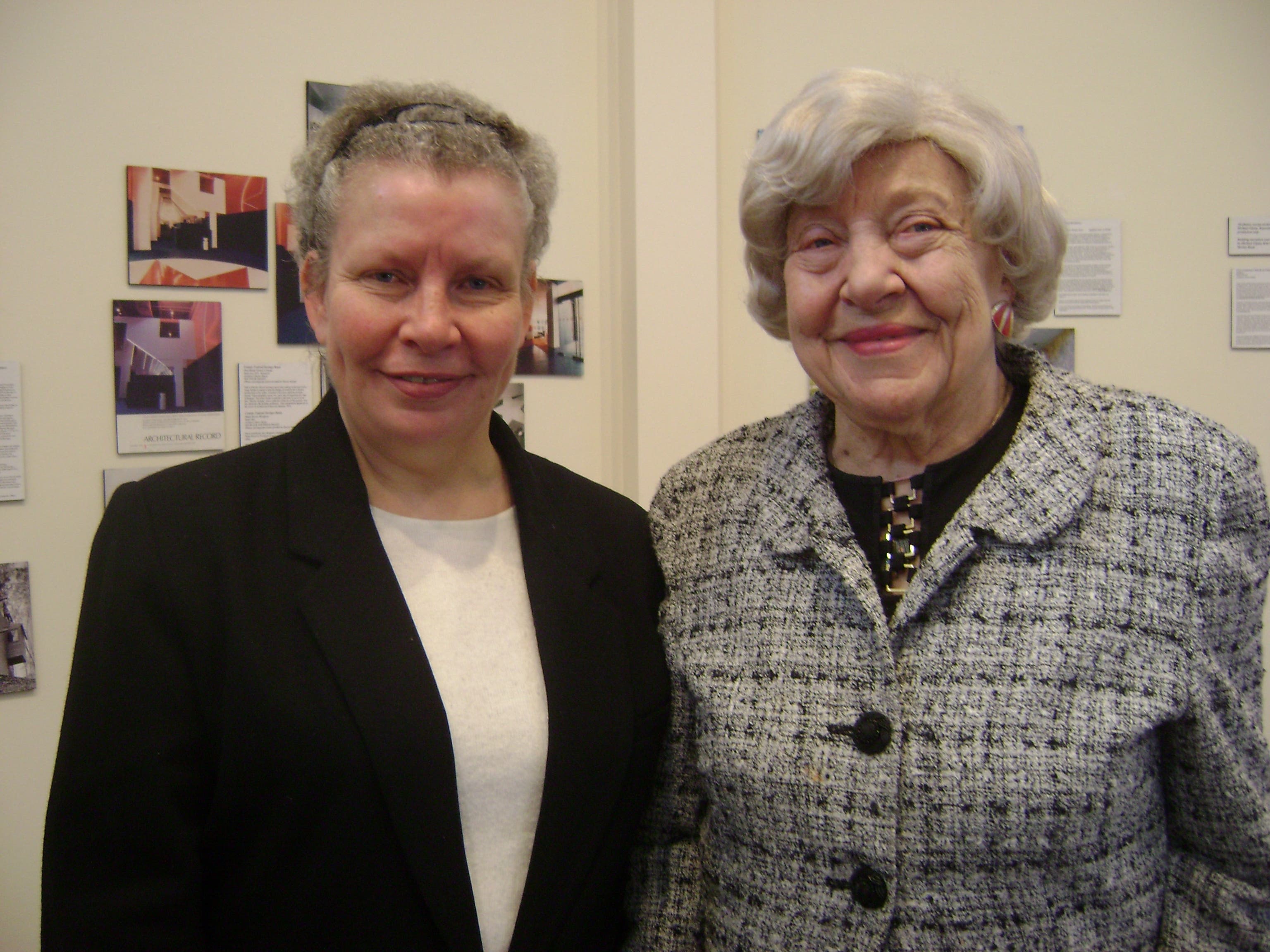
With a twinkle in her eye, Maynard chose to be photographed for this article standing next to a photograph on display at the Historical Society of a modern home she found to be respectful of the environment - the house was built to enclose a tree in its interior to avoid felling it.
Nonagenarian Rabut arrived at the exhibition following a two-mile hike at Compo Beach with her buddy of many decades, Laura Radcliffe.
All told, Rabut said, "Everything seems to have fallen into place here."
Westport's public schools nurtured her children's musical gifts - three are music industry professionals - and she is cultivating her conversational French skills at the Senior Center.