Community Corner
Westport at War
In the spring of 1944, Westport, along with the rest of the nation, was preparing for the anticipated Allied invasion of Europe.
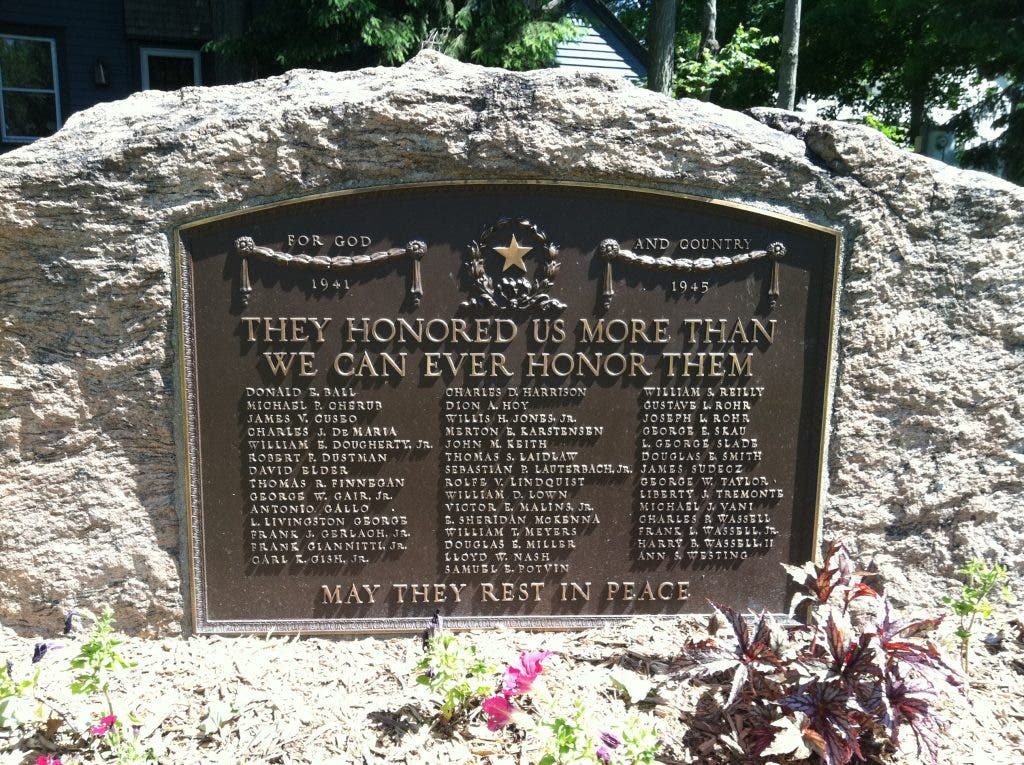


Today, we observe the 67th anniversary of the D-Day invasion of Normandy, the largest amphibious assault in history.
Though it’s not a landmark anniversary in the historical sense, it’s a day I approach with reverence as it brought members of my family, who were suffering famine and occupation in Europe, that much closer to liberation. Among those soldiers who risked and sacrificed themselves for my family’s freedom were 1,380 Westport men and women who served in World War II, as Woody Klein reports in Westport, Connecticut. Forty-three of them never returned home.
Westport luminary Tracy Sugarman participated in the invasion as a naval officer, landing on Utah Beach late in the day. Collected in his book My War are his letters and drawings sent during the war to his wife June (who then lived in New York). His sketches, watercolors, and letters document scenes of life amidst rubble and chaos. They present an incredibly vivid and poignant portrait of a soldier’s life by someone acutely aware of beauty within ugliness and determined to extract wisdom from the experience.
Find out what's happening in Westportfor free with the latest updates from Patch.
In the epilogue, Sugarman writes, "June’s was a harder war to bear because she could only guess, pray, and imagine what might be happening to her husband. Yet she was determined to keep up her morale and mine."
How did Westport’s residents keep their morale up? I wondered. I’ve heard first hand accounts of life under Nazi occupation from my aunts and uncles abroad. But what about here, in the town I now call home? How did Westporters negotiate the demands of everyday life during war as they braced for the expected invasion?
Find out what's happening in Westportfor free with the latest updates from Patch.
These questions sent me our library’s archives of Westport’s two local newspapers, The Westporter-Herald and The Westport Town Crier.
Newspaper notices called on residents to limit their long distance calls, collect their scrap paper, and invest in war bonds. Updates on the ration timetable ran alongside announcements for birthdays, weddings, and social gatherings. At Gristede’s, residents could purchase a 6-ounce package of Kellog’s Corn Flakes for 5 cents. ‘Fowl’ went for 39 cents per pound, and a 16-ounce package of Clover Honey cost 29 cents.
Frank L. Achorn printed reduced hours for his pharmacy ‘because of clerk shortage due to the war.’ Michael Calise reported that the Compo Beach concession was again under his ‘personal management.’ And the Depot Dry Cleaner’s at 41 Railroad Place reminded women that ‘Yes, It’s Fur Storage Time!’
Alongside a picture of a local soldier killed in action and under the headline “Back the Attack,” Gray’s Drug Store on Main Street posted a June 2 advertisement for a war bond drive to run from June 12 through July 8.
Both newspapers printed letters from soldiers. The content of these letters echoed Sugarman’s sentiment, that those at home needed to keep their spirits up as well, because the morale of those at home and abroad were inextricably linked.
Writing from ‘the European theater,’ Sgt. Jay C. Van Zandt thanked the Town Crier ‘on a job being well one’ and asked that they continue sending the paper abroad. From the central Pacific, Norman K. Bray acknowledged receiving ‘cigarettes, papers and the reprint of the Honor Roll' and credited the efforts of those at home for doing ‘more for morale out here than anything I can think of.’
In the Westporter-Herald, Pfc. Thomas G. Kantor, who was training in New York to be an army doctor, thanked the girl scouts for sending cookies, noting ‘Very few towns have as praiseworthy an organization as yours and it's made me feel proud and the other fellows a little bit jealous of Westport.’ Capt. Howard A. Cook, ‘somewhere in the South Pacific,’ expressed appreciation to ‘the folks back home’ for ‘doing a wonderful job of keeping in touch’ and provided his own words of encouragement: ‘don’t think for a minute that we don’t appreciate all you do […] You are doing a very wonderful job. I hope that we can do ours as well.’
When D-Day arrived, Christ and Holy Trinity held an impromptu prayer service. On Main Street, Frank L. Achorn was the first merchant to fly the American flag, the Town Crier reported. Fellow merchants quickly followed Achorn’s example.
If you happen to be in the vicinity of downtown tomorrow, take a moment to visit the World War II memorial across from Town Hall. And for those who served, I thank you. Without you, it’s possible I would not be here to write this piece.
Do you have family who served in World War II?