Crime & Safety
Coast Guard Unloads $2 Billion Worth of Cocaine at Port Everglades
The shipment reflects 27 separate interdictions.


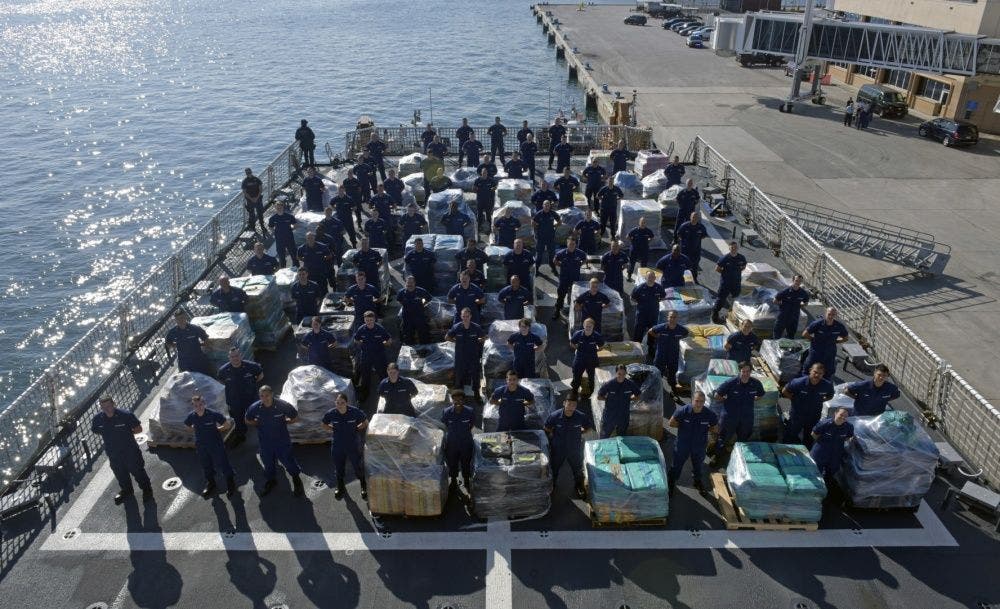
FORT LAUDERDALE, FL — The U.S. Coast Guard unloaded more than $2 billion worth of cocaine seized in 27 separate drug smuggling vessel interdictions and five bale recovery operations on Thursday at Port Everglades.
The seizures were conducted by the Coast Guard, Royal Canadian Naval crews and interagency partners outside U.S. waters along Central and South America by Coast Guard and Royal Canadian Navy ships sailing with embarked Coast Guard Law Enforcement Detachment (LEDET) teams aboard.
"Today we will be offloading 53,000 pounds," Coast Guard Vice Admiral Karl Schultz told reporters near the vessel loaded with the seized narcotics. "That’s equivalent to about 24,000 kilograms of cocaine with an estimated wholesale value of $715 million. That’s probably equivalent to about two-plus billion dollars on the streets of America.”
Find out what's happening in Aventurafor free with the latest updates from Patch.
“This not only showcases the threat posed by dangerous cartels, gangs and criminal groups that make up extensive transitional organized crime networks, but it also highlights the commitment of the Coast Guard and its interagency partner’s efforts to detect, interdict, investigate and prosecute operatives for these criminal networks,” said Schultz, commander, U.S. Coast Guard Atlantic Area.
Commodore Craig Baines, commander of the Royal Canadian Naval Atlantic Fleet, said such seizures promote regional security.
Find out what's happening in Aventurafor free with the latest updates from Patch.
“It is a tangible example of our collective efforts to keep narcotics off our streets while at the same time promoting regional security," he said.
Officials added that numerous U.S. agencies are involved in fighting the transnational organized crime bosses that engage in transporting cocaine through international waters.
The Coast Guard, Navy, Customs and Border Protection, FBI, Drug Enforcement Agency, and Immigration and Customs Enforcement along with allied and international partner agencies all have a part to play in counter-drug operations as do the Departments of Defense, Justice and Homeland Security.
“When pursuing modern maritime smugglers, seconds count, and each of these interdictions involved a collaborative effort of joint, interagency and international aircraft and vessels against stealthy well coordinated, fast moving smugglers.” explained Capt. Scott Clendenin, commanding officer Coast Guard Cutter Hamilton.
The Coast Guard increased U.S. and allied presence in the Eastern Pacific Ocean and Caribbean Basin, which are known drug transit zones off of Central and South America as part of the Guard's Western Hemisphere Strategy.
During at-sea interdictions in international waters, a suspect vessel is initially located and tracked by allied military or law enforcement personnel, according to the Coast Guard.
"The interdictions, including the actual boarding, are led and conducted by U.S. Coast Guard men and women. The law enforcement phase of counter-smuggling operations in the Eastern Pacific are conducted under the authority of the 11th Coast Guard District headquartered in Alameda," according to the Coast Guard.
Here is a breakdown of the seizures:
- The Coast Guard Cutter Hamilton was responsible for 11 cases, seizing an estimated 10.3 tons of cocaine.
- The cutter Mellon was responsible for seven seizures and two bale recoveries for an estimated 5.5 tons of cocaine.
- The cutter Forward was responsible for one seizure for an estimated 1.7 tons of cocaine.
- The cutter Dependable was responsible for four seizures for an estimated 2.8 tons of cocaine.
- The cutter Active was responsible for one bale recovery operation for an estimated 2.2 tons of cocaine.
- The cutter Dauntless was responsible for three seizures for an estimated 3.4 tons of cocaine.
- The Royal Canadian Ship HMCS Edmonton and a Coast Guard LEDET were responsible for two seizures and one bale recovery operation for an estimated 1,500 pounds of cocaine.
- The Royal Canadian Ship HMCS Brendon and a Coast Guard LEDET were responsible for one bale recovery operation for an estimated 1,540 pounds of cocaine.
Photo and video courtesy of the U.S. Coast Guard.
Get more local news delivered straight to your inbox. Sign up for free Patch newsletters and alerts.