Neighbor News
Inside the Quiet Flame: William May on Craft, Memory, and “Blaze Without Burning”
An interview with poet William May on grief, restraint, and the emotional architecture behind his debut chapbook

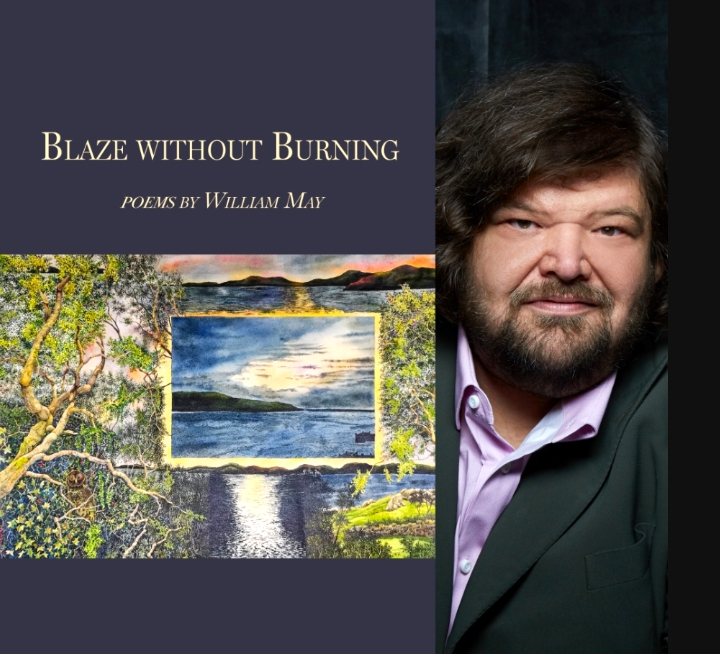
In Blaze Without Burning, poet William May traces the delicate terrain between intensity and control, shaping a debut collection that feels both intimate and carefully composed. Written across a turbulent period marked by personal loss and shifting domestic landscapes, the chapbook emerges not as a pre-planned project, but as something discovered in retrospect—assembled through distance, revision, and the discerning eye of a collaborator who recognized its hidden cohesion.
In this conversation, May reflects on the origins of the collection and the emotional conditions that shaped its creation, from grief and memory to the quieter rhythms of life in Boca Raton. He speaks candidly about the tension suggested by the book’s title, where brilliance and danger coexist, and how that duality informs both his poetic structure and sensibility.
Across the interview, May also considers the role of place, the evolution of individual poems through revision, and the influence of literary traditions that reveal themselves only in hindsight. At its core, Blaze Without Burning becomes less a fixed statement than a living process—one that holds space for contradiction, restraint, and release, and ultimately gestures toward healing without diminishing the weight of what has been endured.
Find out what's happening in Boca Ratonfor free with the latest updates from Patch.
What first sparked the idea for Blaze Without Burning, and how did the project begin to take shape for you?
My process as a poet is not generally focused on a larger project. I sit down each day and I write, and usually I put those poems away somewhere for a bit. It is only later, after time has allowed me a bit of distance from the work, that I will return and read through what I’ve written with an eye towards revision. The poems in this collection were all written at a certain period in my life, and they share the preoccupations and concerns that were central in my mind at that time, but they weren’t intended as a book. A friend and collaborator of mine, the poet Freesia McKee, was actually the person who recognized that this group of poems worked well together, and suggested that I revise them into a chapbook. It was through that process that the book took shape.
Find out what's happening in Boca Ratonfor free with the latest updates from Patch.
The title Blaze Without Burning is striking. What does it mean to you personally, and how does it connect to the themes in the book?
That title comes from a line in the book, from the first of the two poems titled, “What Is Released.” In the context of that poem, it is about the speaker feeling as if they can hold a flame in their hand without it burning them, though as a title it becomes a bit broader. For me, the idea that is most resonant, and what led me to this line as a title, was the idea of the tension that exists between those two poles, between the brilliance of the blaze and the danger of being burnt by the flame that creates it. That feels like a good metaphor for so much of what I was attempting to communicate in these poems.
When you were assembling this collection, did you notice any recurring emotional threads or obsessions in your writing?
The poems that became Blaze Without Burning were all written during a specific period of my life, and a particularly tumultuous time, as well. My father had passed away quite recently, and I was helping my partner, Melissa, to support and care for her aging mother, who has since passed as well. There was a sense of loneliness and grief that hung over life at that time, and it is very much at the core of this collection.
How has living in Boca Raton influenced the imagery, tone, or emotional landscape of your poetry?
I grew up in an apartment on the second floor of a building downtown in Manhattan, which was a pretty incredible place to grow up in lots of ways, and, if I am honest, there are many aspects of life in a big city that I still miss. At the same time, I know that moving to Florida has opened up my awareness in different ways. I tend to spend a lot more time just sitting outside now than I ever did when I lived in New York, and that time outside has certainly carried into my poetry in many different ways. There is also a lot more quiet here. The apartment I grew up in was directly above a bus stop on an already busy street; even late at night, I would hear people shouting and cars whizzing by, but here, while I wouldn’t call this area rural, the sounds, especially at night and early in the morning, tend to come far less from my human neighbors. A few years back a peahen took up residence down the street from us. She comes to visit every so often, standing outside the house and waiting until we offer her some peanuts or fruit. I know that is something that wouldn’t happen in NYC, at least not in any of the neighborhoods I am familiar with.
How do you balance restraint and intensity in your work, especially given the tension suggested by the book’s title?
Contrast is the key to making any tool or technique work; if everything is extreme in any direction, it no longer remains extreme, and certainly not in the same way. It is like looking at a photograph: if everything in the photo is the same color and the same brightness, you may not really notice much detail. Intense moments in a poem gain their power from the rest of the poem, from the context that is created to support these moments. I think a great deal of what works best in this collection is the way that it is able to build those contrasts, not only within the poems, but across the collection. For me, the real pleasure of crafting this book was developing a journey that could carry the reader through the entire collection, and a lot of that is about building and releasing tension, in contrasting the various levels of emotion and energy so that they ebb and flow across the whole of the work.
Were there any poems in this collection that were particularly difficult to write or that changed significantly over time?
It is hard for me, if I am candid, to really remember the writing process for many of my poems. For one thing, I write a lot, and I write each day, so I don’t necessarily remember the original process of drafting a poem. I can tell you that there are poems which transformed a great deal in writing this book. I think, for example, of the two poems titled “There Is A Space for You.” The first of these actually began as two different poems, but through revision I came to feel that they were very closely connected in a way that made joining them together feel sensible, even necessary. The second, as I recall, was actually a bit longer, but in working on it, I realized that many of the specifics that had originally been present served no real purpose: everything necessary could be captured in just those few lines.
What role does memory play in your poetry, and how do you decide what to reveal versus what to leave unsaid?
Memory is what we keep, it is what we hold from the past, for better and for worse. I couldn’t write anything of value without an awareness of myself and the world, and all of that is bound up in what is remembered, really. To understand the moment we are in, whether on the scale of the personal or that of society, the world, the universe, we have the past, and what we remember, to provide understanding and context and an opportunity for comparison, and so much else. Of course, when it comes to intimate and personal memory, it can be complicated. Even if one puts aside the fears that can rise up when thinking about discussing personal matters, it can be complicated to decide what is worth divulging, what truly matters. I think the core question that I ask is whether I am telling this for a genuine reason: is it really in the poem because it is something I feel the need to share these specifics with the reader?
Who are some poets or artists that shaped your voice, whether consciously or unconsciously, while writing this book?
I never would have said this while working on Blaze Without Burning, but when I consider it now, I can’t help but feel that there is a deep connection to the Romantics. The twin structure of the book is reminiscent of William Blake, in particular Songs of Innocence And Experience. Even when I consider the title itself, I can’t help but feel that there is a kind Romantic notion at the core of the image, with that tension between what will sustain and what will destroy.
How do you see Blaze Without Burning fitting into your larger body of work, or does it represent a shift in direction?
Blaze Without Burning is my first published book, though it does not constitute my full body of work, it is a milestone in my writing career. It is certainly true that if one were to look over the poetry I’ve written during my life, at least to this point, that work has shifted a great deal as I’ve matured. As an example, when I was younger, I was often writing surrealist narrative poems, each one telling a kind of strange, often humorous little story. I do still find myself writing those types of poems, on occasion, though even then the work is very different from what I would have done as a younger poet. But, I can’t really say that I am certain just what direction my poetry is likely to take, and, if I am honest, I don’t really want to know. For me, so much of what is exciting about writing poetry is the exploration and discovery, the surprise of finding a new approach or idea that takes the work in a different, unexpected direction.
What do you hope readers carry with them after finishing the collection?
Blaze Without Burning is a book that carries with it a lot of deep and somewhat heavy emotions, but I think it is also a book that points in the direction of growth and healing. It can be so important, in times of pain and grief, to be able to fully experience those emotions; often just letting those feelings exist inside of ourselves can be difficult. Even so, it is also important that those feelings are not stagnant, that they don’t just become a cloud that hangs over life. I would hope that this is a book that gives readers a chance to explore those feelings, to enter into that space of loneliness and loss, not in a way that is disparaging or hopeless, but rather with a sense that they are part of a process that can bring us back towards life and hope.