Community Corner
Water 'Completely Safe To Drink' During Piney Point Crisis: Baugh
Manatee County is siphoning thousands of gallons of water from the Piney Point reserves to prevent the release of toxic wastewater.


Updated: 7:15 p.m., Sunday
PALMETTO, FL — As Manatee County and other local, regional and state agencies continue to siphon water from the Piney Point reservoirs to prevent the collapse of one of the phosphogypsum stacks on site and the uncontrolled release of toxic wastewater, officials say the county’s drinking water remains safe for consumption.
“We’re hearing a lot of rumors and misinformation on these topics,” Vanessa Baugh, chair of the Manatee County Board of Commissioners, said during a news conference Sunday afternoon. “Manatee County utility customers can rest assured that their drinking water is completely safe to drink. The water distribution system is a closed system without any way for flood water to enter. There is also no threat to our primary source of drinking water, Lake Manatee.”
Find out what's happening in Bradentonfor free with the latest updates from Patch.
There is also no effect to the well water used by some north county residents, she added. Even if there if there is a substantial uncontrolled breach, the dirt and earth would likely filter it before it reaches the wells, and the state’s Department of Health would also review the well water, she said.
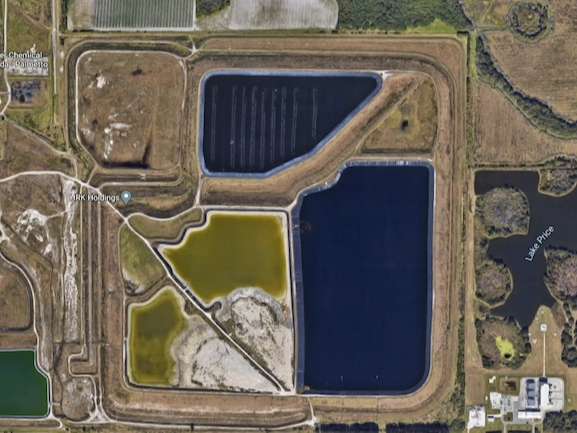
Since Friday evening, county staff and state workers have been siphoning at least 22,000 gallons of water a minute from the reservoir since Friday afternoon when county staff realized a reservoir at the site of the Piney Point phosphate fertilizer processing plant was leaking contaminated wastewater.
Find out what's happening in Bradentonfor free with the latest updates from Patch.
The state has provided around 20 additional pumps to remove water at the site. They should be in place and running at full capacity by Monday morning, Scott Hopes, the acting county administrator, said during Sunday afternoon’s news conference.
About 33 million gallons are being pumped from the retention pond daily, Gov. Ron DeSantis said at a Sunday morning press conference.
While he stressed that the water isn’t radioactive, it isn’t “water we want leaving the site,” he added.
The processed water has a pH level of 5.7, which is “within a safe margin,” Hopes said Friday night. “Obviously, you would not prefer to go swimming in it. There’s a little bit of ammonia in it, but we’re not talking about anything with radiation or high levels of heavy metals or anything like that.”
The silt mixed in with the water contains a metal composition that is already found on the bottom of the bay, he said.
“What is being displaced currently is not as bad as what we are trying to maintain (in the other two ponds so it) does not leave Piney Point in an uncontrolled way. The other two areas do have, I would say, waste that would be less conducive to life on land and life in the sea,” Hopes added Saturday.
To safely discharge the water from the other two retention ponds at Piney Point, the pH level would need to be improved by treating it for ammonia content and other materials, he said.
The larger retention pond contains mostly saltwater and has been sustaining wildlife, including ducks and snook, Hopes said. “That’s not the case for the other two pools.”
A big concern for the area is the potential failure of the radioactive phosphogypsum stack at the site, the Center for Biological Diversity said in a news release Saturday. Phosphogypsum is the radioactive waste leftover from the process of turning phosphate ore into materials used in fertilizer, CBS said.
The county has created and reviewed several models sharing potential scenarios should Piney Point reservoirs see a complete collapse. In one model, a collapse would send a “20-foot wall of water” into the surrounding area, Hopes said Sunday.
At least 30 people and pets have been evacuated from the area and with assistance from the county’s 311 emergency call center and the American Red Cross, they’re sheltering in local hotels.
The initial evacuation order from Manatee County came Friday evening and included as many as 20 homes. The evacuation order was expanded Saturday evening due to further collapse of one of the phosphogypsum stacks on site.
Currently, US Highway 41 is closed at 113th Street East in Manatee County and at College Avenue in Hillsborough County. Motorists needing to travel south should take the detour to College Avenue, then travel east and access I-75. Motorists needing to travel north should travel east on Moccasin Wallow Road and access I-75.
For questions about whether or not you live in the evacuation zone, call 311.
County emergency management workers and staff from other agencies are working on the Piney Point breach 24 hours a day, Jacob Saur, the county’s public safety manager said Sunday.
In addition to continuing to “remove wastewater from the site in a controlled manner to avoid total collapse,” workers are also using drones to detect small-scale changes in the berm structure to determine whether further breaches will occur, he said.
Workers saw “a plateau” in the breach and pressure on the reservoir around 3 a.m. Sunday, Hopes said. “Looking at the volume of water that has been removed, I think the team is much more comfortable” than they were at the start of the crisis.
He expects the risk factor for a complete collapse of the reservoir to decrease by Tuesday, he said, adding, “We are not out of the critical area yet.”
Get more local news delivered straight to your inbox. Sign up for free Patch newsletters and alerts.