Sports
Clearwater Neighborhood Residents Monitor Spring Training Parking With City Help
Although residents say Clearwater police have done much to reduce parking and public nuisance tensions, some issues remain in the College Hill neighborhood next to Bright House Field.
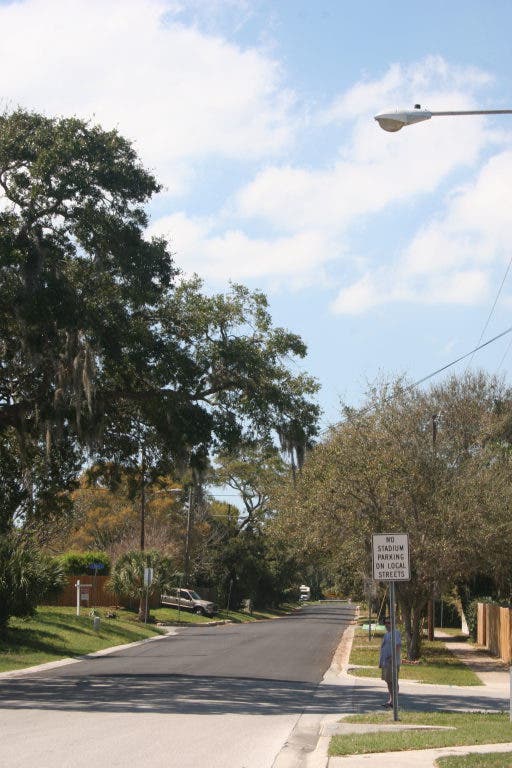

As spring training season opens, so does another: parking season.
Every year the College Hill neighborhood, immediately west of Bright House Field, defends its streets against fans who don't want to pay or wait for parking. And it was no different Sunday as the Yankees and Phillies fans made their way into the stadium.
Clearwater Detective Sgt. Wilton Lee stands sentinel at the gateway to the neighborhood. He speaks politely but firmly, his message clear and unyielding: none shall pass.
Find out what's happening in Clearwaterfor free with the latest updates from Patch.
"Sometimes, you can tell by the tag," Lee said as a silver Odyssey minivan with New York plates slows as it passes his police cruiser.
The passenger clutches a twenty. The driver rolls down his window.
Find out what's happening in Clearwaterfor free with the latest updates from Patch.
"Is there somewhere around here we can park?" they ask Lee.
"Nowhere around here," Lee replies.
The Phillies pay for all the officers working game-related issues, including the illegal parking in surrounding neighborhoods, Lt. Dan Slaughter said.
And neighbors appreciate the efforts.
Slaughter said they got complimentary e-mails from residents about the way the police handled the crowds last season.
The problem, the police say, isn't a lack of parking. The stadium seats almost 9,000 fans, and the adjacent lots as well as the St. Petersburg College field offer ample parking.
"I think it's more of a convenience thing," Slaughter said. "They want to be close."
Residents say that it started with the first game played at Bright House Field.
"The first game they had here with the Yankees, we complained. It was every one of these streets," College Hill resident Jim DeVine said.
Today, he stands by a No Parking sign, a stogie clamped between his teeth. DeVine is watching the cars cruise by to park on the side streets. Other neighbors also stand outside their homes watching and waiting.
"I come up here to see how they handle it," DeVine said. "The Yankees and the Red Sox (fans) are the worst."
Initially the neighborhood formed groups to combat the parking. The groups also sent e-mails and pleas to the city asking for help.
"Ever since the stadium was built, they don't like negative feedback," DeVine said, adding that the city responded to the e-mails "the next day."
The problems, DeVine said, isn't just the parking but the behaviors associated with it. After the game, fans return to their cars filled with high spirits and, well, spirits.
"The girls would go over to the bushes and go to the bathroom," DeVine said. He said he's also seen people relieve themselves in plain view.
Some neighbors choose not to wait on the police.
One fan parked his convertible - top down - in front of a house. The homeowner pointed out the city-posted signs warning people not to park on the streets during the games. The convertible driver ignored the homeowner and walked to the stadium. He also neglected to put up the top on his convertible.
The homeowner, DeVine said, turned on his sprinklers. Shooting water into the open car for nine innings.
Neighbors approach any car that parks and tell them not to park there, informing fans that they can get a ticket for doing so. Some people listen; others shrug off the warning.
"I'll take my chances," one man told DeVine.
That's OK. After the game starts, Lee patrols the neighborhoods, looking for cars whose drivers failed to heed the warnings, leaving a ticket on their windshield.