Crime & Safety
Florida Leads Nation In Number Of People Killed By Lightning
The corridor from Tampa Bay to Titusville (aka Lightning Alley) receives the most lightning in the United States on an annual basis.


TAMPA BAY, FL — It's the one weather phenomenon that even the most sophisticated forecasting equipment can't predict.
Lightning strikes silently, often without warning.
That's the lesson several Tampa Bay residents learned last week.
Find out what's happening in Clearwaterfor free with the latest updates from Patch.
On Friday, a Safety Harbor was outside doing yard work when lightning struck nearby. Although he wasn't directly hit, he was sustained injuries from his proximity to the bolt, which carries about 300 million volts of electricity, and was taken to the hospital.
The day before, a 60-year-old father and his 16-year-old daughter were walking on St. Pete Beach behind the Tradewinds Island Grand Resort when the teen was struck by a bolt of lightning.
Find out what's happening in Clearwaterfor free with the latest updates from Patch.
Hotel staff quickly moved her to safety and performed CPR with help from Pinellas County sheriff's deputies until St. Pete Beach Fire Rescue arrived. Both the teen and her father, who was injured by the indirect strike, were lucky. They were taken to Bayfront Health in St. Petersburg where both are expected to recover.
However, many residents and visitors in Florida don't survive the deadly impact of a lightning strike.
In the three milliseconds it takes for a lightning bolt to course through your body, it can cause third-degree burns, singe hair, catch clothing on fire and literally knock your shoes off your feet.
Some survivors have compared a lightning strike to the pain of a thousand wasps stinging from within.
Blood vessels may burst from the electric discharge, creating a pattern of scars along the vessels.
It’s not uncommon for the blast to rupture the eardrums, possibly leading to hearing loss.
However, cardiac arrest is the most common cause of death following a lightning strike. The lightning disrupts the heart's electrical rhythm.
It can also cause seizures, respiratory arrest and paralysis.
If it enters through the skull, it can super-heat the brain, causing brain damage or coma.
“We have many visitors to our area and residents who aren’t aware of the dangers of our storms," St. Pete Beach Mayor Alan Johnson said. "The storm’s natural beauty can be deceiving. When it comes to thunder and lightning, no storm is just a small one. Always err on the side of caution. Our thoughts are with the victims of the lightning strike and their families. We are thankful for the quick actions of the Tradewinds staff, our Pinellas County Sheriff’s Office deputies and the crew at the St. Pete Beach Fire Rescue.”
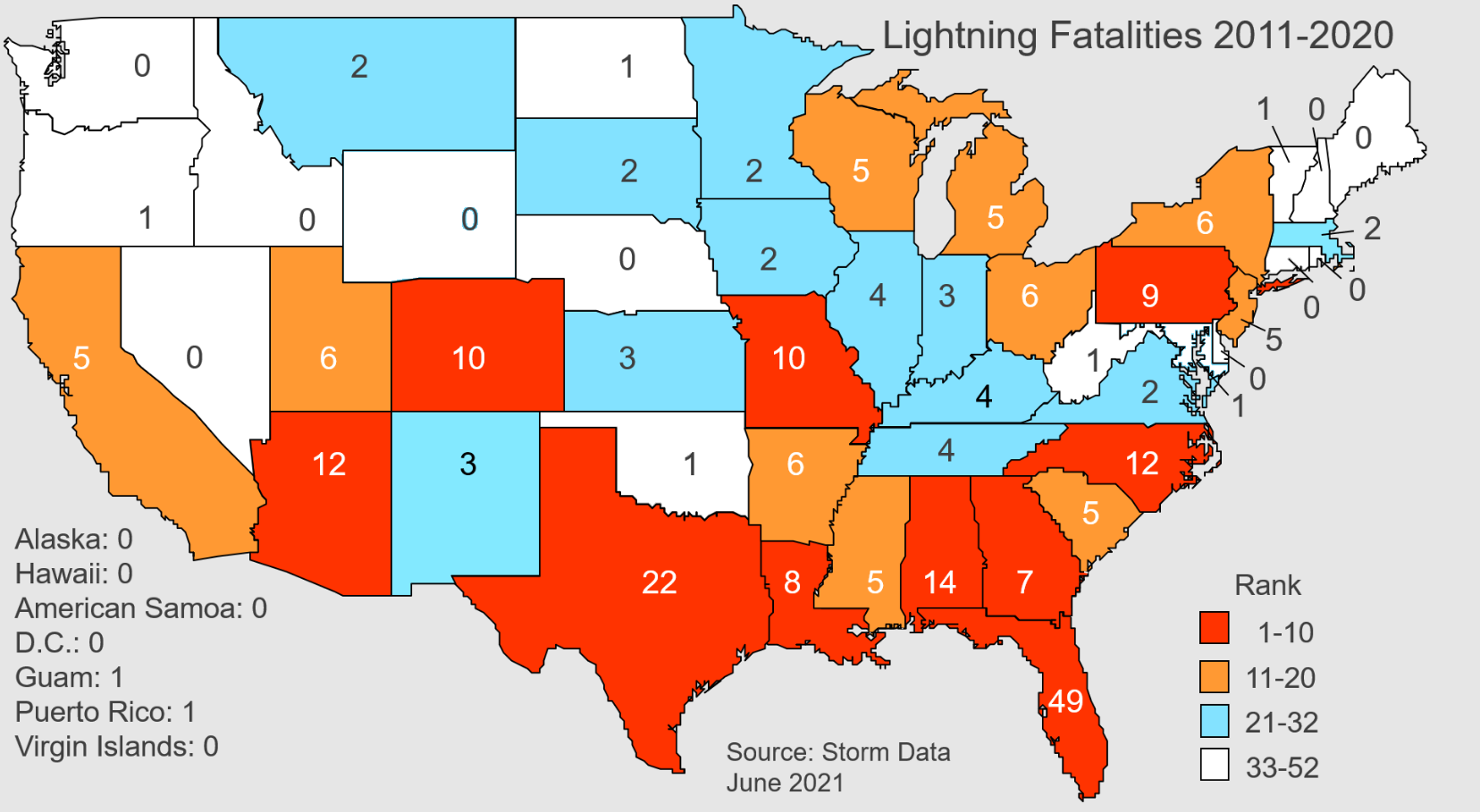
According to the National Weather Service, more people die from lightning strikes in Florida every year than in any other state.
It doesn't take a rocket scientist to understand why. Florida's weather produces more lightning than any other state.
Tampa Bay National Weather Service warning coordination meteorologist Daniel Noah said Florida's unique location surrounded by warm water provides the necessary ingredients for thunderstorms to form. It's earned Florida the title of Lightning Capital of the U.S.A.
On average, 10 people die each year from lightning in Florida.
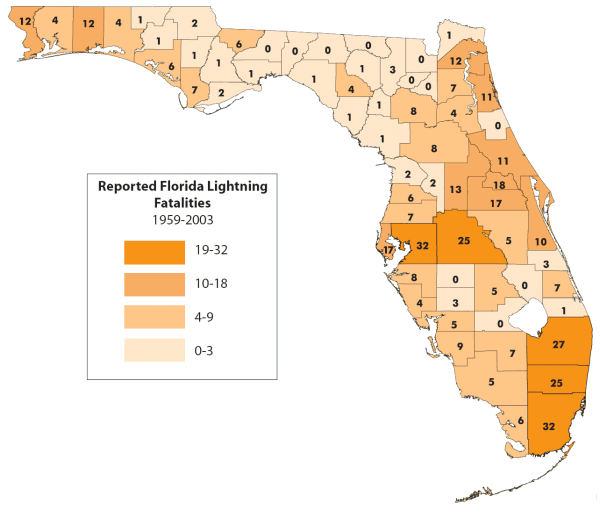
The corridor from Tampa Bay to Titusville, FL (aka Lightning Alley) receives the most lightning in the United States on an annual basis. Furthermore, more than 90 percent of the lightning in this area occurs from May through October between the hours of noon and midnight.
During this time of day and year, people in Central Florida who spend a large portion of their lives outdoors (e.g. construction workers, park rangers, golfers, campers) are much more likely to be struck than anytime or anywhere else in the country.
On the other hand, thunderstorms are uncommon in the Pacific northwest, and are virtually unheard of during the winter months. People in this region who spend much of their lives indoors (e.g. shopkeepers, librarians, bowlers, billiard players) are more likely to win the lottery than be struck by lightning.
Statistics show that teenage boys are most vulnerable simply because their lack of maturity and sense of immortality means they're less likely to heed warning signs and seek shelter.
The next most likely victims are people in their 30s who don't have immaturity as an excuse, followed by those in their 20s.
"It's important to understand the dangers associated with this weather phenomena and what you need to do to stay safe when thunderstorms threaten," Noah said. "There is no safe place outside when thunderstorms are in the area. If you hear thunder, you are likely within striking distance of the storm. Just remember, 'When Thunder Roars, Go Indoors.' "
He said too many people wait far too long to get to a safe place when thunderstorms approach.
"Unfortunately, these delayed actions lead to many of the lightning deaths and injuries in the U.S.," Noah said.
Between 2006 and 2020, 75 people died as a result of lightning strikes. In most of these cases, the victims were only steps away from safety when they were struck. They either failed to recognize the danger of a nearby thunderstorm or failed to respond quickly enough to that threat.
Ten of the fatalities occurred on the beach or in the water at a beach. Others were killed while grilling in the back yard, repairing a roof, doing yardwork, riding a motorcycle, swimming in the backyard pool, fishing, camping, golfing, playing soccer, playing football and even walking through a parking lot to a car (click here to see all fatalities).
“When you hear thunder, seek cover as quickly as possible in either a substantial building or hard-topped metal vehicle and remain there for at least 30 minutes after the last rumble of thunder," St. Pete Beach Fire Marshal Kelly Intzes advised, adding there is no safe place outside.
This includes carports, open garages, covered patios or pavilions, she said.
St. Pete Beach Fire Chief Jim Kilpatrick said it's especially important to stay away from isolated tall trees, towers or utility poles since lightning tends to strike taller objects in an area. Metal and water are both strong conductors of electricity and an electrical current can travel long distances through them.
Counting the seconds between lightning and thunder to see how close it is to you is no wives' tale.
Forecasters call it the "flash to bang method."
The air in a lightning strike is heated to 50,000 degrees F. It is this rapid heating of the air that produces the shock wave that results in thunder.
When you see the flash, count the number of seconds to the bang of thunder and divide this number by 5. This gives you the miles the lighting is away from you.
If it takes 15 seconds between the time you see a lightning flash and hear the rumble of thunder, then the lightning flash is 3 miles from your location. You shouldn't wait any longer than 30 seconds between the lightning flash and thunder boom to seek shelter.
The Lightning Safety Council offers these tips if a storm approaches while you're outdoors:
- Get out of the water. This includes pools, lakes, rivers, oceans, water rides, and even puddled water.
- Put down metal objects such as fishing poles, golf clubs, tennis rackets and tools.
- Dismount from tractors and heavy construction equipment. Do not seek shelter under the equipment.
- Move away from metal objects such as fences, sheds, telephone and power lines, and pipelines.
- Seek cover in an enclosed building or vehicle with a hard top.
When indoors during a thunderstorm:
- Avoid contact with corded phones.
- Avoid contact with electrical equipment or cords. If you plan to unplug any electrical equipment, do so before the storm arrives.
- Avoid contact with plumbing. When thunderstorms are occurring, do not take a shower or bath, wash dishes or do the laundry. Wait until after the storm.
- Move away from windows and doors. Do not stay on the porch.
If you're on the scene when lightning strikes a person:
- Call 911 immediately.
- Determine if the victim is unconscious. Call out their name or gently shake them. If there is no response, check to see if they are breathing.
- Gently roll the victim onto his back. If the victim is not breathing, you will need to perform CPR until the paramedics arrive. Use the American Heart Association's "ABCs of CPR" to guide you through the process.
1. Airway: clear obstructed airways.
2. Breathing: perform mouth-to-mouth.
3. Circulation: start chest compressions.
Other lightning facts from the National Weather Service:
- One death occurs for every 345,000 flashes of lightning.
- The average number of thunderstorms occurring worldwide at any given moment is 2,000.
- The average number of lightning strikes worldwide every second is 100.
- The average number of lightning strikes worldwide per day is 8.6 million.
- There are between 100 million and one billion volts of electricity in a lightning flash.
- The average lightning flash would light a 100-watt light bulb for three months.
- The estimated diameter of a lightning channel is about 1 inch.
Get more local news delivered straight to your inbox. Sign up for free Patch newsletters and alerts.