Politics & Government
Library May Add Gateway to Keep Out Homeless
In an effort to keep the homeless from loitering, a nearly 7-foot-tall, wrought-iron-style locking gateway could be part of redesign plans for the Main Library front entrance.


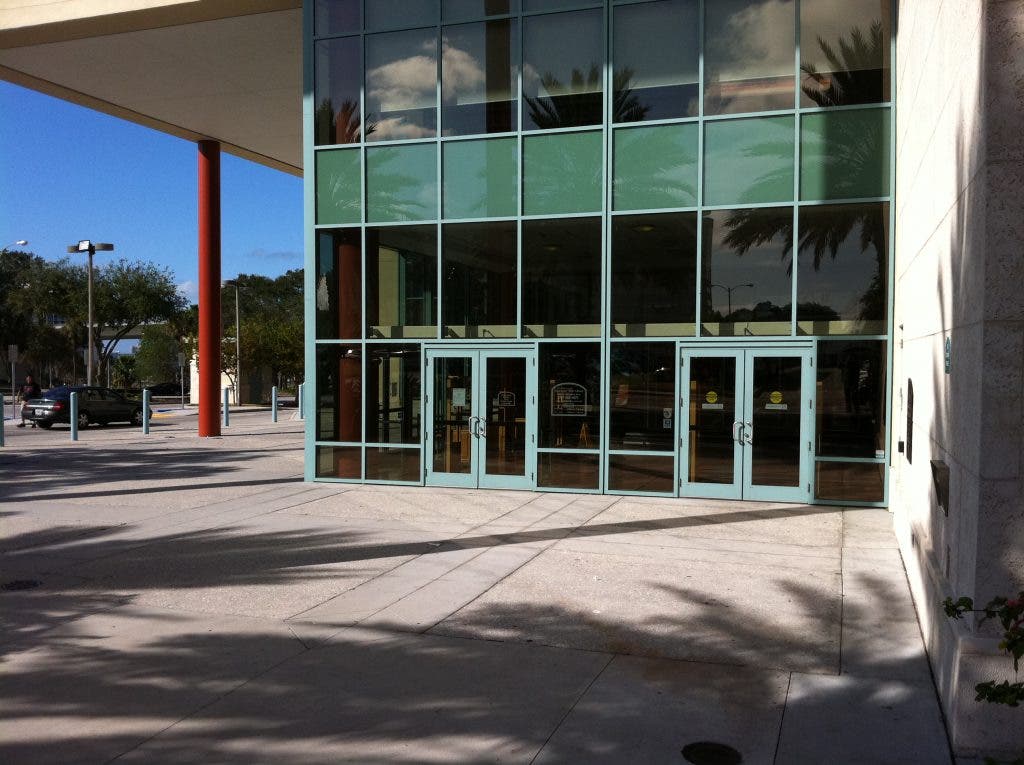


The entrance to the could look drastically different in six months.
That is, if plans go through to fund a nearly 7-foot-tall, wrought-iron-style fence, essentially to keep the homeless out after hours.
Barbara Pickell, director of the library system, said that after seven years the staff evaluated the strengths and weaknesses of the building, and the front of it is a bit shabby.
“We do have transients who are in the park area and in the library. The idea here is not to keep transients out of the library. ... It’s a free and open place,” Pickell said. “We’re just hoping to enhance the front of the library and make it a better place.”
The fence would incorporate an artistic theme and would border along the stairs at the front of the entrance. Within its perimeter would be a courtyard gallery to showcase touring art pieces, similar to the 360 Sculpture program along Cleveland Street, Pickell said.
Discussion at a September art and advisory board meeting suggested that the fence should serve as artwork and reflect the building’s design. The group recommended approaching Robert A.M. Stern, the building's architect, for input and ideas.
Of course, the plan still would have to go before the city council to get funding, Pickell said.
“It’s still in the planning and talking phases,” Pickell said. “I think six months would be a positive date, but I think a year would be a little long.”
Find out what's happening in Clearwaterfor free with the latest updates from Patch.
Howard Warshauer, a member of the city’s art advisory board and the Coachman Park Enhancement Committee, sees fencing as a symptom of a bigger problem.
“There is not enough public using our public property like the downtown library, , and our downtown sidewalks to deter undesirables from using those areas,” Warshauer said in an email.
Warshauer said public property should be appealing and suggested fixing the problem by having more public use in these areas.
“All the cities (the ) studied that had the same limited public usage problems have turned things around by creating an actively used park that will attract hundreds of thousands of our citizens each year to use these public places," Warshauer said. "A gate will usually do nothing but proliferate the problem by creating more dead spaces. That is basic urban design."
Get more local news delivered straight to your inbox. Sign up for free Patch newsletters and alerts.