Community Corner
Lost Black Cemeteries: Sacred Spaces Ignored, Abandoned For Years
Archaeologists are searching for proof to validate hazy memories and stories shared by generations about Florida's lost Black cemeteries.


CLEARWATER, FL — For decades there has been no visible sign of the sacred spaces that were the last resting place of some Tampa area residents. The forgotten — some indigent, others with families who tried to keep their memories alive — share one common trait.
They were Black Floridians devalued in the era of segregation, so parking lots and buildings were erected over their graves.
A spate of excavations has unearthed unmarked and abandoned Black graves across the Tampa area.
Find out what's happening in Clearwaterfor free with the latest updates from Patch.
“These are all examples of residues of structural racism, how Black lives haven’t mattered for a really long time,” said Jeff Moates, regional director of the Florida Public Archaeology Network’s West Central Region at the USF Department of Anthropology. “These places need to be recognized. They're sacred.”
During the first week of Black History Month in February, as the country remembered those who shaped the destiny of Black residents in America, University of South Florida archaeology students were busy searching for evidence of those who have been forgotten.
Find out what's happening in Clearwaterfor free with the latest updates from Patch.
Within days after beginning their excavation of a property in Clearwater, the team uncovered irrefutable proof of the site's former use. Beneath layers of dirt marking the passage of decades was an engraved nameplate that was once affixed to the casket of William Ridley. The property had been Ridley's final resting place in 1951.
Search For Unnamed Black Cemeteries
Researchers searched for proof to validate hazy memories and stories passed down through generations indicating the property at the corner of Holt Avenue and Engman Street was once home to an unnamed segregation-era cemetery for Black residents.
Although there is no indication in city records of a cemetery at that location, a Dec. 21, 1954, story in the Tampa Tribune chronicled “the transfer of bodies from the old Negro cemetery to a new one northeast of Dunedin."
The Clearwater/Upper Pinellas branch of the NAACP believes the property was a cemetery for Black residents between 1940 and the early 1950s.
The site, located across from the now-abandoned Curtis Fundamental School-Palmetto Elementary School on Holt Avenue in the all-Black North Greenwood subdivision, was purchased by the Pinellas County School District in the early '50s.
As far as Clearwater City Manager Bill Horne can determine, the city and school district swapped land so the city could build a swimming pool on the property. The agreement was contingent on 350 graves on the property being relocated to the Parklawn Memorial Cemetery, 2966 Belcher Road in Dunedin.
"The assumption was that all the graves had been moved," said Horne. "But some residents believe there were some graves that weren't marked with headstones could still be there."
At the urging of the NAACP and North Greenwood residents, in February and August 2020, the city hired the Tampa office of global engineering firm, Cardno Inc., to use ground-penetrating radar to determine if there were still graves on the site, now known as the North Greenwood Cemetery.
Cardno, along with the Florida Public Archaeology Network, used ground-penetrating radar to survey the area and found 44 anomalies consistent with graves located 2 to 5.5 feet below the surface.
Last month, Cardno Inc. and Moates' USF archaeology students returned to the site to find physical proof in an archaelogical investigation known as ground truthing by excavating the site. Such investigations are now routinely required before a property is developed.
Over two weeks, the teams uncovered 25 gravesites and numerous artifacts indicating the presence of graves.
While they worked, Moates said a number of residents dropped by the dig site to share their memories.
“We’ve heard from people here who remember going to funerals at this site and spending time with family here," Moates said. "So, to be part of bringing these sites back to the forefront and giving these communities the chance to memorialize them is really special.”
Archaeologists with Cardno, Inc. will analyze the data collected at the site and submit a report to the city.
“We’re really trying to answer the questions that the community and the property owners have about what happened here, and we’re trying to use our expertise to get those answers,” said Becky O’Sullivan, a senior archaeologist with Cardno who graduated with her master's degree from USF. “It’s important work and we’re all glad to be part of it.”
Work To Unearth Historic Sites Focuses On Lost Black Cemeteries
The Florida Public Archaeology Network has investigated historic sites throughout the state, including Seminole Indian mounds, battle fields and shipwrecks located 4,000 feet beneath the waters of the Gulf of Mexico.
But lately, the majority of the network's activities in Tampa Bay have been focused on lost Black cemeteries discovered throughout Tampa Bay.
With the help of ground-penetrating radar, at least 120 graves from the Zion Cemetery have been found under a warehouse, a vacant storefront and the Robles Park Village public housing project in Tampa.
The Ridgewood Cemetery, reserved for indigent Black residents in Tampa, was located on the campus of King High School on 56th Street in Tampa.
And a cemetery for Blacks living in the Port Tampa area has been found in a wooded area at MacDill Air Force Base.
Indifference To Graves Reflects Black Disenfranchisement: NAACP
Zebbie Atkinson IV, president of the Clearwater/Upper Pinellas NAACP, said the discovery of the Black cemeteries is a tragic reminder of how Blacks were devalued and disenfranchised in Tampa Bay during the Jim Crow era.
"I'm most definitely outraged to find out this has been happening," Atkinson said. "It's an injustice to those buried in these cemeteries and their loves ones who are still here. These cemeteries stood in the way of progress, but instead of going to the process of moving them, they built right on top of them."
He said one of the most egregious examples of how Black residents were disenfranchised is the lost cemetery beneath the parking lot of Tropicana Field in St. Petersburg.
"There was once a thriving Black community where Tropicana Field is today," Atkinson said. "The property was redlined so property taxes would increase and those living there couldn't afford to pay them anymore. Then the property was taken by eminent domain so they could build that stadium. It was a land grab with no consideration for those alive or dead who made their homes there."
The North Greenwood site is believed to be one of two lost Black cemeteries in Clearwater.
Former residents of the Clearwater Heights subdivision, a Black community established in the early 1900s bounded by Cleveland Street, Court Street, Ewing Avenue and Missouri Avenue, told officials a Black cemetery maintained by St. Matthews Baptist Church once occupied the property now owned by Frank Crum Staffing at 100 S. Missouri Ave.
Crum purchased the property in 2004.
Old deeds show the St. Matthews Baptist Negro Cemetery was founded in 1909. The church sold the property to the city for $15,000 in 1955 to create a quicker route to Missouri Avenue.
Those bodies also were supposed to be relocated to Parklawn Memorial Cemetery in the 1950s.
But there's anecdoctal evidence that not all the bodies were moved.
Residents recall parents and grandparents visiting the parking lot where the cemetery once stood, praying for the souls of loved ones.
Former Clearwater Heights resident Ruth Rembert said her grandfather, Jefferson Rembert, was buried in the Baptist church cemetery in 1930, yet there is no record of him at the Parklawn cemetery.
And Barbara Sorey-Love, who has since founded the Clearwater Heights Reunion Committee with other former residents of that community, recalls kids in the neighborhood finding human bones scattered at the cemetery site weeks after the bodies were supposed to have been moved.
Ground-penetrating radar has detected 70 possible graves remaining at the site.
“When I was growing up, people were always talking about the graves," Sorey-Love said. “It was part of our history that has finally been confirmed."
Atkinson said he doesn't believe it was a mere oversight on the part of the city.
"They had to have seen or known there were graves still there when the site was developed," Atkinson said. "They were ignored because they belonged to people who were poor and Black."
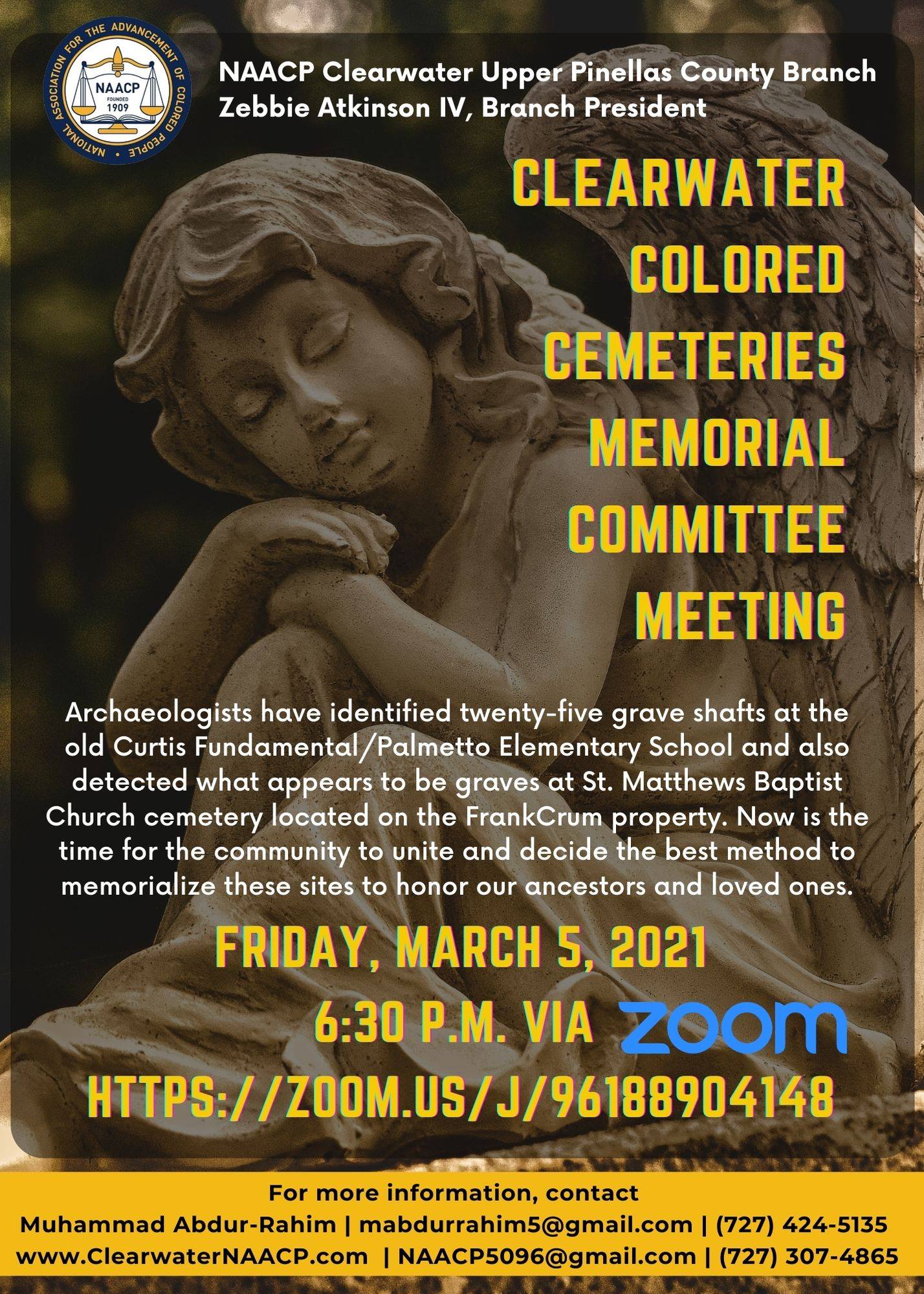
The Clearwater Heights Reunion Committee and the NAACP have formed the Clearwater Colored Cemeteries Memorial Committee to find a way to memorialize the two lost cemeteries in Clearwater.
The committee has scheduled a Zoom meeting for Friday at 6:30 p.m. to discuss ways to honor those in the lost graves in Clearwater.
“The work that was done at the North Greenwood site is monumental to the North Greenwood community,” said Atkinson. “For so long the community has voiced that there were bodies that hadn't been removed, but those voices fell on deaf ears. The work that USF and Cardno have done proves that the community was correct. There are still bodies at the site and there needs to be recognition of the wrongs that have been committed against the African American community in the North Greenwood area.”
State Legislator Seeks Law To Identify Lost Cemeteries
The lost cemeteries haven't escaped the attention of Tampa Bay legislators.
State Sen. Janet Cruz, D-Tampa, has called for legislation to form a task force to investigate lost Black cemeteries around the state. Historians have identified more than 3,000 abandoned cemeteries across the state.
Cruz sponsored a similar bill during the 2020 legislative session that passed the Senate but stalled in the House.
She reintroduced Senate Bill 222 this session with state Rep. Fentrice Driskell, D-Tampa, sponsoring a companion bill, House Bill 37.
“We now have an opportunity to right this historical injustice,” Cruz said. “We’re not asking for any money. We’re asking for a task force that will start to identify the abandoned cemeteries in Florida and recommend strategies that will preserve the history and ensure dignity and respect."
If approved, the task force would be led by the Secretary of State, who would appoint representatives from the Bureau of Archaeological Research in the Division of Historical Resources, the NAACP, the Florida Council of Churches, the Florida African American Heritage Preservation Network, the Florida Public Archaeology Network, the cemetery industry, representives from local government and legislators selected by the Senate president and House speaker.
Florida Gov. Ron DeSantis and legislators have already approved a $100,000 fund for memorials at the Zion and Ridgewood cemeteries.
Horn said the city is willing to do whatever is needed to right this injustice.
“We’re clearly learning that this is providing insight to our past and to our past deserves a little more exploration,” he said.
“What’s important is we now recognize that properties for what they are - cemeteries,” Atkinson said.
Muhammad Abdur-Rahim, a former resident of Clearwater Heights and now president of the Clearwater Heights Reunion Committee, agrees.
“We have had this mystery for years but now the truth has come out," Abdur-Rahim said. "Now we can move on to properly memorialize those who were left behind.”
“What we're finding is that, while the cemeteries can be erased from sight, the memories of the people who are buried there aren’t as easily erased,” Moates said.
See related stories:
- Lost African American Cemeteries Researched By USF Students
- Officials Look For More Lost Black Pauper's Cemeteries In Tampa
- Forgotten Black Cemetery Discovered On Florida High School Campus
- Planners Named To Redevelop Projects Built On Black Cemetery
- King High School Campus May Contain Black Pauper's Cemetery
- District Unveils Memorial To Lost Black Cemetery At High School
Get more local news delivered straight to your inbox. Sign up for free Patch newsletters and alerts.