Neighbor News
The Battle For The Dunedin Causeway: Why Passive Gates And Signage Won't Fix Our Crowding Crisis
A timeline of traffic chaos, water rescues, and rule-breaking
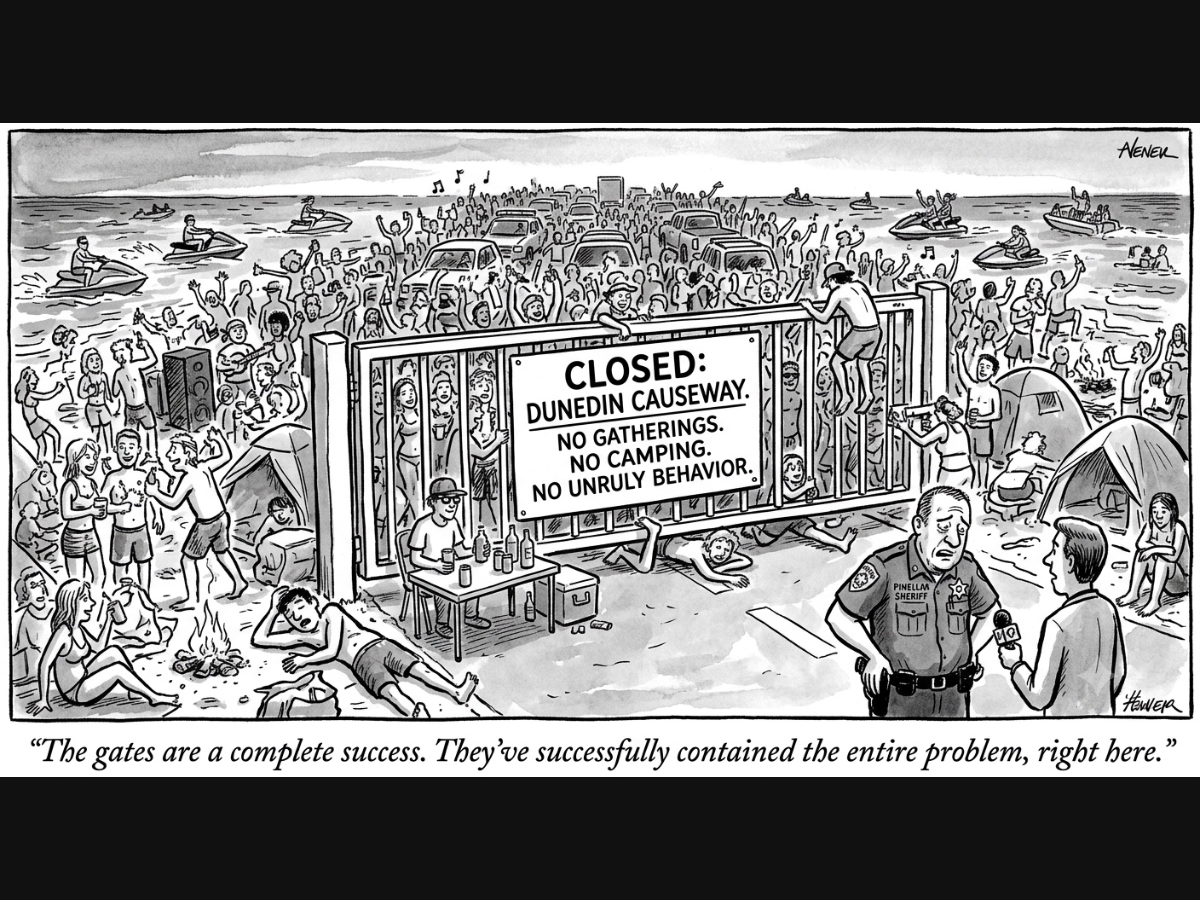
DUNEDIN, FL — Emerald waters and sun-drenched shores dominate the local social media feeds whenever someone mentions the Dunedin Causeway or Honeymoon Island State Park. To the casual observer tracking the area online, it is the very picture of postcard perfection—a curated narrative of endless summer vibes.
But look closer. Beneath that glossy digital surface lies a far starker, more turbulent reality.
For the thousands of residents who actually live here and navigate the corridor daily, the narrow strip of land connecting our mainland to the Gulf has increasingly transitioned into an infrastructure nightmare. The area is buckling under the weight of severe overcrowding, unruly behavior, and a clear deficit in real-time law enforcement presence. Passive measures are a band-aid on a fractured civic asset.
Find out what's happening in Dunedinfor free with the latest updates from Patch.
2026: A Timeline of an Escalating Crisis
This year alone, the cracks in the foundation have grown impossible to ignore. The timeline of recent events paints a troubling picture of a waterfront pushed to its absolute limit.
Find out what's happening in Dunedinfor free with the latest updates from Patch.
January 2026: The Cost of Chaos: The year began with a tragic reminder of how quickly our local waters can become a stage for disaster when safety isn't actively monitored. On January 18th, emergency crews rushed to Honeymoon Island following a critical water rescue call. Three young people had ventured out into treacherous, wind-whipped waves in kayaks, causing two to overturn. While one teenager was pulled from the water, an 18-year-old disappeared beneath the surf. The incident triggered a massive, multi-agency response drawing assets from the Coast Guard, the Florida Fish and Wildlife Conservation Commission, and local fire departments. It was a staggering drain on public resources—and a devastating wake-up call regarding the safety vulnerabilities of an unmanaged waterfront.
Spring 2026: The Escalation of Ordinance Violations: As the weather warmed into spring, the true nature of the causeway’s behavioral problem became apparent. Official municipal regulations clearly state that alcohol, overnight camping, and ground fires are strictly prohibited on the Causeway. Yet, any resident driving the stretch on a typical weekend witnesses a blatant disregard for these rules. Unregulated beach parties, illegal overnight vehicle storage, and aggressive jet-ski launches have turned a public space into a lawless free-for-all, escalating dangerous vehicle-pedestrian conflicts along the narrow right-of-way.
May & June 2026: The Daily Strain: The data on the ground reflects the strain. A review of the Pinellas County Sheriff’s Office active call logs reveals a persistent, relentless cycle of intervention. Week after week, deputies are dispatched to the causeway footprint for "Special Details," narcotics calls, traffic accidents, and ordinance violations. The asset is under siege, and the current strategy of reactive, intermittent policing is completely failing to deter the crowd.
The Admission of Failure: Gating Paradise
Perhaps the most damning evidence that the causeway has grown out of control comes from the county government itself. Faced with a mounting stack of resident complaints regarding late-night traffic, noise, and unsafe circulation, Pinellas County transportation officials were forced to introduce an aggressive, multi-part safety intervention.
The county's structural proposal is telling. It outlines plans for installing physical swing security gates to completely lock down the causeway overnight, alongside implementing a strict, one-way clockwise traffic pattern along the north beach frontage to prevent chaotic vehicle-pedestrian conflicts. Because the sand prevents standard pavement markings, the county is relying heavily on an influx of regulatory signs.
When a municipality is forced to build physical gates to lock out the public at night, it is a formal admission that they have lost control of the space.
The Case for Real Enforcement
Gates and signs are passive measures. They do not write citations. They do not test for sobriety. They do not stop an unruly crowd from destroying the riprap, littering our beaches, or intimidating families trying to enjoy the shore.
The Dunedin Causeway is a massive regional draw, but it is currently being policed like a quiet neighborhood street. Relying on passive signage and updated interlocal agreements is an exercise in wishful thinking.
What this area requires—and what taxpayers are explicitly paying for—is a permanent, highly visible, proactive law enforcement presence. We need boots on the sand, hulls in the water, and consistent enforcement of the laws already on the books.
Until the Pinellas County Sheriff’s Office establishes a dedicated, zero-tolerance detail on the causeway from sunrise to well past sunset, the chaos will continue to outpace the infrastructure. It is time to stop looking at the causeway through the lens of a happy social media feed, turn off the digital spin, and face the reality on the ground. Paradise is slipping away, and it is time for our local government to actually police it.
The views expressed in this post are entirely the author's own and do not represent any official city board or municipal entity.
About the Author: Jeremy Reynolds is a Dunedin resident and a student of paralegal studies. He currently serves as a public official on the City of Dunedin Code Enforcement Board. The views expressed in this article are entirely his own as a private citizen and taxpayer, and do not reflect the official position, opinions, or policies of the Code Enforcement Board or the City of Dunedin.