Community Corner
Florida In Tropical Storm Emily's Possible Path
The first time Florida has been in the cone of a storm is a chance to finish those things you've been putting off for hurricane season.
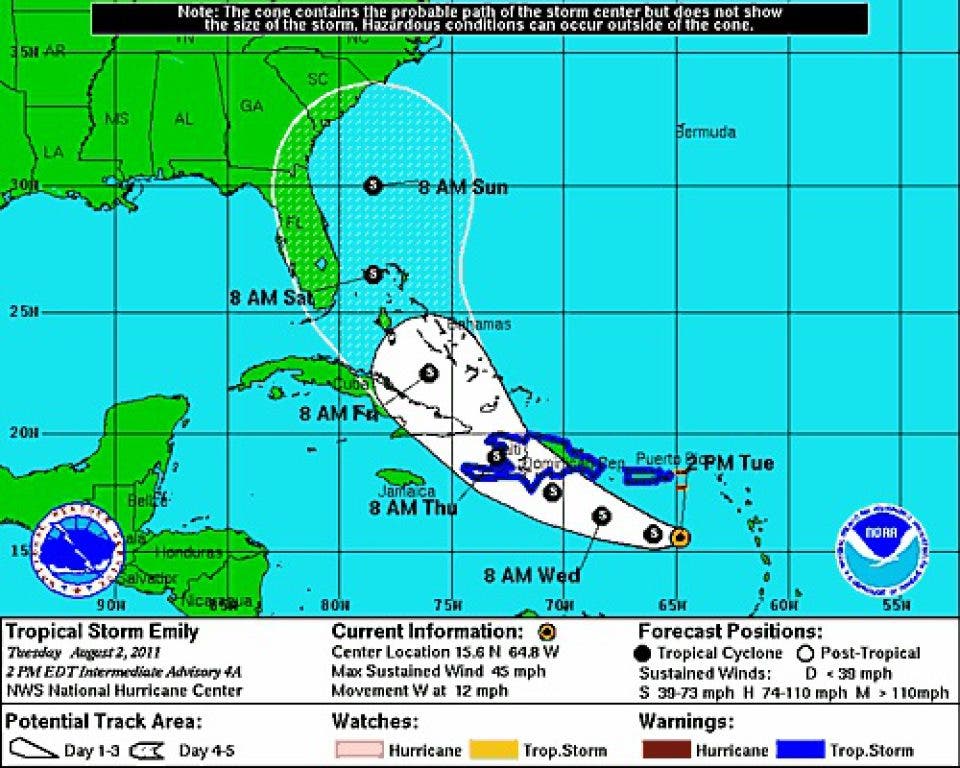

For the first time this season a tropical storm has Florida in its possible path, though forecasters say it’s far too early to tell if the state will stay in the storm’s sights.
Tropical Storm Emily, the season’s fifth named storm, formed Monday near the island of Dominica and is expected to move to the west northwest at about 12 mph the next few days.
National Hurricane Center forecasters expect the storm to make a more northerly swing later in the week and head up the United States coast by the weekend.
Find out what's happening in Dunedinfor free with the latest updates from Patch.
Though forecasts don’t call for Emily to become the year’s first hurricane, the storm could come close.
On Tuesday, hurricane center forecasters expected Emily to become within a whisker of hurricane strength by the weekend. But there wasn’t a large amount of certainty in that early an outlook.
Find out what's happening in Dunedinfor free with the latest updates from Patch.
Computer models used for intensity forecasts are highly divided with some taking Emily to a Category 1 hurricane by Saturday or Sunday. Others have it falling apart over the jagged terrain of Hispaniola on Thursday.
Track models are more uniform in keeping Emily off Florida’s East Coast.
The hurricane center has the Tampa Bay area by the western edge of its track cone of uncertainty, meaning the region is in the area the storm could possibly hit.
The center of the storm could travel anyplace in that cone, so even just outside isn’t entirely safe.
If it stays on the projected path, it could be far enough away to bring no serious impact to local weather. Actually, some dry air will move over places north of Tampa Bay and slightly drop rain chances later in the week.
National Weather Service forecasters aren’t factoring Emily into local outlooks yet.
Wake-up Call
Emily’s distance gives folks time to take steps in case the storm becomes a threat. These early steps will make it easier when the next storm hovers over the horizon, or the one after that.
The first step, experts universally agree, is have an idea what you’ll do if a storm is going to hit. Have a plan.
A key to that is knowing whether you live in an evacuation zone. Much of what you can do next depends on this.
If your home is in one of those colored areas on evacuation maps, you’ll have to leave for one storm or another. You can also find out on line using your address at your county’s emergency management website.
The closer you live to the coast or a river, the more likely it is you’ll be told to leave for a storm. The zones are based on storm strength, so stronger hurricanes mean a larger evacuation.
But whether you evacuate or not, you can still figure out what to do.
That can start with talking with family members. Do you have elderly relatives to care for? ? Prescriptions to have filled? Special medical needs or diet? Where are all your legal documents?
The county’s Emergency Management site has other information to guide you through the early preparation steps.
The online 2011 hurricane guide goes into more detail about lists and how to take your first steps for a storm.
Other important links: