Neighbor News
The Manufactured Consensus: How Dunedin Muted Its Citizens and Bought Its Own PR
Turning off comments while using tax dollars to scrape Facebook echo chambers silences residents—and we are footing the bill.
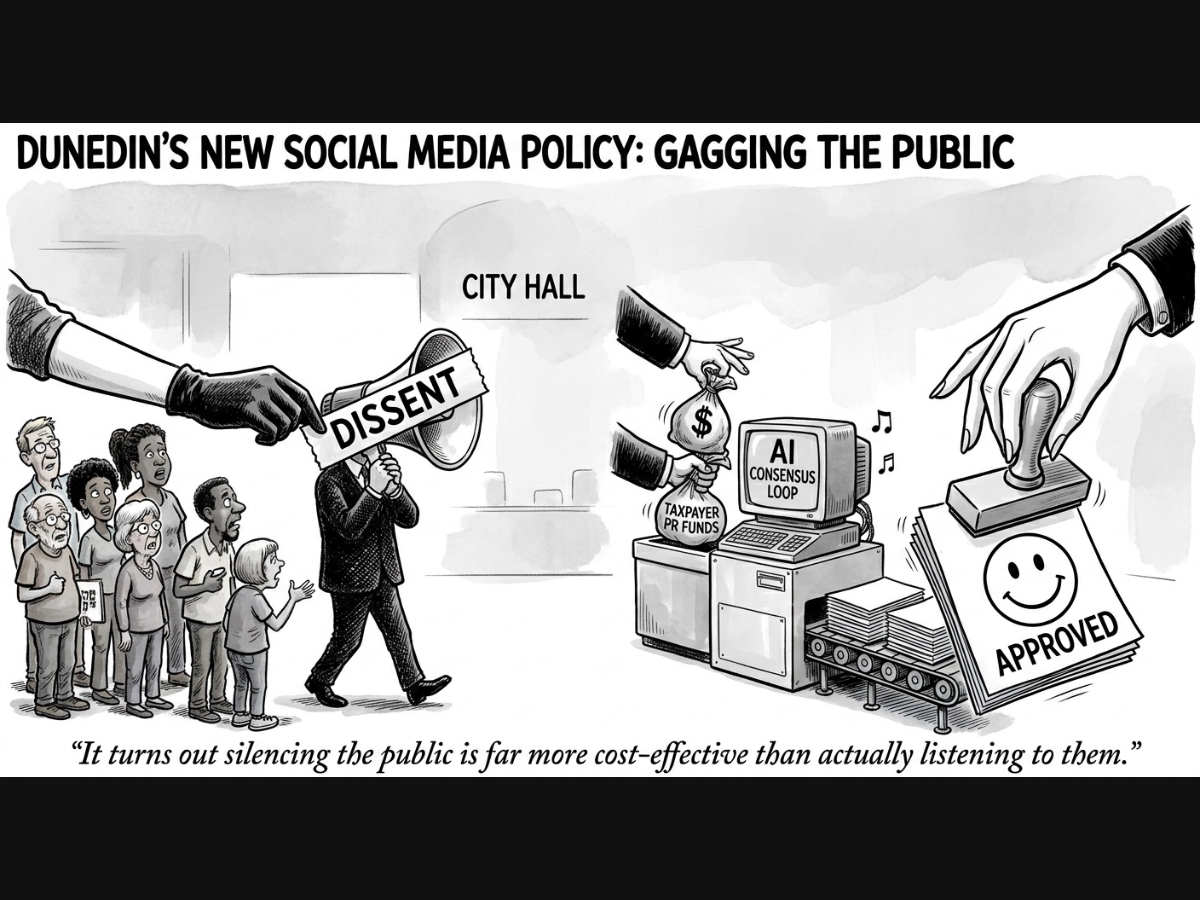
The fundamental contract between a local government and its citizens relies on open, accessible communication. A healthy municipality actually requires friction—the push and pull of taxpayers raising uncomfortable issues, debating policies, and holding elected officials accountable.
But what happens when a city decides it only wants to hear the good news?
Recently, the City of Dunedin executed a sweeping change to its public communications strategy that fundamentally alters how it interacts with the public. On May 5th, the city abruptly disabled comment functionality across all of its official social media platforms, citing that public comment sections had become a source of "misinformation."
Find out what's happening in Dunedinfor free with the latest updates from Patch.
While this maneuver may be legally sound, it is deeply unpopular, ethically questionable, and relies on a taxpayer-funded feedback loop that effectively manufactures a positive consensus.
From a strict legal perspective, closing a "limited public forum" like a Facebook comment section is permissible under First Amendment jurisprudence, provided the closure is absolute. If nobody can comment, nobody’s civil rights are specifically violated. Studying the intricacies of law and serving on the city's Code Enforcement Board provides a front-row seat to how these municipal mechanisms operate. You quickly learn that "legal" does not always mean "right."
Find out what's happening in Dunedinfor free with the latest updates from Patch.
By shutting down the easiest, most accessible avenue for public feedback, the city has transformed its social media presence from a modern town square into a taxpayer-funded billboard. Constituents are now expected to navigate eComment portals or attend City Commission meetings in person if they want to be heard. These avenues completely lack the immediate, public visibility of a social media thread where neighbors can actually witness and validate each other's concerns.
This gag order becomes significantly more complicated when you look at how the city is currently gathering public sentiment.
Dunedin spends taxpayer dollars on third-party software—specifically, the Zencity platform—to scrape, monitor, and summarize social media feedback. This data is then aggregated into monthly insight reports and presented to the City Commission to guide their decision-making.
The irony is staggering: The city shuts off comments on its own pages to avoid "misinformation," but uses public funds to pay a service to scrape unofficial platforms to figure out what residents are thinking. When you eliminate direct, centralized dialogue, you surrender your data pool to whichever third-party groups happen to be the loudest.
And right now, one group is overwhelmingly the loudest.
According to the city’s own internal reporting mechanisms, roughly 65% of all the feedback comprising these monthly social media sentiment reports originates from a single Facebook group: Dunedin is Awesome (DIA).
For those who have followed the history of the DIA page, this statistic should set off immediate red flags. Prior to the city's recent communications shift, the DIA page operated primarily as a commercial hub heavily populated by advertisements for local businesses. Recently, however, it has undergone a massive pivot, operating as a continuous feed of glowing, feel-good civic stories about Dunedin.
While it is highly unlikely that the city is directly paying DIA to write these stories, the result is exactly the same. Because the city has muted its own pages, dissent and debate have been fractured. Meanwhile, the algorithm scrapes the internet, ingests the aggressive positivity of the DIA page, and feeds it back to the City Commission.
If 65% of the Commission's "public sentiment" data is sourced from a localized hype-machine, the city is no longer reading the room. It is reading a curated echo chamber.
This dynamic raises a serious philosophical issue about the role of local government. When a municipality curates its own glowing narratives, relies on artificially skewed data to prove its citizens are happy, and shuts off the ability for residents to publicly object, it crosses a dangerous line. It ceases to be a governing body engaging in public relations and essentially enters the news business.
Local governments exist to manage infrastructure, enforce codes, balance budgets, and protect public safety. They should absolutely communicate their initiatives to their constituents. But directly competing with local journalism by acting as the sole, unfiltered broadcaster of its own success stories—while simultaneously silencing public critique—is a bridge too far.
Independent local journalism is designed to look at the cracks in the foundation. It asks why a project went over budget, or why a zoning law was changed. When the city controls both the microphone and the mute button, those stories disappear from the public consciousness.
Transparency in government is not just about publishing meeting minutes or keeping the sunshine laws intact. It is about facilitating an environment where citizens can speak truth to power. By disabling social media comments, the City of Dunedin has silenced the public square. By relying on a sentiment-scraping tool dominated by a single Facebook group, it has successfully bought its own PR.
It is a highly efficient system for ignoring the public—and as taxpayers, we are footing the bill for it. It is time for the city to turn the comments back on and face the music, friction and all.
About the Author: Jeremy Reynolds is a Dunedin resident and a student of paralegal studies. He currently serves as a public official on the City of Dunedin Code Enforcement Board. The views expressed in this piece are entirely his own and do not represent the Code Enforcement Board or the City of Dunedin.