Neighbor News
The New FWC Constituency: Why Wildlife Agencies Love the Hunter Who Never Hunts
State wildlife agencies are chasing "broader constituencies," but their ideal customer isn't a new conservationist—it's an absentee buyer.
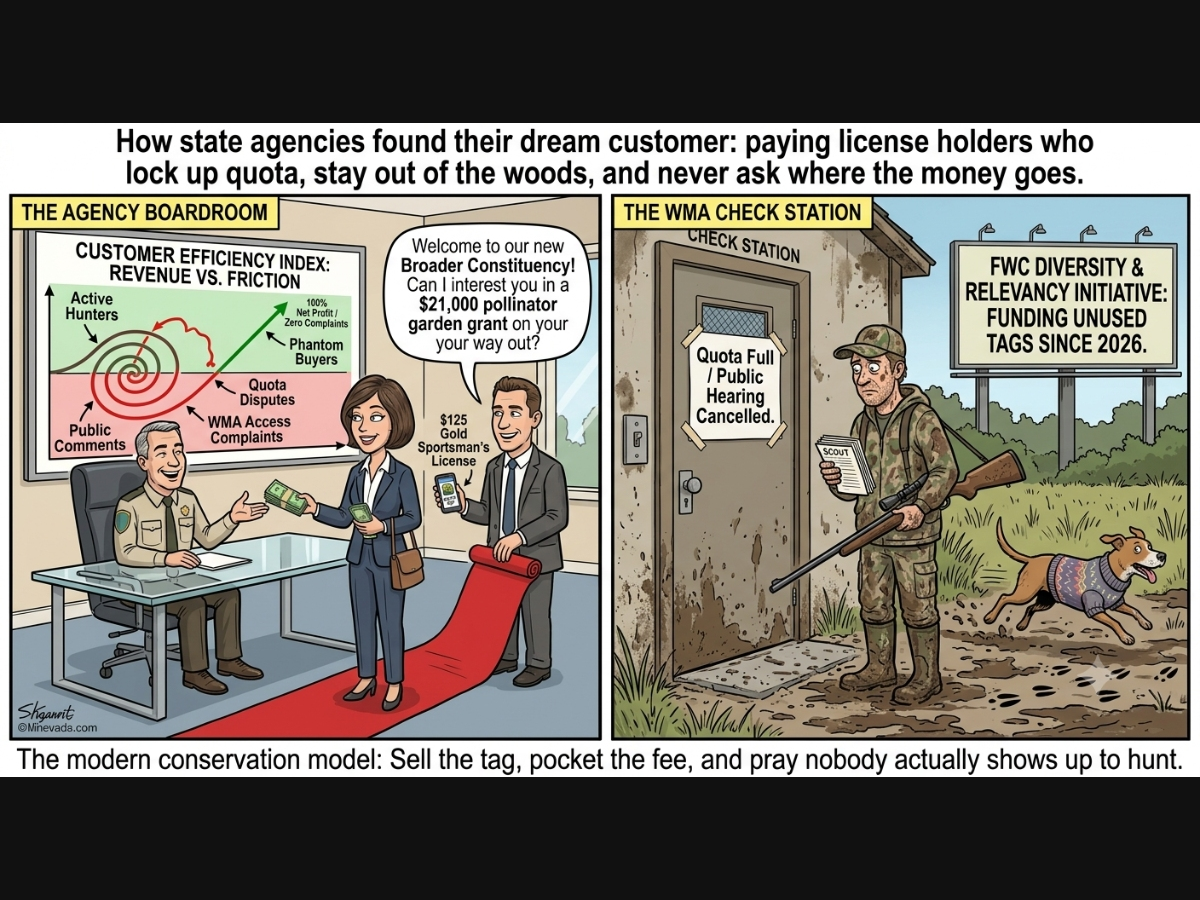
State wildlife agencies have a story they tell about the "relevancy road map." Hunting participation is declining, they say, so agencies must reach "broader constituencies" to replace lost revenue. Case in point: Ohio Division of Wildlife, under Chief Kendra Wecker, recently issued a $21,400 grant — part of a $34,400 project — called the Cleveland Pollinator Youth Corps. The plan was to turn a contaminated vacant lot into a pollinator garden and bee haven, complete with birdhouses and "pollinator homes." Reviewers noted the proposal had no real measures of success, no clear follow-up, and no plan for maintaining the garden after the program ended.
Outdoor writers have already pointed out the obvious hole in this logic: looking at butterflies doesn't sell a deer tag. Planting flowers doesn't sell a bow or a box of shells. If the goal is genuinely to replace lost hunting-license revenue, a pollinator garden in Cleveland isn't going to do it.
But I think that critique, while correct, stops one step short of the real problem. It assumes the agency actually needs converts — people who come to love hunting, buy gear, and become lifelong customers of the dedicated funding stream. It doesn't. It needs buyers. And there's a growing class of buyer who is, from a pure revenue standpoint, the best customer a wildlife agency has ever had: the person who pays the fee and never picks up a weapon.
Find out what's happening in Dunedinfor free with the latest updates from Patch.
The $125 Non-Hunter
Take Florida's Gold Sportsman's License. For $125 a year, it bundles hunting privileges for deer, turkey, and waterfowl with freshwater and saltwater fishing access in a single purchase. Anyone can buy it. Nothing requires the buyer to ever load a stand, glass a field, or fire a shot.
For an environmentally minded person who doesn't want to see hunting funded through conflict with wildlife agencies, $125 a year is a remarkably cheap way to feel like they've done something. It's certainly cheaper than the usual advocacy playbook — the ballot initiatives, the litigation, the PETA-style campaigns that cost real money and produce years of bitter fighting with uncertain outcomes. Buy the license, download the app, draw a tag through the quota system, and just... don't go. One less hunter in the woods, in their math, is one more animal walking around. Nobody gets hurt. The garden grows. And the agency still books its $125, no different than if the buyer had hunted every weekend of the season.
Find out what's happening in Dunedinfor free with the latest updates from Patch.
I don't think this is a hypothetical. I think it's already happening, and I think agencies have every reason to like it.
Why the Agency Doesn't Mind
Here's the part that doesn't get said out loud: this buyer is the agency's dream customer. Think about what an engaged, committed hunter actually costs an agency in friction. They show up to public meetings. They fight over small-game seasons during archery, over crossbow restrictions, over WMA access rules at places like Richloam. They file comments on rulemaking. They organize. They complain — loudly, and often for good reason — when regulations shift in ways that make the resource harder to access.
A quota holder who pays the fee, claims the tag, and stays home generates the exact same revenue with none of that friction. No public comment. No pushback at a commission meeting. No op-ed. Just a clean transaction and a compliant customer.
That is not a bug in the relevancy road map. I'd argue it might be the whole point. An agency chasing "broader constituencies" isn't necessarily chasing people who will show up to a WMA opening weekend — it's chasing people who will pay without asking anything of the agency in return. Diversifying revenue and diversifying complaint-free revenue are not the same goal, but they get marketed identically.
Meanwhile, the actual hunter — the one who uses the resource, absorbs the cost of dwindling quota, and deals with the on-the-ground consequences of these buyers — gets none of the benefit. If a non-hunting license holder's dog runs off-leash through ground you spent weeks scouting, that's not the agency's problem to manage. That's yours. The agency has already been paid.
The Wrong Fight
I want to be careful here, because I think a lot of hunters respond to this dynamic with the wrong instinct. The reflexive response to any "broader constituency" outreach effort is "they're coming to take your hunting away." I understand the impulse, but I think it's the wrong fight, for two reasons.
First, it's not accurate. Nobody is coming to legislate hunting out of existence through a pollinator garden grant. The threat isn't confiscation. It's dilution — a slow reallocation of quota, access, and agency attention toward a constituency that costs nothing and demands nothing, while the constituency that actually built and funds the system gets treated as a cost center to be managed rather than a partner to be served.
Second, and more importantly, the "they're coming for your hunting" framing asks hunters to circle the wagons around the very agency that's supposed to represent them — at a moment when that agency's own conduct deserves scrutiny, not blind defense. Asking hunters to rally behind an institution while that institution is dealing with its own credibility problems is not a winning message. It reads as tribalism for its own sake, and it hands ammunition to anyone who wants to paint hunters as reflexively defensive rather than substantively right. A polarized, us-versus-them posture doesn't protect access. It just makes the actual argument — that funding incentives are structurally misaligned — easier to dismiss as culture-war noise.
What the Real Argument Should Be
The real argument isn't "keep outsiders out." It's "follow the incentive." Every dollar in a state wildlife agency's dedicated hunting fund is supposed to exist because hunters created demand for wildlife management, habitat work, and enforcement. That fund was never supposed to be agnostic about whether the person paying into it actually uses the resource the way the fund was designed to support.
If an agency can hit its revenue targets by selling licenses to people who have no intention of hunting, and still call that success under a "broader constituencies" banner, it has quietly redefined what the license fee is for. It's no longer a proxy for hunting participation and habitat use. It's just a proxy for having $125 and an opinion about wildlife. That's a fundamentally different transaction, and treating it as interchangeable with a hunting license is either sloppy or deliberate — and given how consistently agencies lean on this framing to justify weak, poorly measured programs like the Cleveland grant, I lean toward deliberate.
Hunters should be asking for transparency, not sympathy. Show how quota is actually being used. Show what percentage of tag holders in a given unit report a harvest versus report nothing at all. Show whether "relevancy" grants produce any measurable increase in people who go outdoors and participate, versus people who write a check and never leave the driveway. If an agency can't or won't produce that data, that itself is the story — not because outreach to new constituencies is inherently bad, but because an agency that can't distinguish between a participant and a payment isn't managing wildlife. It's managing a revenue line, and calling it conservation.
That's the fight worth having. Not "keep them out." Follow the money, ask who benefits from the incentive as currently structured, and hold the agency accountable to the people who actually use the resource — not just the people who fund it and walk away.