Politics & Government
Washington Palms Along Edgewater Drive are Part of the Florida Lifestyle
With hurricane season starting today and these trees approaching the end of their natural life cycle they can be susceptible to damage from the strongest hurricane winds.
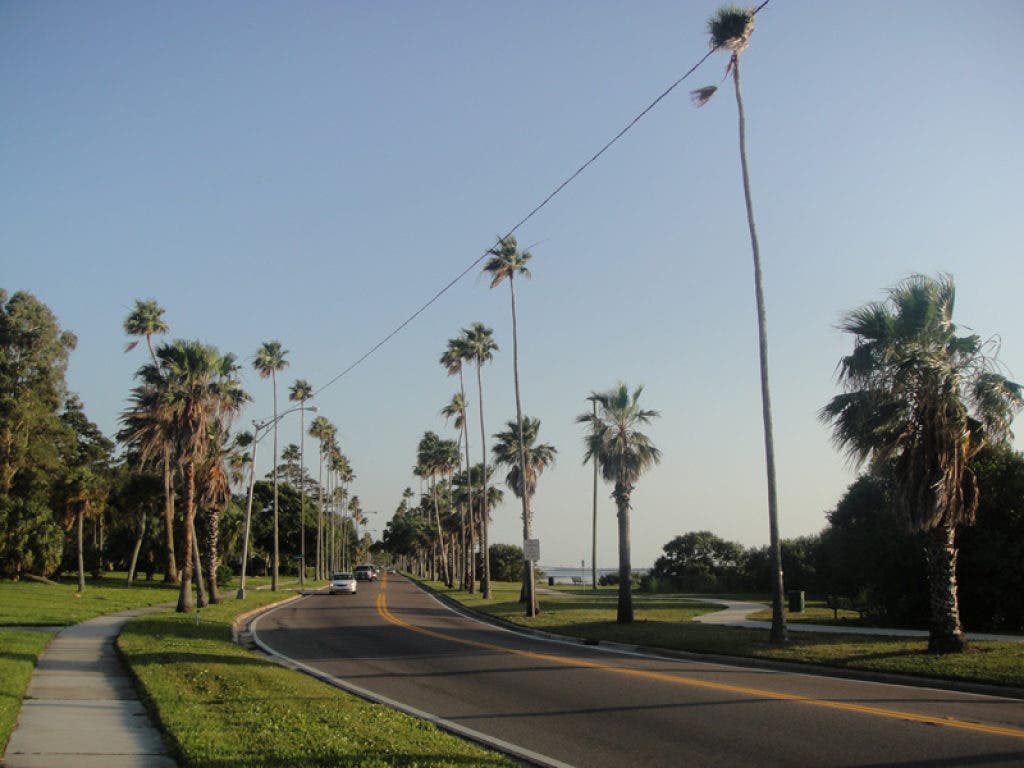


Families enjoyed the placid tranquility afforded by “The Florida Lifestyle" on a recent evening at Edgewater Park.
Children squealed in delight while traversing obstacle courses and soaring on swing sets. Their parents, for the most part, were not concerned about the aging palm trees that dot the landscape.
The general consensus is appreciation for the way the hundreds of Washington Palms add a Hollywood-esque aura to the area.
Find out what's happening in Dunedinfor free with the latest updates from Patch.
"I love Edgewater Drive, it reminds me of the drive along the Columbia River, coming up on Astoria (Washington)," said Elizabeth Piacquaddio, who lived in Dunedin four years. "The calm water, the open skies, yet dotted along the horizon here you see palm trees, a sure sign you have left the pacific northwest for humid weather, warm water and sunny days."
But with hurricane season starting today and these trees approaching the end of their natural life cycle they can be susceptible to damage from the strongest hurricane winds.
Find out what's happening in Dunedinfor free with the latest updates from Patch.
Proper pruning and fertilizing are the best way to care for them officials say.
Avoid falling into the trap of "hurricane cutting” or “pony-tailing" a palm said Andy Wilson, a senior specialist at the Pinellas County Extention office.
This causes trunk failure, as the palm absorbs its own trunk until enough green fronds develop to feed the plant properly. They can be fertilized with special fertilizer mixtures in February, May and November and with a another one in August.
An area of the trunk will consequently be disproportionately smaller, called pencil pointing, which becomes an area of weakness that can snap in high winds.
The Washingtonia Robusta commonly grow to heights of 40 to 90 feet Wilson said.
And studies conducted by the University of Florida indicate that the taller the tree the greater susceptibility to high winds. With wind resistance of trees 66 feet and taller plummeting.
However, trees shorter than 66 feet had a 92 percent survival rate during hurricane Charley’s 145 mph winds in 2004.
From Big Sur to the Sunshine State
In the 1920s, Florida experienced one of the greatest economic and social migrations ever. Real estate investments sky-rocketed and the materialism and prosperity of the times seemed to indicate that anyone could become rich by investing in Florida land.
Architects and engineers of the era did more than build houses. They created a way of life that became known throughout the world as "The Florida Lifestyle."
One very vivid visual element of this involved palm trees; lots of palm trees.
Throughout Clearwater, Largo and Dunedin neighborhoods streets underwent botanical makeovers. In Clearwater, along Sunset Point Road, Betty Lane and Edgewater Drive rows of the iconic palms native to California line the roads.
"One of my earliest childhood memories is the sight of the tall, graceful palms along Edgewater Drive," said Derri Davisson, of Clearwater, "Seeing them was a sign that we were nearing home from long days at the beach."
The Dunedin Garden Club organized March 29, 1929. They started planting flowers, shrubs and trees on public land including the north and south entrances to Dunedin on Alt 19.
The palms that dot Edgewater Drive and other Dunedin streets were the first street tree plantings undertaken by the city. Much of this took place in the 1930s while the country was in the throes of the Great Depression.
The trees are not considered a hurricane hazard to Art Finn, City of Dunedin parks superintendent.
Although two trees were removed from the waterfront area because their roots become uprooted and they began leaning due to washout caused by wave activity after the “No Name Storm” in 1993, Finn said.
Aside from washouts, lightning is their only other weather related nemesis. The trees are often struck because they tower over everything else. This led to some trees becoming partially destroyed naturally. Once the trunk is broken the tree will not recover.
Finn estimates the removal and disposal of each tree is about $100.
Finn also said that several years ago Dunedin received federal grant money to plant 50 Washington Palms. The city plans to replace the trees as they are destroyed or removed.
If the palm is uprooted, it should be put upright as soon as possible and replanted at the same depth and braced for six months.
And, if fronds are broken but still green, leave them attached so they can provide photosynthetic capability for the palm as it recovers.
When Ric Alonso studied abroad people would ask him what this area is like. There was always an image of palm trees and beaches.
Alonso can't imagine a drive along Edgewater without them.