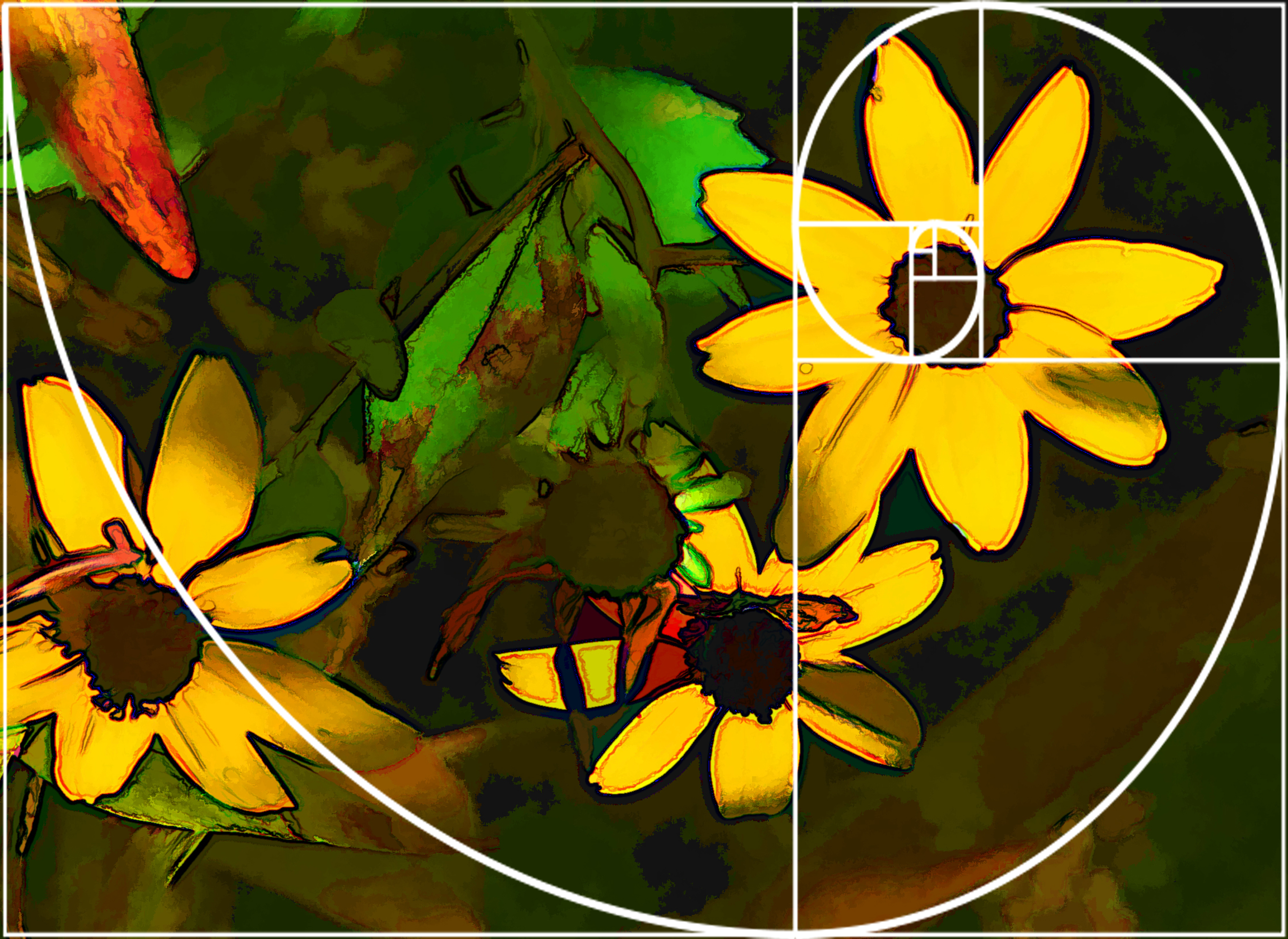

Oh, they may call it a “Point and Shoot” camera, but that’s not good advice for taking a picture. I have done it too often myself – I’ll aim my camera, centering my prey as though I’m aiming a gun, and pull the trigger (oops – I mean release the shutter). In my last blog I mentioned the “Rule of Thirds” that suggests that you place your subject one-third of the way into the frame. That is a useful and simple rule, but an approximate one that can immediately improve your photography, but there is more to it than that.
I recently read in a photo book that we should compose by using “strong design,” whatever that means. It does take more than rules to create a great image, but a few guidelines can help us think about the image that we see in the viewfinder.
Above is an example of a lesser known design guideline known as the Fibonacci spiral. This spiral occurs in nature and is most commonly seen in the chambered nautilus. The sizes of the chambers are reflected by the mathematical Fibonacci series: 1, 1, 2, 3, 5, 8, 13, 21, etc., where each successive number is the sum of the two preceding numbers. As the numbers get higher, the ratio of two adjacent numbers approximates 1.618, known as the “Golden Number” or Phi. This ratio is found in classic art and in Biblical proportions such as Noah’s ark and the Arc of the Covenant. It is also applied in photography and art with that ratio referred to as the “Golden Ratio.” The technical definition is: “The larger part divided by the smaller part is equal to the whole divided by the larger part.” But enough mind bending. The rule of thirds is a good starting point, but if you look at the numbers above, numbers you see adjacent include 5 and 8 (5/8) and 13 and 21 (13/21), with those ratios getting closer to 1.618 (or its inverse 0.618 – interesting?).
Find out what's happening in Land O' Lakesfor free with the latest updates from Patch.
So now we have the Fibonacci Spiral and the Rule of Thirds. If we refine the Rule of Thirds to use the Golden Ratio, we get a slightly different and more accurate representation of this magical ratio used in art and design. In the example, you see both principles applied.
Another interesting layout is shown by the Golden Triangles. This essentially divides a rectangular image along the diagonal, then draws a line from one of the other corners to hit the diagonal at a right angle. Picture this one mentally or draw it yourself.
Find out what's happening in Land O' Lakesfor free with the latest updates from Patch.
Remember that these are just some guidelines for you to think about and they should not be taken as unbreakable “rules.” Your own eye or sense of balance may lead you to a different design, but do think about design and layout the next time you “point and shoot” and you may find yourself creating some artful photography.