Politics & Government
Saint Leo University Students Forecast 2026 Midterms Before Election Day
POL 304 students predict outcomes in competitive Senate and gubernatorial races

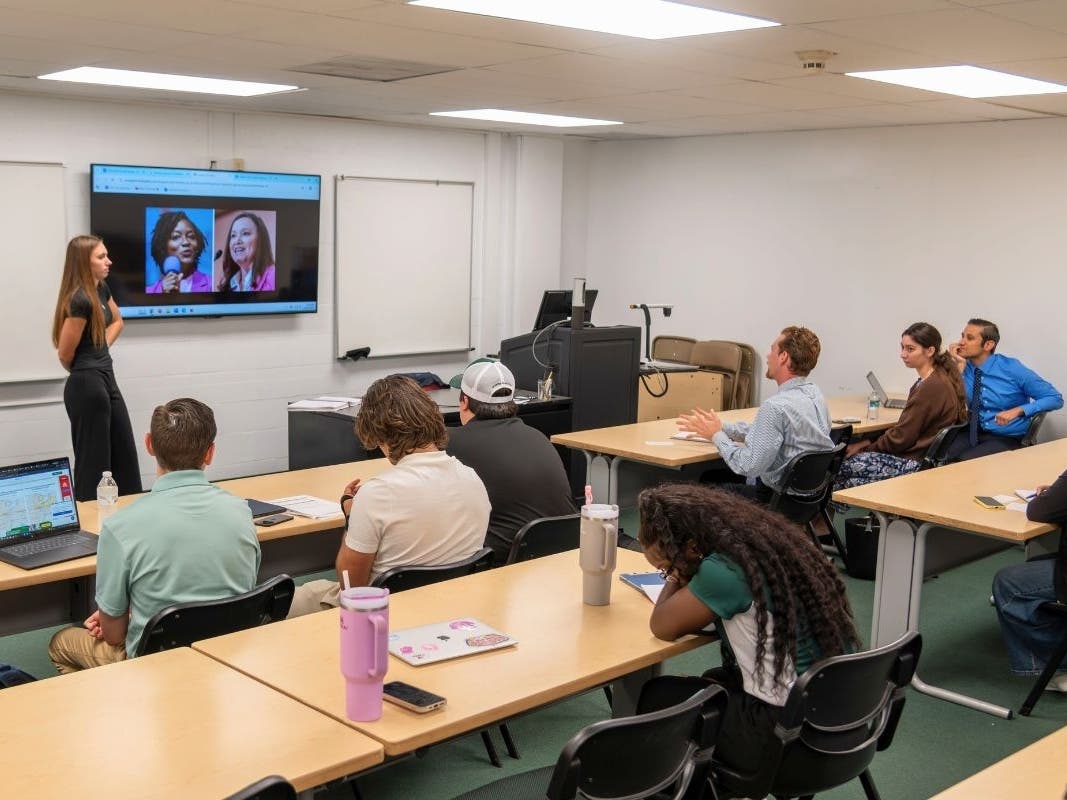
ST. LEO, Fla. – With the November 3 midterm elections days away, Saint Leo University students are forecasting the outcomes of competitive races for the U.S. Senate and state governorships. In the course POL 304: Campaigns and Elections, which is offered every two years to coincide with election cycles, students analyze candidates, electoral history, voter demographics, and emerging political trends to put their predictions to the test.
“I want students to move from being casual observers to trained analysts,” said Frank Orlando, an instructor of political science who teaches the course.
Generation Z could swing close races
Find out what's happening in Land O' Lakesfor free with the latest updates from Patch.
“Young voters always have the potential to be pivotal, but they don’t always realize that potential,” Orlando said. “It’s much harder to convert younger people from possible voters to actual voters, so campaigns usually focus on older voters. It’s both a skill and a will issue in getting young voters to the polls.”
The Saint Leo students tracking races in Florida, Texas, and Michigan are exploring how much that potential could shape the outcomes.
Find out what's happening in Land O' Lakesfor free with the latest updates from Patch.
Sophomore Evie Paget, a political science major who is analyzing Florida’s Senate and gubernatorial races, predicts Republicans will retain both offices, with Sen. Ashley Moody defeating Democratic state Rep. Angie Nixon and U.S. Rep. Byron Donalds beating former Rep. David Jolly. Paget was surprised that a candidate as progressive as Nixon won her party’s Senate nomination, a result she attributes to the mobilization of Generation Z voters.
“Nixon is a rebellious character and that gives her a voice for the youth,” Paget said. “She’s been effective in persuading people to vote for her, especially the youth, but I don’t think she will win.”
Elijah Penn, a junior with a dual major in English and political science, commented that Texas is a “younger state, but historically younger people don’t vote.” Instead, he expects suburban and border counties to play an important role in determining the outcome of the Senate race between Democratic state Rep. James Talarico and Republican Attorney General Ken Paxton. Recent polls have shown the race within a few points.
“I’m surprised how close the Senate race is for how extreme Talarico is and how conservative the state is,” Penn said. “I picked Texas because I wanted a close race to watch, but it’s a dead heat. I didn’t expect it to be this close.”
Junior Ethan Parks is following Michigan’s key races, including the Senate contest between Democrat Abdul El-Sayed and Republican former Rep. Mike Rogers, in which the conflict in the Middle East has become a significant concern for younger voters. “Younger voters are tired of forever wars,” Parks said.
The political science major added, “I thought at the beginning of my research that Rogers would win. My eyes have been opened more to the role that independents play in this process.” Polls of the race have varied, and Parks now predicts that El-Sayed will take the Senate seat.
Personalities and political drama test party loyalties
As Election Day nears, Saint Leo students also are seeing how local issues, candidates’ personalities, and campaign dynamics can affect voters’ decisions as much as party labels. “Before, I focused on the policies of the candidates. Now, I’m also looking at the personalities, and the scandals, around them,” Penn said.
Angeliki Thomas, a senior and English major, is studying Ohio’s Senate and gubernatorial races, where data centers have become a prominent campaign issue. She believes Democrats Sherrod Brown and Amy Acton are gaining ground against Republicans Sen. Jon Husted and Vivek Ramaswamy, with recent polls showing both Democrats ahead. She thinks Ramaswamy’s attack ad featuring Acton’s estranged mother, which drew bipartisan criticism, has backfired, and that the Democrats’ more localized campaigning could help them in both contests.
“I think the Democrats will take it in both races very narrowly,” Thomas said.
Alaska’s Senate race has been marked by political drama and has received national media coverage. Junior Amaria Solomon, a political science major who is researching the state, said she has been surprised by the twists in the contest between Republican Sen. Dan Sullivan and former Rep. Mary Peltola, a Democrat, including allegations that Peltola mistreated former staffers, which her campaign has disputed.
After watching the October Senate debate, Solomon believes the traditionally Republican state is still in play and that Peltola may have the edge. “Peltola is an Alaska Native and she’s focusing in on Alaska issues,” Solomon said. “Most registered voters in Alaska are independents, so that might make the difference.”
Iowa’s Senate race between Democratic state Rep. Josh Turek and Republican U.S. Rep. Ashley Hinson, by contrast, has received less national attention, and junior Vincent Farides believes that’s partly because it has been relatively free of the controversy surrounding other contests. Both candidates have focused largely on affordability, agriculture, and other policy questions, and recent polls show a very close race.
“In a national environment where there are so many toss-ups, a handful of votes in Iowa could decide who will control the Senate,” said Farides, a political science major. He expects independent voters to decide it.
What students are taking away
“Students care about the results of political action, even though it is sometimes hard to understand how the process works, which leads to exasperation and apathy and anger,” Orlando said. “Helping students to learn how the system plays out not only assists them in becoming informed, but also helps them in being able to change the system should they choose.”
“This class has opened my eyes,” said sophomore Giuliana Adonteng, another political science major taking the POL 304 course. “Prior to this class, I thought I knew about politics but didn’t. I only knew what my peers and parents knew about, and now I see the true ins and outs in politics and the process. Now I am educating my friends about voting and using their voices.”
The November 3 elections will give students a real-world benchmark for their forecasts. Beginning at 7 p.m., the campus-only Election Night Watch Party will give students an opportunity to watch election returns live and see how their predictions compare with the results.
For more information about Saint Leo University’s political science program in the College of Arts, Sciences, and Allied Services, visit saintleo.edu/programs/arts-sciences-degrees/bachelors-degree-political-science.