Community Corner
The Story of the Bradley Massacre
Reminiscent of a scene right out of the TV series "Daniel Boone," on May 14, 1856, the still evening erupted with gunfire as Indians attacked the home of Pasco pioneer and Seminole War veteran Capt. Robert Duke Bradley.
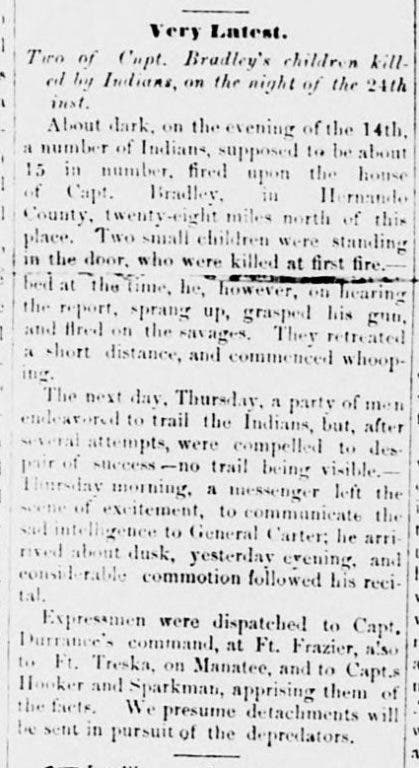

There are many different versions of the horrific day in Pasco County history when Indians besieged the isolated cabin of Capt. Robert Duke Bradley in Darby, killing two children.
For more than a century, the story of the Bradley Massacre has been passed from generation to generation. And now, after scouring newspapers and military accounts for reports of this tragic event, we pass that history forward.
Arriving to the Florida frontier in December 1827, Bradley became an aged veteran of the 2nd Seminole Indian War, having served from 1835-41.
Find out what's happening in Land O' Lakesfor free with the latest updates from Patch.
During his service, he was quickly promoted to captain after organizing his first company of armed men from the Madison County neighborhood where he lived.
Throughout his military career, Bradley and his men skirmished with several bands of indians along the Suwannee River, in some instances with the loss of life on both sides.
Find out what's happening in Land O' Lakesfor free with the latest updates from Patch.
In February 1842, as part of military backed resettlement efforts, the Bradley family left its Madison County home and set out for a new frontier — recorded among the first group of settlers to arrive south of the Withlacoochee River in Hernando County.
After 11 long years in the Brooksville area, enduring frequent indian raids and at times near starvation, by 1853, like true pioneers, the Bradleys ventured further south into the unsettled lands.
Following the south, they settled in the Land O’ Lakes area for a few years before making their final homestead in the isolated area of Pasco County now known as Darby — then apart of Hernando County.
While the area was still frequented by indians, evident only by moccasin tracks through the swamps and hammocks, it had been several years since an outright attack on settlers.
But that was all about to change.
On May 14, 1856, life around the new home and neighborhood seemed to have some normalcy as the settlers were busy tending to their crops and livestock with the hopes of having a good harvest before the humid, hot summer days crept in.
As the sun began to set on another long day, not feeling well, Capt. Bradley was confined to his bed while his wife, Nancy, and the children attended supper.
Returning from their supper, the children were standing, perhaps playing, in the open passage of the family’s double-pin cabin. As the crickets chirped and cicadas buzzed from the trees above, in an instant the quiet spring evening erupted with gunfire.
A group of skulking Indians opened fire on the cabin, instantly killing 11-year-old Mary Jane Bradley and mortally wounding 15-year-old William Brown Bradley.
Courageous in his attempts and with his mortal wounds, young William ran into the cabin, grabbed a gun, and was able to fire off a shot toward the Indians before falling dead.
During the chaos, Nancy Bradley reportedly ran out amidst the hail of bullets and gathered the other children into the cabin — miraculously unharmed.
By this time Capt. Bradley had risen from his bed, and, with two or three guns, returned fire toward the indians, causing them to finally retreat into the woods.
Just south of the Bradley home was the farmstead of daughter and son-in-law Samuel and Julia Ann Bradley Colding. Upon hearing the gun shots, Julia sent a family slave to ascertain the cause, but he soon returned unharmed after not seeing the indians.
Capt. Bradley immediately prepared a statement of the facts, which he sent to Brig. Gen. Churchill, who was lodging for the night at Mr. Whitfield's near Brooksville. Bradley reported at least 15 indians in the band.
The following morning, May 15, 1856, a party of men endeavored to trail the indians, but after several attempts was compelled to call off the search with no trail being visible. Capt. Thomas C. Ellis left the scene of excitement to communicate the sad intelligence to Gen. Carter at Fort Brooks in Tampa.
Capt. Ellis arrived at Fort Brooks at about 8 p.m. on the evening of May 16, 1856, and considerable commotion followed the recital of the message he carried.
The morning of May 17, 1856, three days after the attack, Gen. Carter prepared communication and dispatched express men to Capt. Hooker; Capt. Sparkmen; Capt. Durrance's, command at Fort Frazier; and also to Fort Treska on the Manatee River apprising them of the facts in the massacre.
But no troops were dispatched to the scene; instead, they gathered at points south hoping to intercept the band of indians.
Mail and stagecoach service between Tampa and Pilatka was halted as roving indians once again made life difficult for the settlers, who left their homes to seek refuge in the nearby forts and block houses built for their protection.
Without the aid of troops, the able men of the community began routine, daily patrols of the hammocks, swamps and abandoned plantations, scouting for any sign of the indians.
But, with the frontier on alert, Bradley and his wife were preparing the graves of their two children — the only casualties reported in contemporary accounts of the massacre.
In an attempt to prevent the indians' returning to disgrace the burials, the two young children were reportedly buried in unmarked graves on the Bradleys' farm in Darby.
For weeks after the massacre, from as far north as Brooksville, area slaves working in the fields reported sightings of the indians. But they always remained at a distance, knowing they were being trailed by the settlers.
The Bradley Massacre was one of several events that lead to the beginning of the 3rd Seminole Indian War and one of the last battles Capt. Bradley would engage in.
On Dec. 14, 1857, at age 54, Capt. Robert Duke Bradley died at his Darby home surrounded by his family and likely attended by a former company doctor. The cause of his death was reported as "hemorrhage of the bowels and lungs or blood from the lungs."
Following his death, the entire community mourned the loss and on Dec. 16, 1857, two days later, Capt. Bradley was laid to rest. Some accounts report his burial in the Brooksville Cemetery, while others say he was buried in the Townsend House Cemetery.
For more information about the life and career of Capt. Robert Duke Bradley, visit pascocemeteries.org/bradley-massacre.html.