Community Corner
Tracing the History of Bailey’s Bluff
Most know Bailey's Bluff for its upscale, high-end, subdivision. But for more than 50 years, the bluff played a significant role in the local sponging industry.
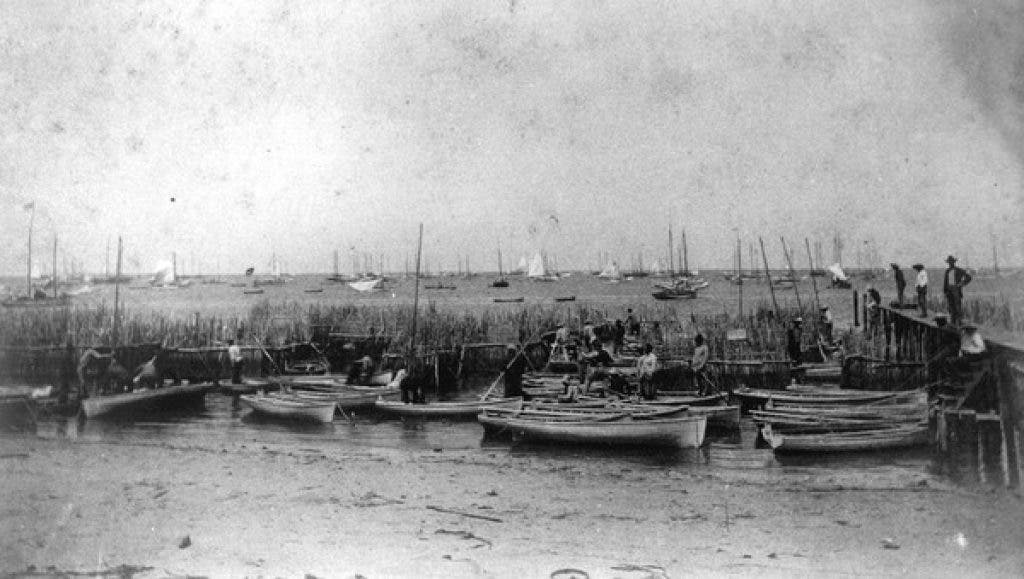


Today, driving along the nicely paved streets of the Bailey’s Bluff subdivision, it’s hard to believe for nearly half a century this small section of coastal land was the scene of considerable activities, which played a significant role in the beginnings of the Tarpon Springs sponging industry.
Traces of this grand operation are scant, but its mark on our local history is great.
According to one account, the birth of sponging along Pasco’s west coast can be traced to the year 1852, when one Walter Lowe went in the schooner Chestnut to Anclote Keys, and, in several days, secured a cargo of sponges.
Find out what's happening in Land O' Lakesfor free with the latest updates from Patch.
This catch brought such large profits that other men soon embarked in the new venture.
However, the Civil War brought many new challenges for these Gulf Coast spongers, and growth of their new industry was significantly inhibited and eventually ceased until the war ended.
Find out what's happening in Land O' Lakesfor free with the latest updates from Patch.
On November 20, 1867, the bluff’s namesake, Peter Karr Baillie, received title to the 22 acres of high prime coastal land now known as Bailey’s Bluff — purchased from the state of Florida.
Upon this land, Baillie built a small home and established one of the first known businesses in west Pasco, a mercantile business trading with local fishermen, who visited the excellent Anclote fishery.
Research reveals by 1869 the taxable value of the Bailey’s Bluff property was $300, or $13.64 per acre, most of this value likely in improvements. Baillie also owned one horse and carriage, $50 in household furniture, including dishware, and was in debt for $25.
For reasons unknown, between 1870 and 1871, P.K. Baillie sold his bluff enterprise to Eugenie I. Stephens, of Cedar Keys. It’s not known what improvements, if any, existed when the bluff property sold, with a reported taxable value of only $30.
But, for the next 14 years, Stephens retained ownership of the land.
By the mid-1870s, the waters off Bailey’s Bluff and Anclote became a well known fishery to harvest the abundant sponges. A correspondence from June 1877, by a Mrs. R.H., provides descriptive insight into these early coastal activities. She wrote:
North and south of Anclote Keys are land locked harbors which vessels … can find anchorage in any kind of weather. In summer we have the Key West schooners, some thirty or forty in number, sponging in these waters.
On Saturday morning they may be seen skimming away like white winged birds to their different crawls* and on Saturday afternoon and Sunday lying anchored close in shore. On Monday morning they weigh anchor, hoist sails, and are off to the [sponge] beds again, giving a lifelike appearance to our otherwise lonely waters.
These trim but jaunty craft were well rigged schooners, varying in size from 5 to 20 tons. Some were painted black, some green, but the prevailing color was white with a narrow red stripe.
During this period, nearly all of Florida’s sponging vessels belonged to Key West.
In 1879, the Nebraska Advertiser reported the safe harbors around Anclote were widely known as only one of two locations along the entire Florida west coast where the sponge schooners stored and cleaned their catches.
For this purpose, the bay spongers kept a concentration of crawls on the north end of Anclote Key, but, with time, the Bailey’s Bluff mainland would become the more significant site for their operations.
These fishermen soon realized their north Anclote Key crawls were exposed to the full force of the wind when blowing from certain directions.
On several occasions, considerable loss was sustained by storms washing the sponges from the crawls and out to sea — a hard lesson learned, perhaps, during the 1888-89 hurricane season when two storms made landfall near Crystal River.
Following the death of bluff owner Eugenie Stephens (then known as Eugenie Nason) in Jacksonville on February 16, 1886, ownership of the land transferred to her legal heirs.
In 1890, under ownership of Captain Charles Floyd, of Jacksonville, Nason's son-in-law, the crawls were moved from the more venerable Anclote Keys to the Bailey’s Bluff mainland, and for the next seven years, Floyd retained ownership of this successful enterprise.
In 1891, our coastal sponging industry was met with entrepreneur John King Cheyney’s newly established Anclote and Rock Island Sponge Company.
Cheyney’s company was determined and vowed to “create a reform in the Florida sponge business,” stating there had always been deception in the industry.
South of Anclote River, on what is now Point Alexis, the A & R.I. Sponge Company operation became widely known as the little town of Sponge Harbor, consisting of comfortable houses for the fishermen, a church, school and packing house.
Cheney’s company created significant competition for the Bailey’s Bluff crawls, and on May 31, 1897, with $300 down and a bond for title for an outstanding $300, Captain Charles Floyd sold the bluff enterprise to local resident Samuel Baker.
Within a few months, the entire scene would change.
On account of the waters around the bluff being too rapidly used by the large number of fishermen and for other unknown reasons, in July 1897, the Home Furnishing Review reported the black crews of the sponging vessels were removing their crawls from Bailey’s Point, back to Anclote Key.
Some might speculate the 1897 move was a result of change in ownership, or perhaps was due to the start of the Anclote channel dredging project.
But, by 1899 there were approximately 125 crawls located at Bailey’s Bluff, all kept under the keen eyes of watchmen Samuel B. Baker and Benjamin Baker.
However, in 1900 certain spongers became dissatisfied with Bailey’s Bluff and established about 40 new crawls half a mile closer to the Anclote River at John Sawyer’s place, commonly called the Cabbage Kraals.
This seemed to only encourage the Bakers to make their Bailey’s Bluff operation more alluring to the coastal workers.
To entice the fishermen, in March 1900 the Bakers were instrumental in the establishments of the Pavillion Church and Reading Room on the bluff. In 1902 an 80-by-105-foot lot was deeded to the church, contingent that the property be used for religious purposes.
On July 16, 1900, Samuel B. Baker also received approval to establish a post office on the bluff. He called the new office Security, a name truly understood by the fishermen who found safety from storms along the Anclote Anchorage and security for their catches at the Baker crawls.
For the fishermen, the Bakers also operated a small mercantile store in conjunction with their various other ventures.
But, by 1905, some 500 Greek divers had arrived to Tarpon Springs following A. & R.I. Sponge Company advertisements of guaranteed work in the ever developing sponge industry.
This influx significantly changed the local scene and created a vicious rivalry between the decades-old Key West Conchs and the newly arriving Greek Divers.
In November 1912, for $900, the Baker family sold its Bailey’s Bluff property to young sponge house worker Joseph M. Blackburn, the result of a court order to render care for two minor children.
As Tarpon Springs became the preferred headquarters for the west coast sponging industry, Bailey’s Bluff eventually ceased as a central location for the numerous sponging crawls.
The exact date the bluff activities halted is unknown.
In January 1956, the first unit of six in the upscale Bailey’s Bluff subdivision was surveyed and platted into home lots. The natural harbor of the bluff, now called Sleepy Lagoon, was dredged to create a deep boating channel for easy access from these homes to the Gulf waters.
Today, the waters off Bailey’s Bluff are filled with boats of a different kind — those that utilize the Gulf waters for pleasure instead of the livelihood of harvesting sponges like our pioneers of the bluff in days past.
*Crawl, kraal, craal, or kraul is an Afrikaans and Dutch word for an enclosure for cattle or other livestock, located within an African homestead or village surrounded by a palisade, mud wall, or other fencing, roughly circular in form.
The sponge crawls as described in 1885 consisted of a palisade of 10 or 12 yards in diameter, made in the shoal waters. After the sponges had laid in the crawls for some five days, the men would get in with their bare feet and tread and squeeze the sponges until it was comparatively clean, after which it was taken to the schooners and stowed below deck. Other methods involved beating the sponges with a wooden club.