Politics & Government
St. Petersburg College Hosts Attorney Ben Crump In Webinar On Criminal Justice Reform
Crump represents the families of Ahmaud Arbery, Breonna Taylor and George Floyd.
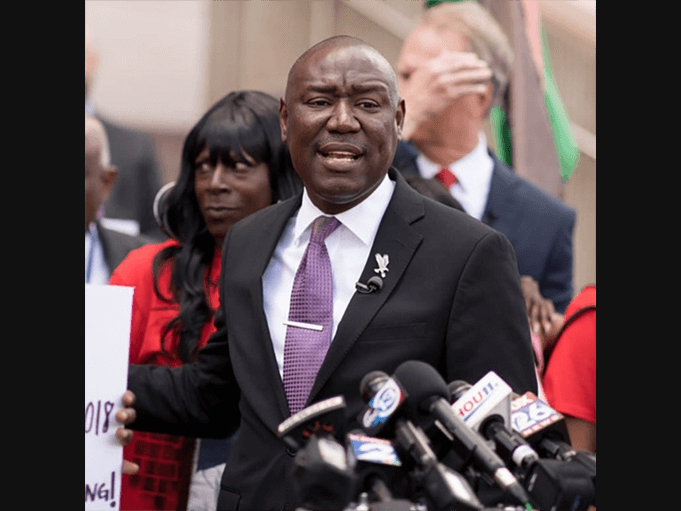
ST. PETERSBURG, FL — St. Petersburg College’s Institute for Strategic Policy Solutions hosted a webinar on June 23, 2020, titled Criminal Justice Reform: Progress and Challenges.
The event brought noted Criminal Justice Attorney Ben Crump, who is representing the families of Ahmaud Arbery, Breonna Taylor and George Floyd, whose deaths have raised concerns over racial injustice.
More than 250 participants, many of whom were local attorneys, joined in to hear Crump, who joined the call while en route to Milwaukee to meet with the family of another client. Crump said he hadn’t planned to join the meeting from his car, but duty called.
Find out what's happening in Largofor free with the latest updates from Patch.
“Because Black lives matter, when we get the call we have to answer the bell,” Crump said. “If we don’t fight for marginalized, disenfranchised members of society, who will?”
Crump, a Jacksonville attorney who has taken the nation’s helm in civil rights law, discussed the details of the Breonna Taylor case, offering a chilling account of a couple who thought they were experiencing a home invasion when, actually, the police were executing a “no-knock” warrant in search of drugs.
Find out what's happening in Largofor free with the latest updates from Patch.
“The officers were in plain clothes, and didn’t identify themselves as police,” Crump said. “Kenny Walker tried to protect his castle – he was a registered gun owner – by shooting a warning shot, police unloaded 25-30 rounds blindly into the apartment. Tragically, Breonna was mutilated with eight bullets.”
Crump then explained how Walker was arrested for attempted murder, and pointed out the juxtaposition of Walker’s treatment versus the men accused of the murder of Ahmaud Arbery, who was out jogging when he was confronted by Gregory and Travis McMichael, a video shows.
“Never have I seen self-defense so vividly distinguished (by race),” Crump said. “When the police came, the McMichaels said it was self-defense. Police accepted their word, and they slept at home in their beds at night for 10 weeks before they were arrested. The police arrested Kenny Walker that night and charged him with attempted murder, and he faced life in prison if convicted. The charges have been temporarily dropped, but they could still be re-introduced. We see two justice systems in America. That’s why we need reform.”
On the subject of George Floyd, who was killed after being detained on suspicion of passing a counterfeit $20 bill, Crump said the video is the crux of change.
“I believe George Floyd’s tragic killing was so riveting,” Crump said. “That video has been viewed over 175 million times in America alone. Because we cannot unsee that video, it represents the best opportunity for systematic police reform in America.”
Crump also discussed the problems within the U.S. prison system.
“When you’re in prison, you are literally a slave of the state,” Crump said. “What we have in America today is the intellectual justification of discrimination. They come up with technical reasons that allow poor people to get the most injustice.”
ISPS Executive Director Kimberly Jackson said the organization has a commitment to remaining a community convener on political, social and economic issues.
“We wanted to have a solution-oriented conversation, primarily with attorneys in our area, to discuss what Pinellas County is doing right and what we need to work on,” Jackson said.
Sixth Judicial Circuit Public Defender-Elect Sara Mollo discussed the goals of the Public Defender’s office, which include juveniles, mental health and abolishing the death penalty. On the subject of the latter, Mollo spoke about how labeling mentally ill people is an issue in the justice system.
“Vernacular is important,” Mollo said. “When you start to think about how you talk about things, it changes the narrative. Why would I say my client is schizophrenic, when they are actually a person who suffers from schizophrenia? Calling someone a behavior makes it sound like a choice.”
Mollo also encouraged attendees to get to know their legislators.
“There are good people in the legislature,” she said. “You just have to ask for specific things to make legislation.”
Before signing off, Crump thanked the ISPS for having the event, and stressed how important their work is.
“ISPS is so vital because we need a think tank to tell people what we’re fighting for,” he said.
This press release was produced by the St Petersburg College News. The views expressed are the author's own.