Politics & Government
Business Vs. The Environment, In Miami-Dade
It's a long-awaited hearing to determine whether Dade's Urban Development Boundary (UDB) would expand to welcome the 800-acre district.
May 24, 2022
A long-awaited hearing to determine whether Miami-Dade County’s Urban Development Boundary (UDB) would expand to welcome the 800-acre South Dade Logistics and Technology District went on for hours last week without a resolution, and the battle isn’t over yet.
Find out what's happening in Miamifor free with the latest updates from Patch.
County commissioners voted to defer the item to June 1 after Jeffrey Bercow, attorney and lobbyist for Aligned Real Estate Holdings, requested more time to address expressed concerns about the company’s development project, which faces stiff opposition from environmental groups, government agencies and the mayor, notwithstanding promises of jobs, jobs, jobs.
After a motion to deny the application presented by District 8 Commissioner Danielle Cohen Higgins fell flat in a 5-7 vote, the commission voted 8-4 to discuss the item again next month without public comment.
Find out what's happening in Miamifor free with the latest updates from Patch.
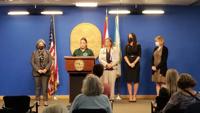
At a press conference last Thursday, Claudia Sebastiani, a climate and environment consultant, joined Miami-Dade County Mayor Daniella Levine Cava and Commissioners Eileen Higgins and Danielle Cohen Higgins in opposing a decision to move the Urban Development Boundary.
(Courtesy of Hold the Line Coalition)
“I can’t imagine what will change between [now] and June first,” said an unwavering Cohen Higgins. “But we will see. It’s entirely up to the board to make those decisions.”
Supporting Cohen Higgins, whose district would be directly impacted by the proposal, were Commissioners Eileen Higgins, Raquel Regalado, Jean Monestime and René García. Both García and Monestime were once in favor of the project. Commissioner Sally Heyman, who voted against it last fall, was absent.
“I was a little disappointed. We can just hope and pray that commissioners see that we need [this],” Rev. Tim Forbes told The Miami Times about the deferment. “We’re tired of feeling like we’re not being paid attention to or remembered. Every time we see an opportunity like this for economic impact to take place, we run into crazy opposition.”
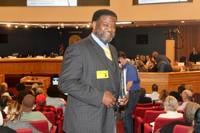
Rev. Tim Forbes attended a Miami-Dade County Commission public hearing last Thursday in support of moving the Urban Development Boundary.
(Johania Charles for The Miami Times)
The Brickell-based development company told commissioners that it would commit 25% of an estimated 30,000 jobs to residents in Districts 8 and 9, in addition to a $250 million community benefits agreement. Approximately 17,000 permanent jobs and 13,000 construction-related jobs would be produced by the three-phase project, according to Bercow.
Developers are still working to flesh out additional project details, including identifying tenants, specifying job opportunities, and determining the height of a buffer between the development and surrounding homes.
Nine of the 13 commissioners must vote in favor of approving the application for it to pass. Mayor Daniella Levine Cava, a strong opponent of the project, said she is prepared to veto it should that happen.
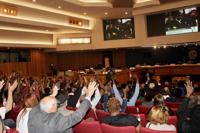
As Rev. Tim Forbes spoke at the podium during a public hearing last week, dozens of people waved their hands to show support for bringing more jobs to South Dade by moving the Urban Development Boundary.
(Johania Charles for The Miami Times)
“Although my motion failed,” said Cohen Higgins shortly after the vote, “there were sufficient enough votes for the applicant to know that they’re going to have a very challenging time, at least at this juncture, to get to nine votes.”
“All [the developers] intend to do is go to each of these ‘no’ votes and say ‘What do you want,’” said Laura Reynolds, president of the Hold the Line Coalition (HTLC). “It’s clear that they are willing to offer anything even if it’s fictitious. They’re willing to pay whatever to get this done … Dade County is going to be left holding the bag for any of those responsibilities. This is just a bad decision.”
Residents and commissioners alike are debating whether the economic impact of the project should supersede multiagency opposition to the project because of its perceived environmental impacts.
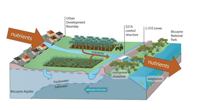
An illustration depicting the flow of nutrients and water if commissioners vote to maintain the existing Urban Development Boundary.
(Courtesy of Hold the Line Coalition)
More than 250 people signed up for a minute at the podium, with dozens left waiting downstairs after the commission chambers reached full capacity.
“Altering the UDB is unnecessary in order to build this facility and would adversely impact the agricultural integrity of the surrounding land and further destabilize water management in the area,” said Nikki Fried, Florida Commissioner of Agriculture and gubernatorial candidate. “[Accepting] this plan would be a big mistake [with] massive consequences.”
“I’ve been here since the onset of this item and I support [it] fully,” said South Dade resident Daryl Young at the hearing, noting that the development was one of few opportunities to improve quality of life. “Approval of this item would definitely be an asset to the community as a whole … I speak for the generation of today and tomorrow.”
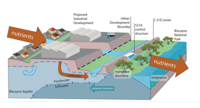
The proposed South Dade Logistics and Technology District, elevated at 4 feet, is depicted in a drawing that maps the flow of nutrients and water.
(Courtesy of Hold the Line Coalition)
Young, who commutes two hours each way to work in North Dade, said he didn’t want the same fate for his combined 30 adult children and grandchildren.
“Our first priority should always be to help people; we need opportunities to feed our families,” said Elsie Heimler, also a resident of South Dade. “Our residents need jobs, not only construction jobs but long term jobs … While I too am concerned about the environment, I also am concerned about people in the community.”
Dozens of other residents, some sporting shirts asking commissioners to “Bring the Jobs,” shared similar testimonies about traffic, commuting and economic access concerns.
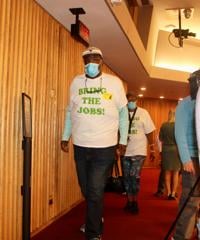
South Dade residents wearing shirts in support of moving the county’s boundary line to bring more jobs to the area.
(Johania Charles for The Miami Times)
On the other hand, those opposing the proposal say the development presents flood and saltwater intrusion risks and interferes with a project to restore the Everglades.
Environmental advocates worry that any negative impacts on Biscayne Bay could directly affect tourism and agriculture, the county’s main economic drivers.
“I understand the need for jobs but this is the wrong location for this proposal,” said Claudia Sebastiani, a climate and environment consultant, told commissioners.
In a more than 40-minute presentation, engineer Ed Swaykon explained how the development site could potentially improve aquifer recharge.
“This isn’t an application where you have to choose between jobs and the environment,” said Bercow.
HTLC members said the presentation only presented a narrow aspect of its impact.
District 9 Commissioner Kionne McGhee was one of the leading commission voices in favor of bringing more jobs to the area, followed by Vice Chairman Oliver Gilbert III, Rebeca Sosa, Keon Hardemon, Jose “Pepe” Diaz and Joe Martinez.
According to a county report McGhee referenced during the hearing, 72% of the South Dade population work outside of the area.
“I’m very sensitive to the arguments of both sides,” he said, recalling times he stood alongside environmental advocates during his tenure as a state representative. “The only problem is that we have held the line for 40 years and every time we hold the line, the great folk of South Dade are pushed further away from crossing [the] line – and the line I’m speaking about is a line of prosperity.”
Showing full support for the project, McGhee said its approval would mean ensuring that South Dade had a fair shot at building generational wealth.
“It is a false narrative to say denial of this application means that the hardworking people of South Dade are not going to get what they deserve,” said Cohen Higgins, disclosing concern for the acreage size of the project. “Where is the interest in developing the land that we have available right now to bring hundreds and thousands of jobs?”
Developers are asking to move the UDB because the project requires 800 contiguous acres that do not currently exist inside the line.
Leonard Abess Jr., a retired banker who owns 160 acres of the farmland in question, called the project a fraud and a con game.
“There is no profit if you lose your soul,” he said, discouraging approval despite standing to gain millions of dollars from developers.
Bercow told commissioners that Abess had previously agreed to allow the development to take place on his property. Without that crucial piece of land to complete phase three of the project, some commissioners worried that developers could not deliver the remainder of the jobs promised.
“If the premise of the project is to move the line because there’s not 800 acres of contiguous land, why are we still talking about this now that they don’t have it?” asked Josh Sproat, policy director for Conservation Concepts and HTLC affiliate.
The county’s planning staff reported that the anticipated number of jobs had been inflated and would actually result in significantly fewer jobs than expected.
“The bottom line is this: iI’s going to provide jobs and opportunities to get jobs, whether that number is 1% or 100% of jobs [reserved for residents],” said Forbes. “There’s no way we’re going to develop without endangering the land around us, but when you minimize that and make it safe to do, you should move forward with it.”
If approved, advocates worry that this application may set precedent for other developers seeking to have the line moved for their respective projects.
“How could we as a board, 13 people, say we know better than 1,300 pages from our administration,” asked Cohen Higgins. “We know better than the federal Department of the Interior, the Department of Environmental Protection, the Department of Agriculture, our mayor … and the 800 emails in my inbox saying we do not want this to move forward?”
“We all can be pro-business and pro-environment at the same time,” said Monestime, before choosing to side with HTLC. “I think the coalition against this, whatever that coalition may be, has presented their facts in a better fashion than this applicant has.”
The Miami Times is the largest Black-owned newspaper in the south serving Miami's Black community since 1923. The award-winning weekly is frequently recognized as the best Black newspaper in the country by the National Newspaper Publishers Association.